
MENU
1. General description
An intermediate wheel is a simple gear whose purpose is to transmit the energy from the crown (and thus from the winding stem) to the motion work when the crown is pulled out and rotated (hand-setting). The hand-setting mechanism may include one or more intermediate wheels. The intermediate wheel is generally made of steel and its toothing occupies its entire height. The intermediate wheel is pierced at the center of its axis and pivots on a tenon driven into the main plate. When the winding stem is pulled out, the sliding pinion slides to the end of the winding stem and then meshes with the first intermediate wheel. A second intermediate wheel often follows it and then directly drives the disc of the minute wheel.
Depending on the mechanism, the intermediate wheel can have a multiplying or reducing role. The number of intermediate wheels in the same train can also be chosen in order to drive the last gear of the train in a defined direction of rotation.
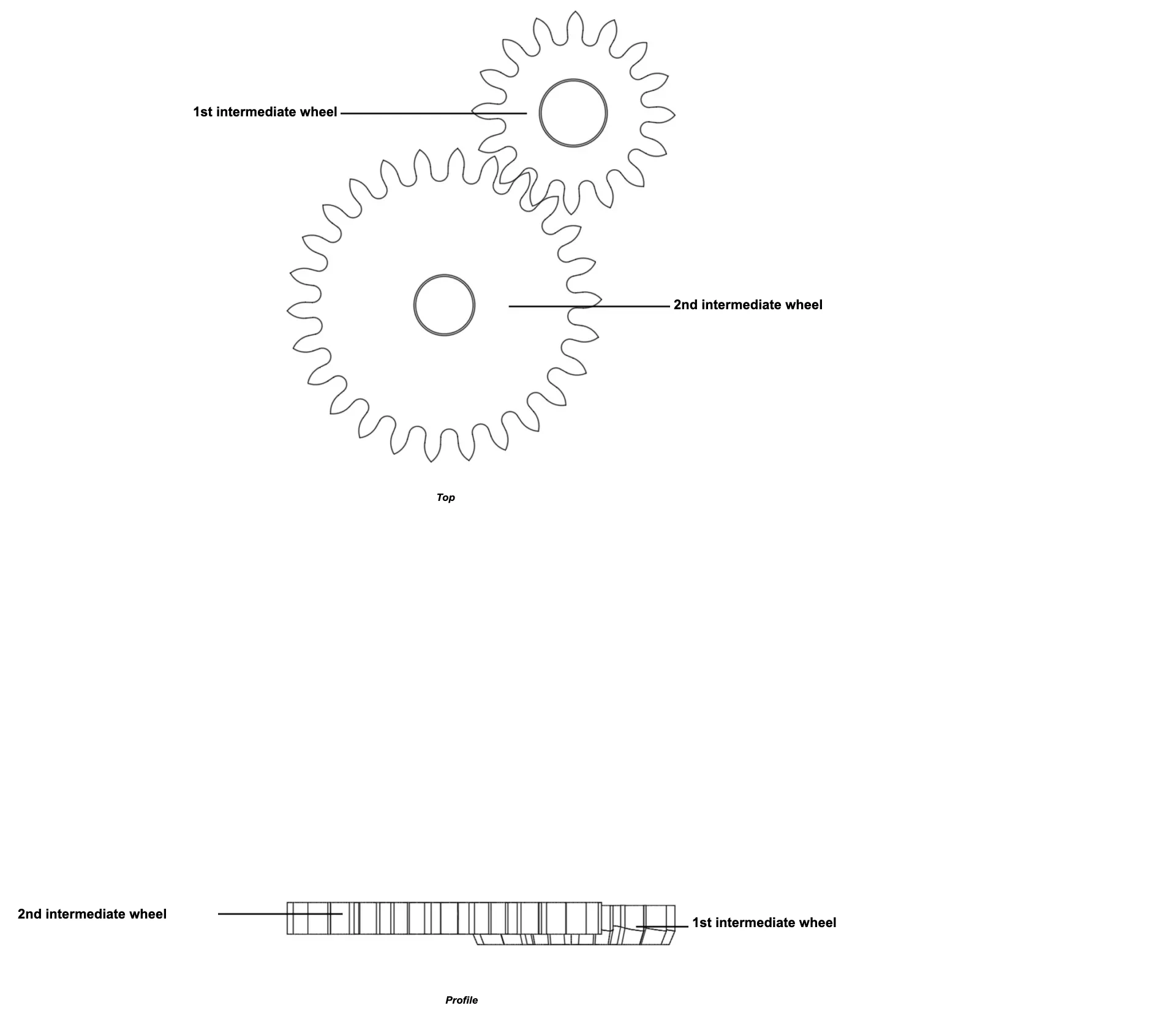
Figure 1
Combination of two hand-setting intermediate wheels
Click on the thumbnail to enlarge it
Figure 2
Kinematics of the hand-setting mechanism
Click on the animation to enlarge it
2. History
Technically, the intermediate wheel is a gear in its simplest form. It is a simple toothed cylinder made of steel. Gears were already known to the Greeks in the 6th century BC. The first known mechanical gears date back to the 4th century BC. and appeared in China. With intermediate wheels (and gears in general), watchmakers simply applied known mechanical principles.
However, it can be considered that the intermediate wheels of the hand-setting mechanism as we know them today, appeared in the mid-19th century with the successive inventions of Adrien Philippe (crown winding / 1842) and Antoine Le Coultre (winding mechanism with lever / 1847).
3. Artisanal manufacturing of an intermediate wheel
A lathe is enough to entirely manufacture an intermediate wheel. Turning operations are few. The teeth can easily be cut on the same lathe using an offset milling cutter and a dividing plate. The finishes and the polishing can also be done using the same lathe.
4. Industrial production of an intermediate wheel
As with most small-diameter circular components, the automatic lathe is the ideal machine to produce intermediate wheels regardless of quantities. This allows, quickly and in a single cycle, all operations (turning, cutting) to be carried out. Whatever quality is desired, machining an intermediate wheel using this method will only take a few minutes.
This page has been automatically translated from the French reference version using an artificial intelligence tool. Errors or inaccuracies may remain. If you notice any, especially if this is your native language, please do not hesitate to report them to info@horopedia.org. Your contribution helps us improve the quality of the encyclopedia.
Pending their translation, images and videos remain temporarily displayed in French.
Thank you for your understanding.