
MENU
Figure 1: Exploded view of the barrel (motor organ (power source))
Click on the animation to enlarge it
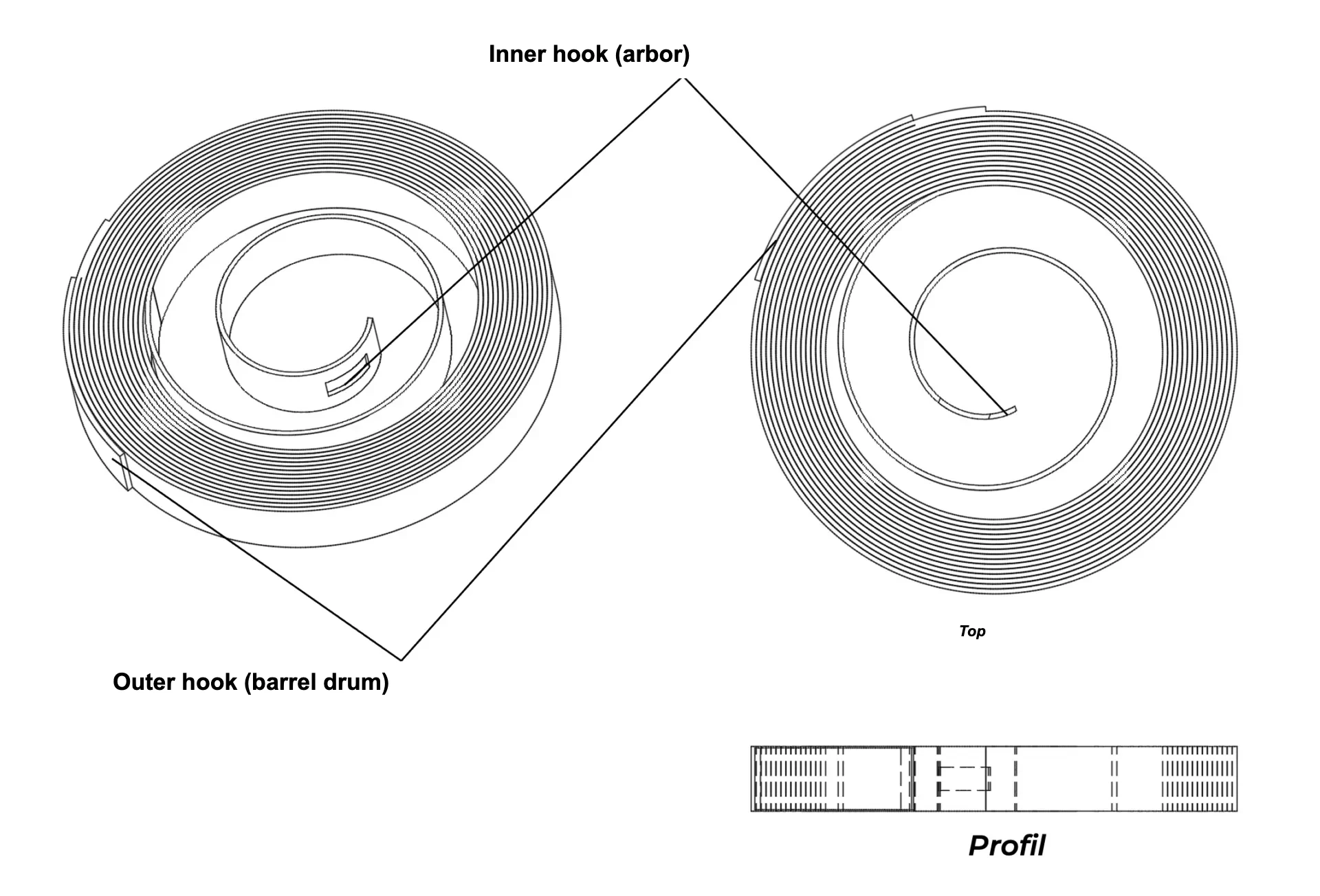
Figure 2: Diagram of a mainspring (manual winding)
Click on the thumbnail to enlarge it
1. General description
This is the major component of the barrel, the motor organ (power source) of the watch. It is a long blade of steel with a rectangular section coiling in a spiral around the barrel arbor, inside the barrel drum. Once wound, it is the mainspring that drives the drum in a rotating motion and thus provides all the energy needed for the operation of the movement. Relaxed, without the slightest constraint, the mainspring displays a regular spiral shape at its center. Then the curve of this spiral reverses on the outside of the spring. This particular shape, fixed during the heat treatments of the spring makes it possible to obtain a torque that is as constant as possible throughout its unwinding. At the very least, to obtain winding curves that are as regular and flat as possible.
The inner end of the mainspring has a rectangular opening that allows the spring to be fixed to the hook of the barrel arbor. At the outer end of the blade, a section of spring with reversed curvature is welded to the last coil. This welded section is called the bridle. It allows the outer end of the spring to be hooked onto the milling made in the inner wall of the barrel drum.
The power reserve of the watch depends on the length of the mainspring.
Its thickness determines the torque it develops and therefore its capacity to drive additional mechanisms (calendars, chronographs, etc.)
The quality of a barrel therefore essentially depends on its spring. It must have optimal efficiency (as little energy loss as possible for increased power reserve) and develop a force that is as constant as possible throughout its unwinding (accuracy of timekeeping). Precise calculations incorporating the nature of its alloy, its dimensions and its heat treatments make it possible to obtain a high-performance and well-suited barrel.
2. Industrial production method
While the manufacturing of the drum, its cover and the barrel arbor is not particularly difficult, the production of springs requires very specific equipment and expertise. Their production is systematically outsourced and only a few manufacturers share this market. The manufacturing of mainsprings is thus exclusively industrial.
The manufacturing of a mainspring takes place according to the following steps.
Rolling
This operation makes it possible to transform the round section of the base wire into a rectangular section and to successively bring the blade of the spring to its final height and thickness within tolerances of less than half a micron (< 0.0005 mm).
Cutting
Once the rolling operations are complete, the spring is cut to its total length and the eyelet allowing it to be attached to the barrel arbor is stamped during the same operation.
At the same time, the bridle coming from the same strip of material is thinned and cut to its correct length.
Folding
Various folding steps give the spring its final shape. This produces the inner coil (the first inner turns of the blade allowing it to attach to the barrel arbor) and then calendering (winding the entire length of the blade into a spiral in the opposite direction to its final winding inside the barrel drum).
Heat treatments
The heat treatments fix the spring in its shape and give it all its mechanical properties (torque, elasticity).
Welding the bridle
The bridle allows the spring to attach to the inner wall of the barrel drum. Manufactured alongside the blade, the bridle is assembled to it by an electric spot welding operation.
Self-lubrication of the spring
In the past, watchmakers used to grease the blades of the mainspring in order to minimize friction during the unwinding of the spring. From the middle of the 20th century onwards, surface treatments made it possible to achieve better results, making any lubrication of the spring unnecessary and even detrimental to the proper unwinding of the spring. Nowadays, this surface treatment consists of applying a thin Teflon coating to the spring blade by immersion in a bath.
Strapping
This is the final manufacturing operation. It consists of winding the spring blade in its operating direction and holding it under pre-stress in an aluminium ring. The spring, once finished in this way, can then be housed directly in the barrel drum.
This page was automatically translated from the reference French version using an artificial intelligence tool. Errors or inaccuracies may remain. If you notice any, especially if this is your native language, please do not hesitate to report them to info@horopedia.org. Your contribution helps us improve the quality of the encyclopedia.
Pending their translation, images and videos remain temporarily displayed in French.
Thank you for your understanding.