
MENU
1. General description
The ratchet wheel is the last component of the kinematic chain of the winding mechanism. Because of the torques present during the watch’s winding and the tensions present in its teeth, the ratchet wheel must be resistant and is almost always made of steel. Technically, the Ratchet wheel is a Disc on the periphery of which its teeth are cut and at the center of which there is a square-section hole.
The Barrel pivots between the Main plate and its Bridge. In most constructions, the Barrel arbor protrudes in its emerging part from the surface of the Bridge. The emerging part of the Barrel arbor is square in section. It is on this square section of the Arbor, once the Barrel is fixed by its Bridge, that the open square at the center of the Ratchet wheel comes to fit. The Ratchet wheel is then directly screwed to the Barrel arbor by a threading made at the center of the latter. In other constructions, the Ratchet wheel can also be located under the Barrel bridge and held between two bearings, without any Screw whatsoever. The operating principle, however, remains identical. The Ratchet wheel turns by the energy received from the Winding mechanism, driven directly by the Crown wheel. By means of its square fit, it drives the Barrel arbor in a rotary motion which winds the Mainspring by putting it under tension, thereby giving the watch the energy needed for a Power reserve. To prevent the energy thus accumulated in the drum from escaping through the Crown, a Click system directly connected to the Ratchet wheel allows only unidirectional rotation of the latter, thus capturing the energy at the heart of the Barrel drum, leaving it with only one way out: the finishing Train (wheel train).
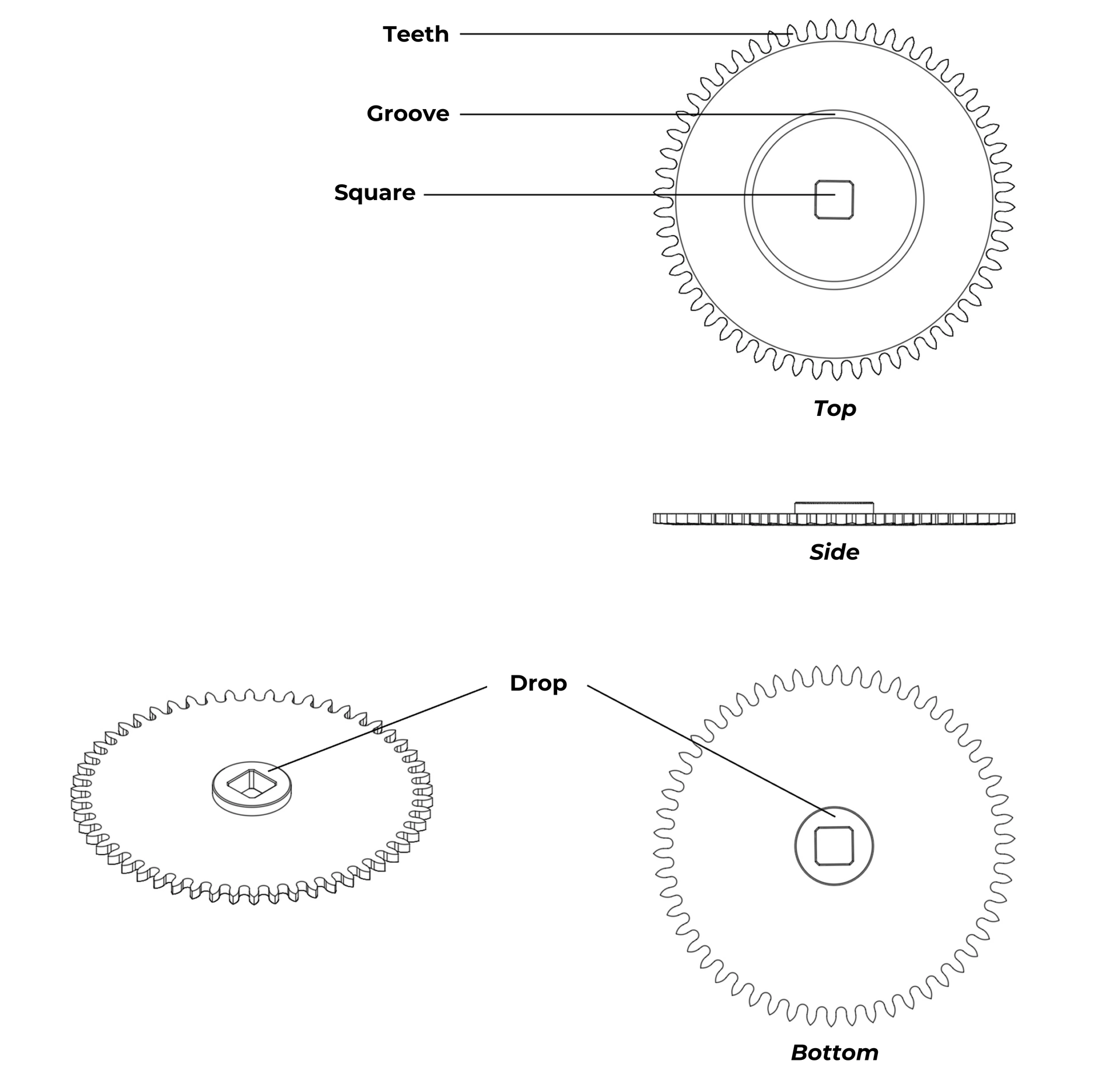
Figure 1
Diagram of a Ratchet wheel
Click on the thumbnail to enlarge it
Figure 2
Kinematics of the Winding mechanism
Click on the animation to enlarge it
2. History
Unlike most components of the Winding mechanism that appeared with Adrien Philippe’s invention in 1842, the Ratchet wheel is as old as the use of a Blade spring (Mainspring) as a motive energy. The date and authorship of the invention (or application) of a Blade spring as motive energy are unknown, but the first clocks thus “motorized” already appeared in the 15th century. It was immediately necessary not to let the force of the spring escape through its Winding device (in this case, a Key directly on the Barrel arbor). To contain this energy in the drum and force it to “escape” through the barillet) comme énergie motrice. La date et la paternité de l’invention (ou de l’application) d’un ressort à lame comme énergie motrice sont inconnues, mais les premières horloges ainsi « motorisées » apparaissent déjà au 15e siècle. Il était d’emblée nécessaire de ne pas laisser échapper la force du ressort par son dispositif d’armage (on parle alors d’une clé directement sur l’arbre de barillet). Pour contenir cette énergie dans le tambour et l’obliger à « fuir » par le going train, a toothed wheel directly engaged by a square (the ratchet wheel) is attached to the barrel arbor. The click mechanism (the click and the winding click spring) blocks the teeth of the ratchet wheel, allowing it to rotate in only one direction (winding) and thus contain the force of the barrel. This medieval principle remains unchanged and present in all mechanical watches.
3. Handcrafted manufacture of a ratchet wheel
Exclusively made of Steel, the ratchet wheel is relatively easy to make. According to the traditional method, a Lathe fitted with a dividing plate allows all the steps to be carried out. The turning steps are the first. The toothing is preferably cut successively on the same lathe without repositioning in order to guarantee the concentricity of the whole (turnings and toothing). These operations are carried out with a milling cutter and a dividing plate mounted on the lathe. Once cut from its bar, the ratchet wheel can be brought to thickness. Its fitting square can be filed starting from a circular hole previously drilled at the center of the ratchet wheel. Heat treatments and decoration (generally a sunburst finish) will complete the manufacturing steps according to the artisanal method.
4. Industrial manufacturing of a ratchet wheel
As with most components that are circular in shape and small in diameter, the automatic lathe is the best way to produce Ratchet wheels using the industrial method. All machining operations (turning, milling, cutting) can be carried out in one cycle, quickly and without any particular difficulty. As always on an industrial scale, the finishing and decoration will be done by hand or industrially depending on the level of finishing required and the range of the watch.
This page was automatically translated from the French reference version using an artificial intelligence tool. Errors or inaccuracies may remain. If you notice any, especially if this is your native language, please feel free to report them to us at info@horopedia.org. Your contribution helps us improve the quality of the encyclopedia.
While awaiting translation, images and videos remain temporarily displayed in French.
Thank you for your understanding.