
MENU
1. General description
The crown wheel is the second-to-last moving component of the Winding mechanism. Its role is to transmit the energy from the winding mechanism (Winding stem, sliding pinion and winding pinion) to the Ratchet wheel which will wind the Mainspring. The gear train of the winding mechanism is a reduction train. Each element rotates more slowly than the previous one. This choice increases the number of turns of the Crown (and of the winding stem) required to fully wind the mainspring, but it requires much less torque (force) to do so. Calculating the reduction ratio of the winding train is therefore subject to a subtle compromise (winding the watch must be neither too long nor too difficult).
In addition to transmitting energy to the Ratchet wheel, the Crown wheel changes the plane of the Gear. Indeed, the Axis of the Winding pinion positions it on a vertical plane whereas the Crown wheel and the Ratchet wheel operate on a horizontal plane. A double toothing is therefore cut around the periphery of the Crown wheel: one of them, cut at a 45° angle (beneath the Crown wheel) will mesh with the Winding pinion, the second, on the horizontal plane (around the periphery of the Crown wheel) will mesh with the Ratchet wheel. It is this double “crown” toothing that certainly earns it its name. Due to the torques present in this Gear train, all its components are made of Steel. This is the case for the Crown wheel, which pivots on a core with as large a diameter as possible. The axis of rotation of the Crown wheel thus better absorbs the forces present and guarantees a friction level as low as possible over the long term.
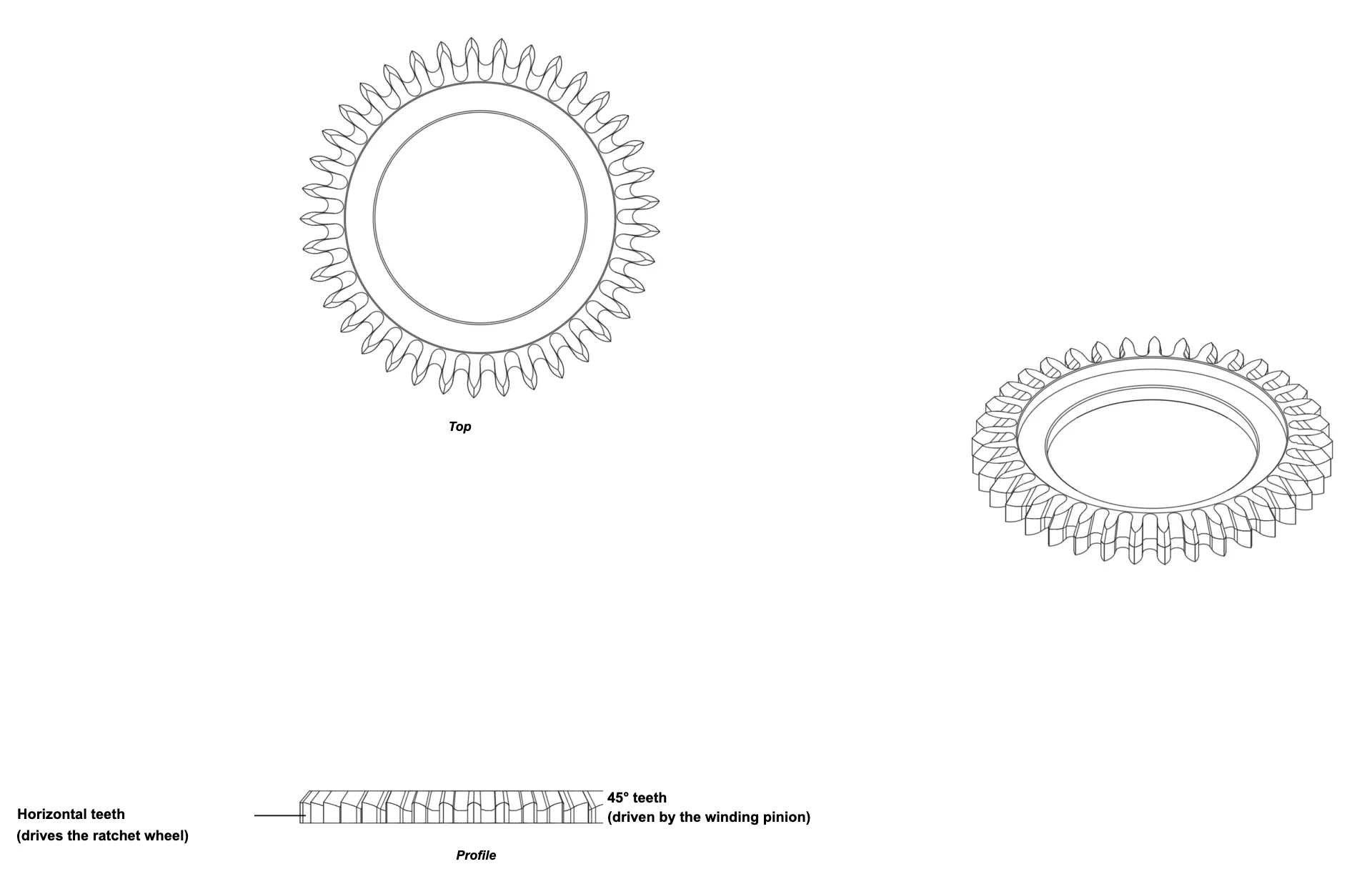
Figure 1
Diagram of a Crown wheel
Click on the thumbnail to enlarge it
Figure 2
Kinematics of the winding mechanism
Click on the animation to enlarge it
2. History
The appearance of the Crown wheel (implicitly its invention) is linked to the invention of the Winding mechanism keyless by Adrien Philippe in 1842. Before him, other watchmakers had imagined such mechanisms without managing to sufficiently miniaturize them to make them acceptable for a pocket watch of that era. The success of such a mechanism therefore lay more in its miniaturization than in its mechanical principle. Adrien Philippe’s solution, still in use today, consists of distributing the mechanism over a vertical Axis (Sliding pinion and Winding pinion) and a horizontal Axis (Crown wheel, Ratchet wheel). The Crown wheel and its double toothing thus constitute, in a way, the keystone of the design of Winding mechanisms since their invention.
3. Artisanal manufacture of a Crown wheel
Made exclusively of Steel, the Crown wheel is relatively easy to manufacture. According to the artisanal method, a Lathe fitted with a dividing plate allows all the steps to be carried out. The turning steps are the first. The double toothing of the Crown wheel and its pivoting on its core make them numerous and require a high level of precision. Preferably, the two toothings are cut successively on the same Lathe without repositioning, in order to guarantee the concentricity of the whole (turnings and toothings). These operations are carried out with specific cutters and a dividing plate mounted on the Lathe. Once cut off from its bar, the Crown wheel can be brought to thickness in order to adjust its pivoting and height clearances. Heat treatments and Decoration (generally a Sunburst finish) will complete the manufacturing steps using the traditional method.
4. Industrial production of a Crown wheel
As with most components of circular shape and small diameter, the Automatic lathe is the best (the only) way to produce Crown wheels using the industrial method. All machining operations (turning, Milling, cutting) can be carried out in a single, fast cycle without any particular difficulty. As always on an industrial scale, finishing and Decoration will be done by hand or industrially depending on the level of finishing required and the range of the watch.
This page has been automatically translated from the French reference version using an artificial intelligence tool. Errors or inaccuracies may remain. If you notice any, especially if this is your native language, please feel free to report them to info@horopedia.org. Your contribution helps us improve the quality of the encyclopedia.
While awaiting their translation, images and videos remain temporarily displayed in French.
Thank you for your understanding.