
MENU
1. Table of main properties of Ruby / Jewel
| Property | Typical value | Remarks |
|---|---|---|
| Density | ~4.0 g/cm³ | Moderate |
| Elasticity modulus (E) | ~350–400 GPa | Very high |
| Tensile strength | Low | Brittle material |
| Hardness (HV) | ~2000 HV | Very high |
| Hardness (Mohs) | 9 | Just below Diamond |
| Thermal conductivity | ~25–40 W/m·K | Average |
| Electrical conductivity | None | Insulating |
| Expansion coefficient | ~5–8 ×10⁻⁶ /K | Low |
| Magnetism | No | Non-magnetic |
| Corrosion resistance | Excellent | Inert |
| Machinability | Very difficult | Abrasive |
2. General description
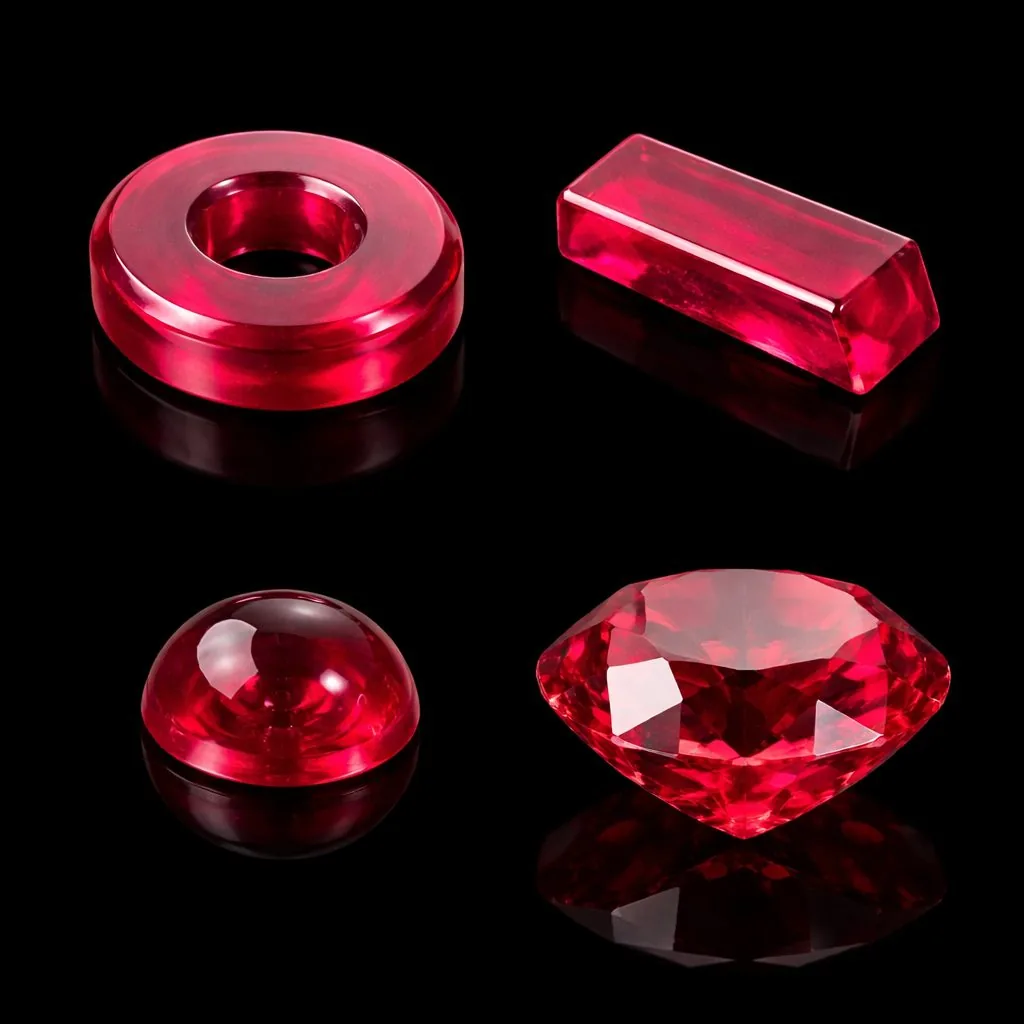
Ruby / Jewel is a variety of corundum (Al₂O₃), a crystallized aluminium oxide, characterized by very high hardness (9 on the Mohs scale) and excellent wear resistance. Nowadays, its presence in Movements occurs exclusively in the form of synthetic Ruby / Jewel, due to its purity, consistency and availability. The properties of synthetic rubies are identical to those of natural rubies, but they are uniform in color and do not present any inclusion (risk of breakage).
Introduced as early as the 18th century in watch Movements, Ruby / Jewel is an essential component of bearings and friction-reduction systems, contributing decisively to the precision and longevity of watches.
3. Natural rubies and synthetic rubies
Natural Ruby / Jewel
Historically, the first rubies used in watchmaking were natural.
Characteristics:
- Variability of properties
- Natural impurities
- Limited availability
👉 Today, its use is exclusively reserved for jewelry applications (Setting (stone/jewel setting) of dials, of cases, of bracelets, etc.).
Synthetic Ruby / Jewel
Synthetic Ruby / Jewel is artificially produced from Aluminium oxide.
Main methods:
- Verneuil process (flame fusion)
- Growth by pulling (Czochralski)
Advantages:
- High purity
- Constant properties (color)
- Controlled production
- Controlled cost
👉 It is now the standard in technical applications (Movement)
4. Manufacturing of synthetic watchmaking rubies
Rubies intended for watchmaking are obtained through:
- Growth of the synthetic crystal
- Cutting into wafers
- Precision machining (drilling, profiling)
- Polishing of functional surfaces
These operations result in:
- perfectly calibrated holes
- extremely smooth surfaces
- precise geometries
5. Types of watchmaking rubies
Several types can be distinguished according to their function:
- Pierced Rubies (bearings) → guiding of the arbors
- Rubies with endstone → axial retention
- Impulse rubies → energy transmission (pallets, roller jewels, etc.) (cf. Distribution mechanism and Regulating organ)
- Friction reduction → rollers, etc.
6. Watchmaking applications
Ruby / Jewel is used for:
- Bearings of axles (gear trains, Balance)
- Escapement systems
- Friction reduction (fixed and rotating rollers)
It is present in practically all mechanical and quartz Movements.
7. Advantages and limitations
Advantages
- Very high resistance to wear
- Significant reduction in friction
- Stability over time
- Non-magnetic material
- Excellent manufacturing precision
- Exceptional durability
Limitations
- Fragility (brittle)
- Higher cost than standard materials
- Requires precise assembly
- Sensitive to severe impacts
This page was automatically translated from the French reference version using an artificial intelligence tool. Errors or inaccuracies may remain. If you notice any, especially if French is your native language, please feel free to report them to info@horopedia.org. Your contribution helps us improve the quality of the encyclopedia.
While awaiting their translation, images and videos remain temporarily displayed in French.
Thank you for your understanding.