
TAPS (THREADING TOOLS)
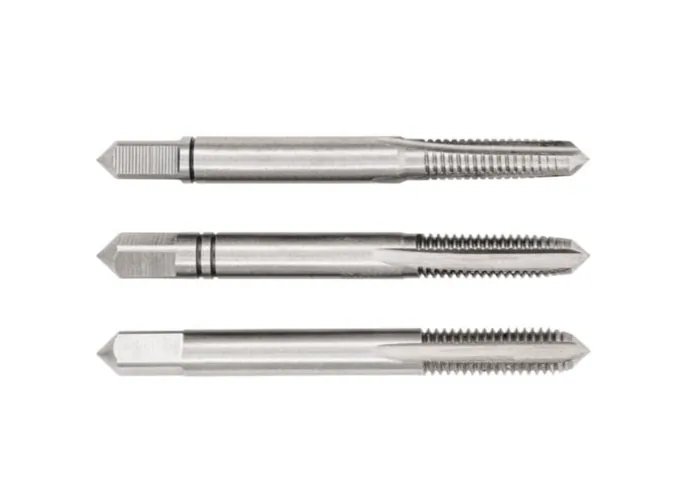
Set of three taps (threading tools)
What are taps (threading tools) used for?
The tap (threading tool) is a rotary cutting tool used to create the internal Threading of a hole — an operation known as tapping. Engaged in a pre-drilled hole of the appropriate diameter, it progressively cuts, by removing chips, a helix that will then form the housing for a Screw. In horology, where diameters frequently fall below one millimetre and where the breakage of the Tap (threading tool) inside a workpiece is most often irreversible, tapping requires specific tools, particular standards, and a especially codified working protocol.
In its general form, the watchmaking Tap (threading tool) is presented as a rod of high-speed steel (HSS) or hardened tool steel, ending in a threaded portion split by two or three longitudinal flutes. These flutes expose the cutting edges and ensure chip evacuation. The tool’s shank, with a square-section end, allows it to be driven by a tap holder — a hand tap wrench, chuck, or tapping stand. Usual diameters range from a few tenths of a millimetre to a few millimetres, for codified pitches and thread profiles.
Threadings used in horology largely comply with the Standards of the Swiss Horological Industry (NIHS), which define the Thread geometry and the series of standardized dimensions. Alongside the ISO metric Threading, reserved for the most massive components, horology mainly uses the so-called “S” pitch, a series of 60° triangular profile Threadings specifically designed for very small diameters: Bridge Screws, clamp Screws, Regulator Screws, etc. This codification guarantees the Interchangeability of threaded components across the industry and the availability, from specialized suppliers, of Taps (threading tools), dies, and Screws with the same specifications. The older Thury pitch retains a residual presence in the restoration of antique pieces.
For horological diameters, threading is traditionally carried out with a set of three successive taps: roughing, intermediate, and finishing. The first — roughing tap — has a long tapered leading section, takes the first chips, and starts the Thread without straining the tool. The second — intermediate tap — has a shorter leading taper; it deepens and evens out the Thread. The third — finishing tap — has only a minimal, or even flat, leading section; it completes the Thread to the nominal diameter and to the bottom of the hole, which proves particularly important in blind holes, where only the finishing tap makes it possible to obtain a usable Thread over the entire available Length. The three-pass progression spreads the cutting effort across three tools, limits the torque applied at each stage, and considerably reduces the risk of breakage — a risk that is all the more critical given that extracting a broken tap fragment from a horological part often forces its outright replacement.
At the Bench, the Horologist (watchmaker) begins by drilling the pilot hole to the prescribed diameter, generally codified in the NIHS tables for each pitch dimension. The piece is then immobilized — between Vice jaws, on a tapping stand, or in a specialized device — so that the Tap (threading tool) penetrates it strictly perpendicular to the plane of the hole. The tool, mounted in its tap holder, is engaged without haste; each forward turn is punctuated by a partial return intended to break the chip and prevent clogging of the flutes. Suitable Lubrication — horological cutting Oil — accompanies the motion. The roughing-intermediate-finishing sequence is scrupulously respected.
Modest-looking tools, horological Taps (threading tools) embody the demands of a craft where every threadable Assembly relies on rigorous standardization — notably that of the NIHS series — and on the mastery of a gesture in which patience always prevails over force.
This page has been automatically translated from the French reference version using an artificial intelligence tool. Errors or inaccuracies may remain. If you notice any, especially if French is your native language, please feel free to report them to info@horopedia.org. Your contribution helps us improve the quality of the encyclopedia.
While awaiting their translation, images and videos remain temporarily displayed in French.
Thank you for your understanding.