
MENU
1. General description
It is a control element (correction) and connection between the inside and outside of the watch case. Made of steel, it is connected to the movement by a blind hole perpendicular to the hands. At its inner end, the winding stem has a pivot that allows it to rotate freely and at all times around its own axis. Following the pivot comes a long square on which the sliding pinion (or shifting pinion) slides. It is the movement of this pinion that will act on the winding mechanism (stem pushed in) and the time-setting mechanism (stem pulled out). After the square of the sliding pinion, a cylindrical fitting receives the winding pinion. The latter rotates freely on the stem. It will only be driven when the sliding pinion is in contact with its common Breguet disengageable teeth. A groove made on the diameter of the winding stem, as close as possible to the periphery of the main plate, houses the setting lever stud which fixes the stem to the movement and allows the setting lever to be operated. The setting lever is a lever that operates the lever/rocker, which slides the sliding pinion on the square of the winding stem and allows switching from one function to another (time setting, winding). In its part external to the movement, the winding stem is entirely threaded. It passes through the tube of the case and, after the winding stem has been carefully adjusted to length, it receives the crown which screws directly onto it and ensures the water resistance of the watch inside and outside the case tube. Generally on a simple watch, when the crown (and therefore the winding stem) is pushed (against the case), the crown and the winding stem operate the winding mechanism. When the crown and the stem are pulled out, they operate the time-setting mechanism. An intermediate position generally allows correction of a Date / Calendar when the watch displays one. Other corrections may be assigned to the crown (secondary time zones, perpetual Date / Calendar, etc.). In these cases, and to multiply the possible commands or corrections, it is not uncommon to assign an indicator to correct/adjust according to the direction of rotation of the crown and therefore of the winding stem.
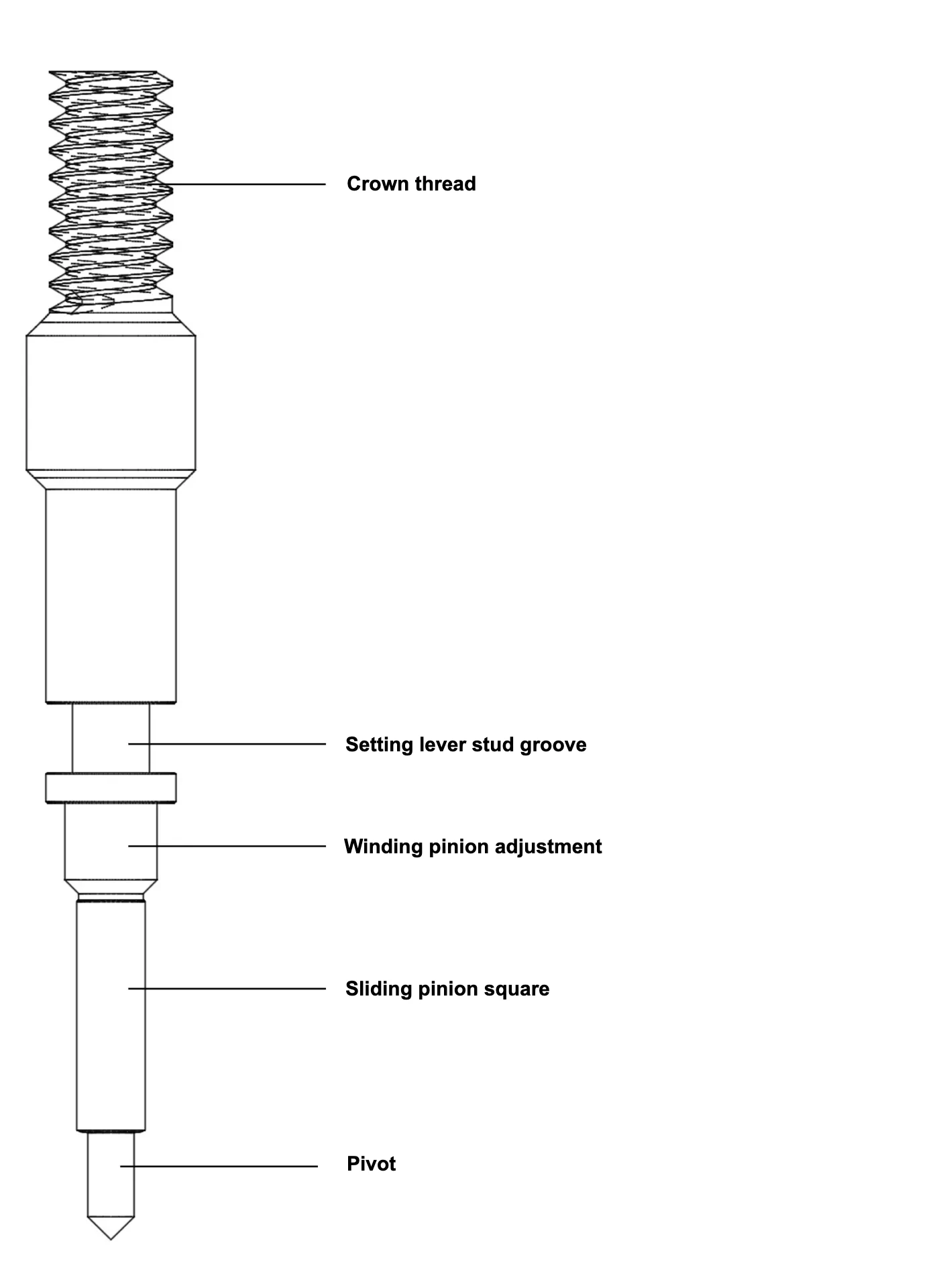
Figure 1
Diagram of a winding stem
Click on the thumbnail to enlarge it
Figure 2
Lever/rocker between the winding mechanism and the time-setting mechanism
Click on the animation to enlarge it
2. History
The winding stem appeared with Adrien Philippe’s invention, in 1842, of the winding mechanism. At this point in history, Antoine Le Coultre had not yet invented the time setting via lever, and the stem then exclusively operated the winding mechanism. This is certainly the origin of the name “winding stem” inherited from this short historical period. Indeed, it was in 1847, only five years after Adrien Philippe’s invention, that Antoine Le Coultre invented the lever winding mechanism, which offers the dual function of winding and time setting without requiring the use of a key. From the end of the 19th century onward, the mechanism evolved and, depending on requirements, became more complex (control of the Date / Calendar, other functions). The materials and manufacturing methods have sometimes appeared since the end of the 20th century, even though most constructions remain very traditional both in the materials used and in the manufacturing methods.
3. Artisanal manufacture of a winding stem
The winding stem is a relatively easy component to manufacture regardless of the method. The craftsman begins by carrying out all the turning operations that make up the bulk of the work. He ensures the concentricity of the turned parts given the particularly delicate length-to-diameter ratio of the winding stem. The craftsman can then thread the end of the winding stem on the same lathe. The next step takes place at the bench. The craftsman files the four faces of the square on which the sliding pinion (jumping pinion) will slide. This operation requires a certain dexterity, as the square is long and must be perfectly regular. The surfaces are then polished or smoothed depending on their function, and the winding stem can be subjected to its heat treatments (hardening and tempering). Heat treatments of the winding stem are relatively difficult to achieve successfully due to its significant length and small diameter. Thus, the heat treatment may not be homogeneous, and deformations of the stem are unfortunately always possible during these steps. A brief polishing and softening step will re-whiten the winding stem, which will then be ready for assembly. Finally, the final length adjustment of the stem will be done during the casing of the movement.
4. Industrial production of a winding stem
The automatic lathe is the most suitable machine for producing winding stems. All operations (turning, threading, and milling of the square) can be carried out in a single cycle. Depending on the steel alloy chosen, the winding stem will not require any subsequent heat treatments. Finally, and depending on the level of finishing chosen, the finishes, and in particular the Polishing, can be done by hand or more industrially in bulk (in a polishing drum, for example).
This page has been automatically translated from the French reference version using an artificial intelligence tool. Errors or inaccuracies may remain. If you notice any, especially if this is your native language, please feel free to report them to info@horopedia.org. Your contribution helps us improve the quality of the encyclopedia.
While awaiting their translation, images and videos remain temporarily displayed in French.
Thank you for your understanding.