
SCREW PLATES
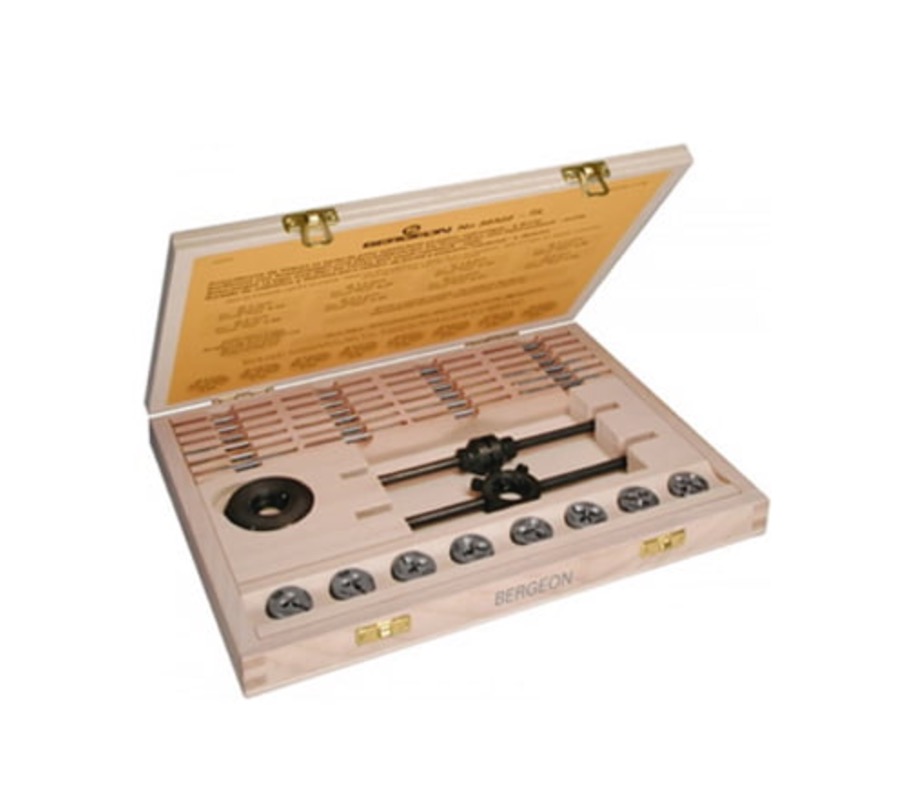
Assortment of screw plates and screw plate holder
What is a screw plate?
Screw plates are cutting tools designed to form an external Threading — in other words, a screw thread — on the circumference of a cylindrical rod. Used by rotation with the help of a screw plate holder or a turret, which hold and drive them, they complement their internal counterpart, the Tap (threading tool), used to create female Threadings. The small size of watchmaking components imposes specific requirements on their use, which distinguish watchmaking screw plates from those used in general mechanics.
The watchmaking screw plate takes the form of a thin Disc made of steel tool steel or high-speed Steel, pierced at its centre with a threaded hole whose profile corresponds to the exact negative of the Threading to be reproduced. Several radial flutes — generally three or four — delimit as many cutting edges and facilitate the removal of chips. The usual diameters of watchmaking Screw plates typically start around 0.30 millimetre, a dimension for which the material removed per turn is on the order of a Micrometre and requires very fluid Lubrication as well as perfect alignment of the rod.
The threadings used in watchmaking follow standardized series specific to the branch, distinct from the ISO metric series of common mechanics. Within the Swiss Horology Industry Standards (NIHS), the “S series” defines a set of diameter/pitch pairs adapted to very small diameters, reserving for watchmaking components proportions more favourable to the strength and stability of the threads. These Threadings equip all the screwed Assemblies of the Calibre — notably the fixing of the Bridges onto the Main plate, the retention of springs, cams, and levers.
A fundamental characteristic of watchmaking practice is the near-total absence of nuts: Screw fastening is carried out directly between the threaded Screw and the corresponding tapped component (Main plate, Bridge, Balance cock, Oscillating weight (rotor), etc.). Several reasons converge here. The thickness of the components most often provides enough material to create a blind tapping ensuring a satisfactory number of threads in engagement; adding a nut would make the Assembly heavier and more complex, at the cost of a bulk incompatible with the density of the Movement; finally, direct tapping ensures controlled identification and disassembly during servicing operations. The Screw plate is thus systematically paired not with a nut device, but with a Tap (threading tool) that reproduces its profile right at the heart of the Calibre’s components.
This page has been automatically translated from the French reference version using an artificial intelligence tool. Errors or inaccuracies may remain. If you notice any, especially if this is your native language, please do not hesitate to report them to info@horopedia.org. Your contribution helps us improve the quality of the encyclopedia.
Pending their translation, images and videos remain temporarily displayed in French.
Thank you for your understanding.