
THE TIMEGRAPHER
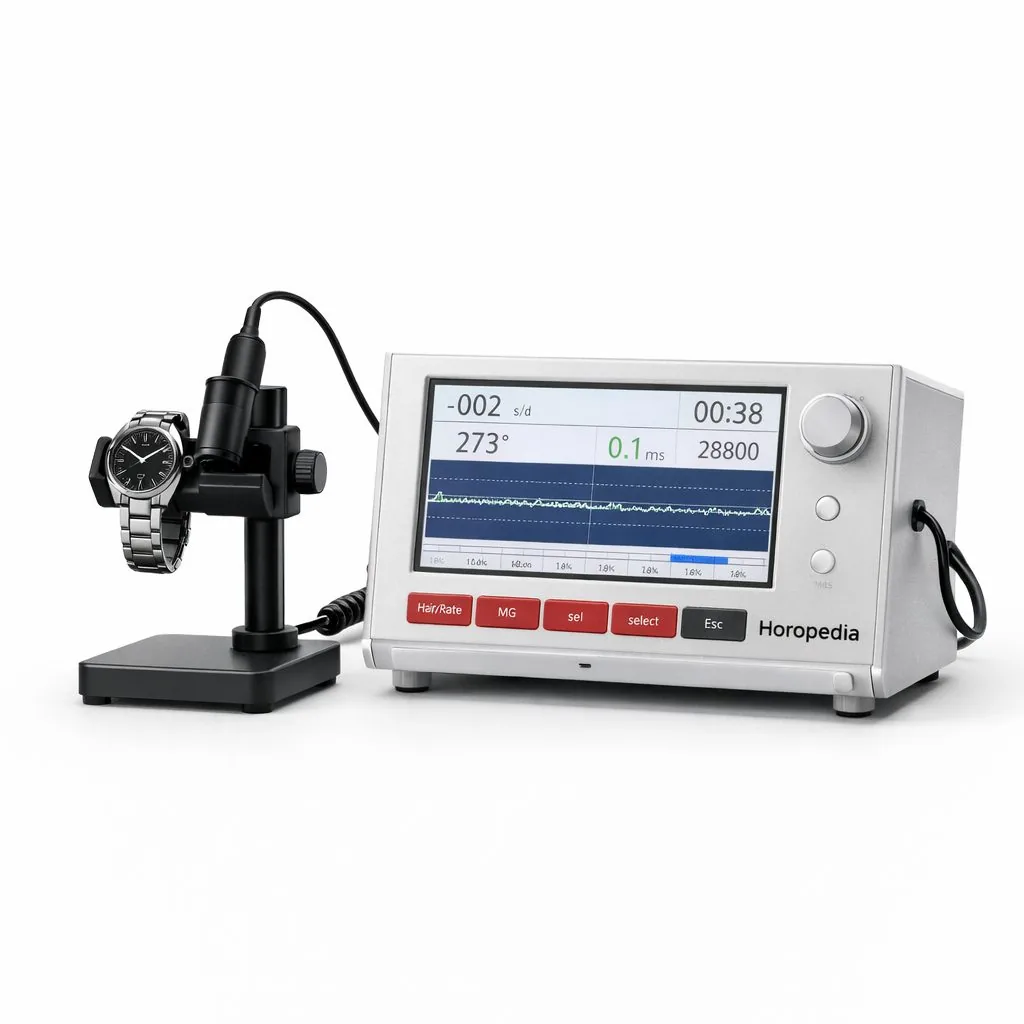
What is a timegrapher?
The timegrapher is a testing instrument used in horology to analyze the precision and regularity of the operation of a watch or a mechanical movement. It allows measuring, in a non-invasive and very precise way, the rhythm of the oscillations of the balance and thus to evaluate the chronometric performance of the Movement.
The timegrapher is often referred to by the name of its manufacturer or its model (Vibrograph, Witschi, etc.).
Function and use
This device captures the sounds emitted by the shocks of theEscapement via a sensitive microphone in the form of a support to which the mechanical movement or the complete watch is held. By analyzing these sounds, it calculates the Frequency of the Regulating organ, the variations in Amplitude, the deviation of the guide mark as well as the Daily rate, expressed in seconds lost or gained per day.
Its use facilitates fine regulation/adjustment of the watch movement by detecting irregularities or malfunctions that may affect the watch’s precision. It is particularly useful during the Regulation / Adjustment phase in the workshop or during quality testing.
Some timegraphers, notably used in laboratories or by chronometric certification bodies (Timelab, COSC, etc.), perform an optical measurement (by filming a component of the movement or the seconds hand of the watch head).
Characteristics
-
Acoustic sensor : High-performance microphone designed to capture the very faint and precise sounds produced by the escapement.
-
Electronic analyzer : Digital processing of acoustic signals allowing the display of key parameters such as the guide mark, the frequency, the daily rate and the amplitude.
-
Clear display : Results visible on a digital screen, often accompanied by graphs that make reading and interpretation easier.
-
Portability : Compact equipment allowing direct use in the workshop without complex wiring.
Importance in horology
The timegrapher is an indispensable tool for watchmakers. By providing quick and accurate measurements of the movement’s behavior, it helps identify the appropriate regulation/adjustment and ensure a steady rate, but depending on the digital or graphical indications, it also serves as a diagnostic tool.
Its non-destructive, contactless principle avoids any mechanical alteration during testing, preserving the delicate mechanics of watches while ensuring a reliable diagnosis.
This page has been automatically translated from the reference French version using an artificial intelligence tool. Errors or inaccuracies may remain. If you notice any, especially if this is your native language, please feel free to report them to info@horopedia.org. Your contribution helps us improve the quality of the encyclopedia.
While awaiting their translation, images and videos remain temporarily displayed in French.
Thank you for your understanding.