
MILLING CUTTERS
What is a milling cutter?
The milling cutter is a multi-edged rotary cutting tool, designed to remove material in successive chip sections. In watchmaking, where components are measured in hundredths or thousandths of a millimetre, the milling cutter occupies a particular place: it must combine geometric precision, cutting fineness and high repeatability. It is found both in restoration workshops, in the form of small hand-held tools, and on CNC machines tasked with machining mainplates, bridges or pinions at industrial production rates.
This article offers a technical overview of the milling cutters used in the watchmaking production chain. It successively addresses the cutters intended for manual work, their constituent materials, and then the cutters mounted on machines, including those dedicated to gear cutting — the emblematic operation of watchmaking mechanics.
General principle of a milling cutter
A milling cutter is made up of two main parts: a shank, by which it is held in the spindle of a machine or in the chuck of a handpiece, and an active part fitted with cutting edges. These edges, called teeth, are defined by several characteristic angles: the rake angle (which determines the ability to form the chip), the clearance angle (which prevents friction after the cut) and the helix angle (which ensures a progressive entry into the material). Depending on the driving mode, the cutter rotates and the workpiece advances, or vice versa.
In watchmaking, miniaturisation imposes very specific constraints. Useful diameters frequently drop below one millimetre; cutting speeds remain high while forces must remain minimal so as not to deform the workpiece or weaken the tool. The geometry is therefore sharper than on common industrial cutters, and the concentricity of the tool with respect to its shank directly governs the quality of the surface obtained.
1. Milling cutters for manual work
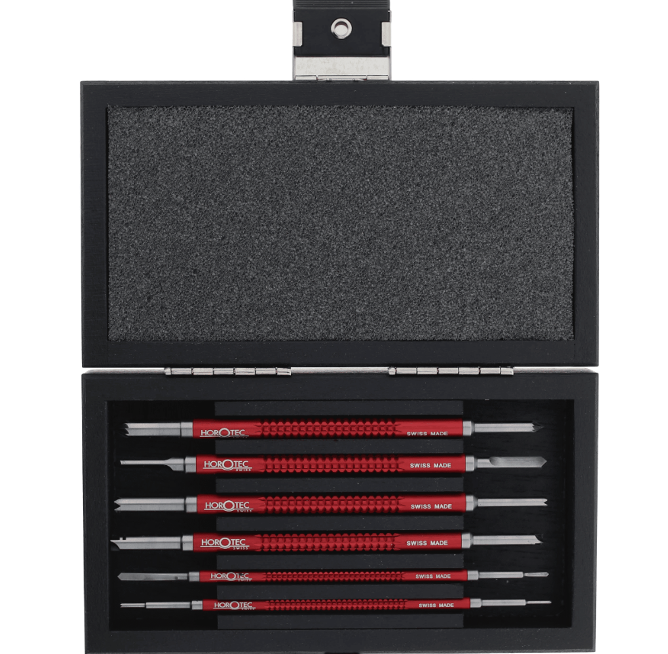
Various shank-mounted cutters
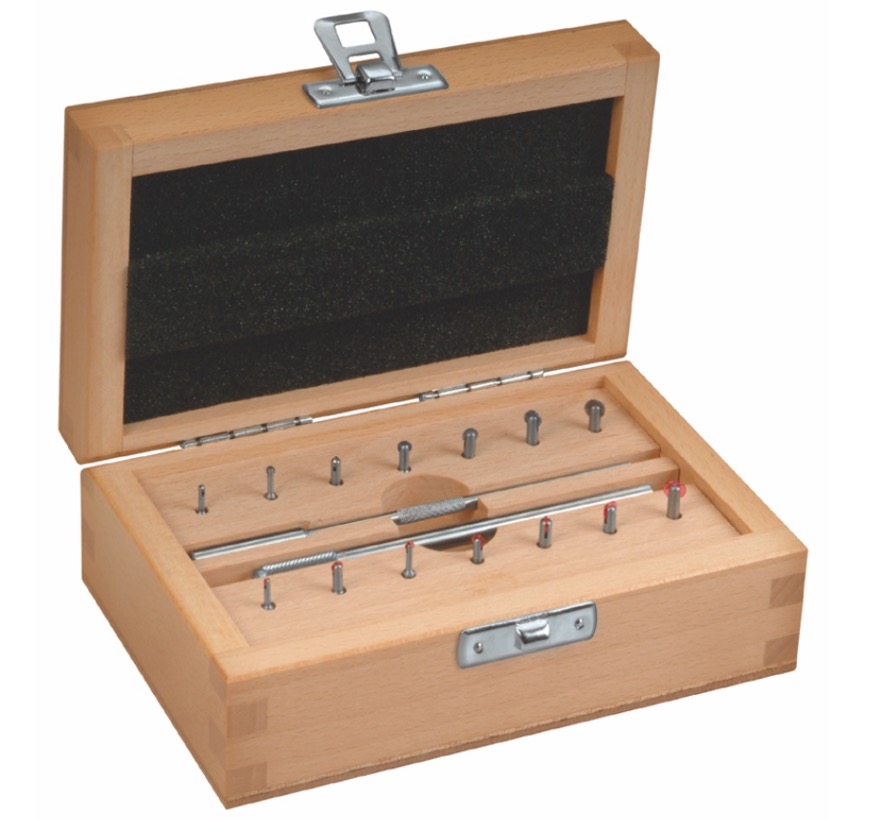
Steel and ruby shank-mounted wheel cutters
Hand-held work covers, in watchmaking, all operations of fitting, retouching, deburring and finishing carried out without a coordinate table. The watchmaker then guides the tool by eye, leaning on the free hand, on a support or on the workpiece itself. The cutters intended for these operations are small in size, generally mounted on a standardised shank — often at a diameter of 2.35 mm, sometimes 3 mm for the more robust models.
Implementation
These cutters are driven by a handpiece, a hand chuck, a bench micromotor, by a watchmaker’s lathe or by a pillar drilling machine. Rotation speeds typically range from a few revolutions to several tens of thousands of revolutions per minute, selected according to the tool diameter, the material being machined and the nature of the operation.
Form cutters
Form cutters reproduce, by simple plunge or by sweeping, a pre-established profile. Their silhouette is the negative image of the geometry sought on the workpiece: fillet, groove, undercut, bevel, shoulder profile. In traditional watchmaking they are used to rework bridge contours, to form decorative recesses on mainplates, to open up jewel or oscillating-weight seats, or to execute repetitive chamfers. Their main advantage is to guarantee the consistency of a profile from one workpiece to the next.
From a geometric standpoint, a distinction is drawn between constant-profile cutters — whose form is identical on each tooth, allowing radial sharpening without loss of profile — and relieved-profile cutters, more complex to re-sharpen but often preferred for very specific profiles.
Ball-nose cutters
The ball-nose cutter, or spherical cutter, presents a hemispherical or spherical head at its tip. It is the tool of choice for hollowing out a cavity with soft bottoms, for deburring a drilled hole, or for adjusting the entry of a bore. In watchmaking it typically serves to soften the entry of a hole before jewel setting, to slightly open up the diameter of a seat, or to produce a local undercut on an already-machined component.
Common diameters range from a few tenths of a millimetre to several millimetres; the smallest enable very fine, almost point-like work, but demand great mastery of pressure so as not to break the tool.
Wheel cutters
The name wheel cutter designates tools whose active part has the shape of a thin wheel, mounted perpendicular to the axis of the shank. The cutting edge develops on the periphery of the disc, sometimes also on the flanks. These cutters are used to produce a bevel edge or to apply its finishing. They are generally made of carbide or synthetic ruby.
Materials for hand cutters
The choice of cutting material governs the tool’s service life, the surface quality obtained and the materials it can work. Three families predominate in watchmaking.
High-speed steel
High-speed steels, designated HSS in international nomenclature, remain widely used for profile cutters and for working soft materials (brass, nickel silver, aluminium alloys). Their hardness is more modest than that of carbide, but they offer good toughness and are easily re-sharpened. They tolerate shocks and variations in feed, which makes them accessible tools for apprenticeship.
Carbide (tungsten carbide)
Carbide refers to sintered carbides, principally tungsten carbide bonded with a cobalt matrix (WC-Co system). Their high hardness — commonly between 1500 and 2000 HV depending on the grade — and their hot-wear resistance allow cutting speeds appreciably higher than those permitted by high-speed steel, as well as the machining of the hardened steels encountered in watchmaking (pivot arbors, stems, watchmaking-steel pinions). In return, carbide is more fragile under shocks and costly to produce in small diameters.
Carbide cutters can be coated, by physical or chemical vapour deposition, with thin layers such as titanium nitride (TiN), titanium-aluminium nitride (TiAlN) or chromium nitride (CrN). These coatings reduce the friction coefficient, extend service life and improve the surface finish of the workpieces.
Synthetic ruby
Synthetic ruby is a variety of corundum (aluminium oxide Al₂O₃) coloured red by a residual chromium content. It has been produced industrially, since the work of Auguste Verneuil in the early 20th century, by flame fusion of alumina powder on a rotating seed, which produces a single-crystal boule. With a hardness of 9 on the Mohs scale and around 2000 HV, it ranks among the hardest materials available industrially, just after diamond and cubic boron nitride.
As a material for hand tools, synthetic ruby is mainly encountered on wheel cutters. It is not used for sharp cutting — which would call for keen edges — but for fine abrasion, lapping and gentle adjustment operations, particularly on hardened steels where the amount of material to remove is minimal but the surface finish must be impeccable.
2. Milling cutters for machines
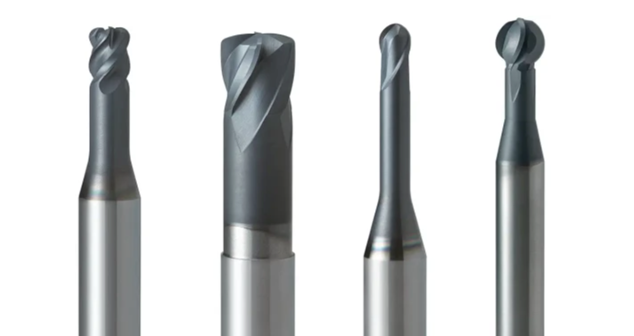
Various machine cutters (milling machine, machining centre, etc.)
The transition from manual to machine work does not change the principle of cutting, but profoundly transforms its possibilities. The cutter’s movement is no longer guided by eye and wrist, but by slideways, tables and controlled axes. Its rotation is driven by a spindle whose speed can, depending on the machine, reach several tens of thousands of revolutions per minute. Admissible forces increase, speeds rise and repeatability reaches levels inaccessible to the most experienced operator. The machine cutter is designed for these stresses: it is more rigid, better balanced and cut to geometries adapted to automated cutting conditions.
Cutters for conventional milling machines
The conventional milling machine — whether horizontal, vertical or universal — still equips prototyping and small-batch workshops. A wide range of tools is mounted on it. Two-flute end mills, whose edges cut simultaneously at the end and on the periphery, suit the production of pockets, slots and shoulders. Three-flute side mills, in the form of a disc cutting on both faces and on the periphery, perform deep slots and lateral undercuts. Face mills, of larger diameter, plane surfaces; dovetail and T-slot cutters produce specific slideway profiles.
For watchmaking, these cutters come in miniaturised versions with a standardised shank, and benefit from the same carbide or high-speed steel grades as in general mechanics, sometimes coated to cope with the machining of special steels or hard bronzes.
Cutters for CNC machining centres
CNC machining centres, with three, four or five axes, have profoundly renewed watchmaking production since the end of the 20th century. They make possible the complete machining of mainplates, bridges, oscillating weights, watch cases, and so on, from rough blanks, by chaining operations with a single workpiece clamping. The associated cutters are generally made of solid carbide, coated, with optimised geometry for very high rotation speeds — sometimes several tens of thousands of revolutions per minute on high-frequency spindles.
Among these tools, a distinction is made between cylindrical end mills for contouring and face milling, hemispherical (ball-nose) cutters for complex surfaces (notably the 3D profiles of shaped cases), engraving cutters for inscriptions and fine decoration, and slot-milling cutters. Micro-lubrication or neat cutting oil, chosen according to the material and the targeted surface finish, generally accompany the cut. On five axes, the continuous orientation of the cutter relative to the workpiece allows shortened, more rigid tool geometries, and accessibilities impossible to reach on three axes.
3. Gear-cutting milling cutters
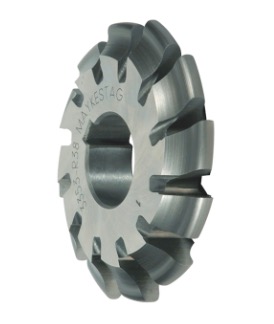
Epicycloidal-profile cutter
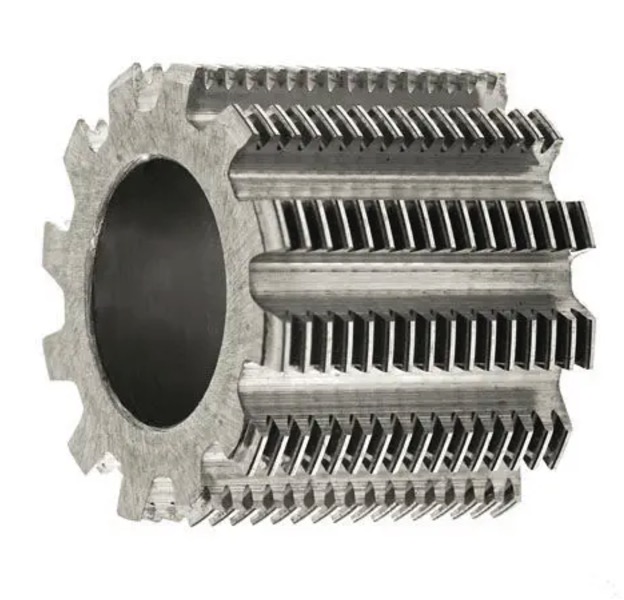
Hob for generation cutting
The cutting of wheels and pinions is the most emblematic operation of watchmaking mechanics. The quality of the gear mesh — and therefore the regular transmission of torque from the mainspring to the regulating organ — depends directly on the precision of the tooth profile. The choice of cutters and processes here is governed by standards specific to watchmaking, in particular the NIHS standards (Normes de l’industrie horlogère suisse, Swiss Watch Industry Standards), which define profiles, modules and tolerances.
The epicycloidal profile
Unlike general industrial mechanics, which favours the involute profile, watchmaking traditionally uses an epicycloidal profile (sometimes described as the “horological profile”). The tooth tip follows an epicycloidal curve while the dedendum is radial. This choice is explained by considerations specific to small modules: better efficiency at low torque, lower sensitivity to centre-distance variations, and the ability to operate with very little lubrication. More recently, derived or hybrid profiles — sometimes with a modified involute for certain applications — coexist with the traditional profile, particularly in high-torque-density pinions or in winding gear trains.
Constant-profile module cutters
The simplest method to cut a gear is index milling. A cutter whose profile exactly reproduces the form of the tooth space passes successively through each space, the workpiece being indexed by a dividing head. These cutters, called module cutters, are defined by their module (ratio of the pitch diameter to the number of teeth), their reference tooth count and their profile. In watchmaking, common modules range from 0.05 to about 0.50 mm. The process remains in use for small batches, prototypes and reworking of existing parts, because it is simple to implement and does not require a specialised machine.
Generation cutting and hobs
For large batches, and when profile accuracy must be maximal, generation cutting is used. The most widespread process is hobbing: a helical cutter, whose edges represent the generating rack of the tooth, meshes continuously with the wheel blank. The relative rolling motion, combined with the feed of the hob, generates the exact form of the teeth flank by flank. This process produces tooth flanks of high quality, geometrically very regular, at high production rates.
Generation cutting also exists in the form of shaping with a pinion cutter (Fellows process) or with a rack cutter, particularly suited to certain geometries such as internal gears or shouldered wheels. These machines, long built by specialised Swiss and foreign manufacturers, remain at the heart of the workshops producing watchmaking wheel-and-pinion assemblies.
Tooth finishing
After cutting, watchmaking gear teeth most often undergo finishing operations. The burnishing of steel pinions, performed by hard rollers that work-harden the surface of the flanks without material removal, considerably improves the surface finish and resistance to wear. For brass or copper-alloy wheels, grinding or lapping with abrasive paste operations may complete the work. These steps no longer strictly belong to milling, but together with the cutting they form an indissociable whole in the manufacture of a precise wheel-and-pinion assembly.
Criteria for choosing a milling cutter
The selection of a cutter, whether for hand or machine use, rests on the joint examination of several parameters. The workpiece material determines the cutting grade required — high-speed steel for brass and soft alloys, coated carbide for hardened steels and superalloys, synthetic ruby for very fine abrasive retouching. The geometry sought commands the tool profile (cylindrical, spherical, conical, form, disc). The diameter, chosen in agreement with the smallest radius of the workpiece, must remain as large as possible to preserve the rigidity of the tool and therefore the surface quality. Finally, the nature of the operation (roughing or finishing) directs the choice towards a cutter with high chip-evacuation capacity or, conversely, towards one with a high material-polishing rate.
The experience of the watchmaker or of the machining programmer intervenes at every stage: choice of cutting speed, of feed per tooth, of depth of pass, of lubrication. A well-suited but poorly used cutter will produce a mediocre result; conversely, a modest but well-mastered cutter may suffice for many routine jobs.
Conclusion
Milling cutters occupy a pivotal position between traditional manual tooling and modern industrial production. Small form cutters, ball-nose cutters or wheel cutters handled by hand on an old piece bear witness to a centuries-old practice; coated carbide cutters launched at very high speed on a five-axis machining centre embody contemporary watchmaking. Between the two, gear-cutting cutters — module cutters or hobs — perpetuate a technical tradition typical of watchmaking: that of epicycloidal profiles, infinitesimal modules and tolerances measured in micrometres.