
MENU
1. Table of main properties of German silver
| Property | Typical value | Notes |
|---|---|---|
| Density | ~8.5–8.8 g/cm³ | High |
| Elastic modulus (E) | ~120–140 GPa | Moderate to high |
| Tensile strength | ~400–700 MPa | |
| Hardness (HV) | ~100–250 HV | Moderate |
| Thermal conductivity | ~25–40 W/m·K | Low |
| Electrical conductivity | ~5–10 MS/m | Low |
| Thermal expansion | ~16–18 ×10⁻⁶ /K | Moderate |
| Melting point | ~1000–1100 °C | |
| Magnetism | No | Non-magnetic |
| Corrosion resistance | Good | Stable |
| Machinability | Good |
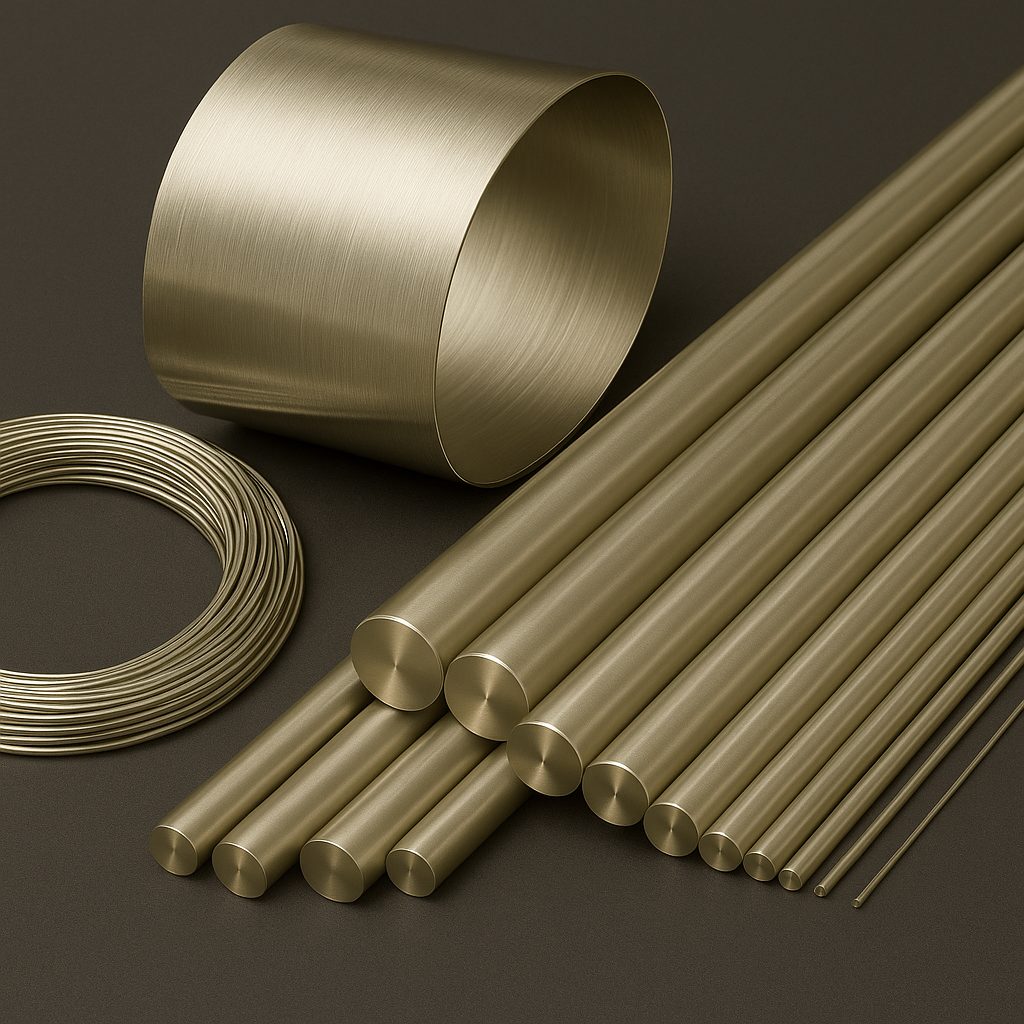
2. General description
Although a page is dedicated to it, German silver is an alloy belonging to the brasses family.
German silver is an alloy of copper, nickel, and zinc, containing no silver despite its common name of “german silver”. In watchmaking, it is particularly valued for its mechanical qualities, dimensional stability and natural aesthetics, notably in movements high-end.
Historically used for various components, German silver is now experiencing renewed interest in high-end watchmaking, particularly for untreated movements, where its natural patina contributes to the aesthetic identity of the piece.
3. Composition and variants
German silver is generally composed of:
- Copper (~60–65%)
- Nickel (~10–20%)
- Zinc (~15–25%)
The proportion of nickel influences:
- The color (lighter with more nickel)
- The Hardness
- Corrosion resistance
4. Surface treatments
Unlike Brass, German silver is often used without surface treatment, in order to preserve:
- Its natural slightly golden/grey appearance
- Its ability to develop a patina over time
However, it can also be:
In high-end watchmaking, the natural finish is often preferred.
5. Watchmaking applications
German silver is mainly used for:
- Mainplates
- Bridges
- High-end structural components
It is notably found in:
6. Advantages and limitations
Advantages
- Good mechanical resistance
- Stability over time
- Non-magnetic
- Excellent base for finishing (Beveling / Angling, Polishing, etc.)
- Unique aesthetic with natural patina
- No treatment required
Limitations
- Machinability slightly lower than Brass
- Higher cost
- Sensitivity to surface oxidation (possible uneven patina)
- Higher Hardness that can complicate certain operations
This page has been automatically translated from the French reference version using an artificial intelligence tool. Errors or inaccuracies may remain. If you notice any, especially if this is your native language, please feel free to report them to info@horopedia.org. Your contribution helps us improve the quality of the encyclopedia.
While awaiting their translation, images and videos remain temporarily displayed in French.
Thank you for your understanding.