
MENU
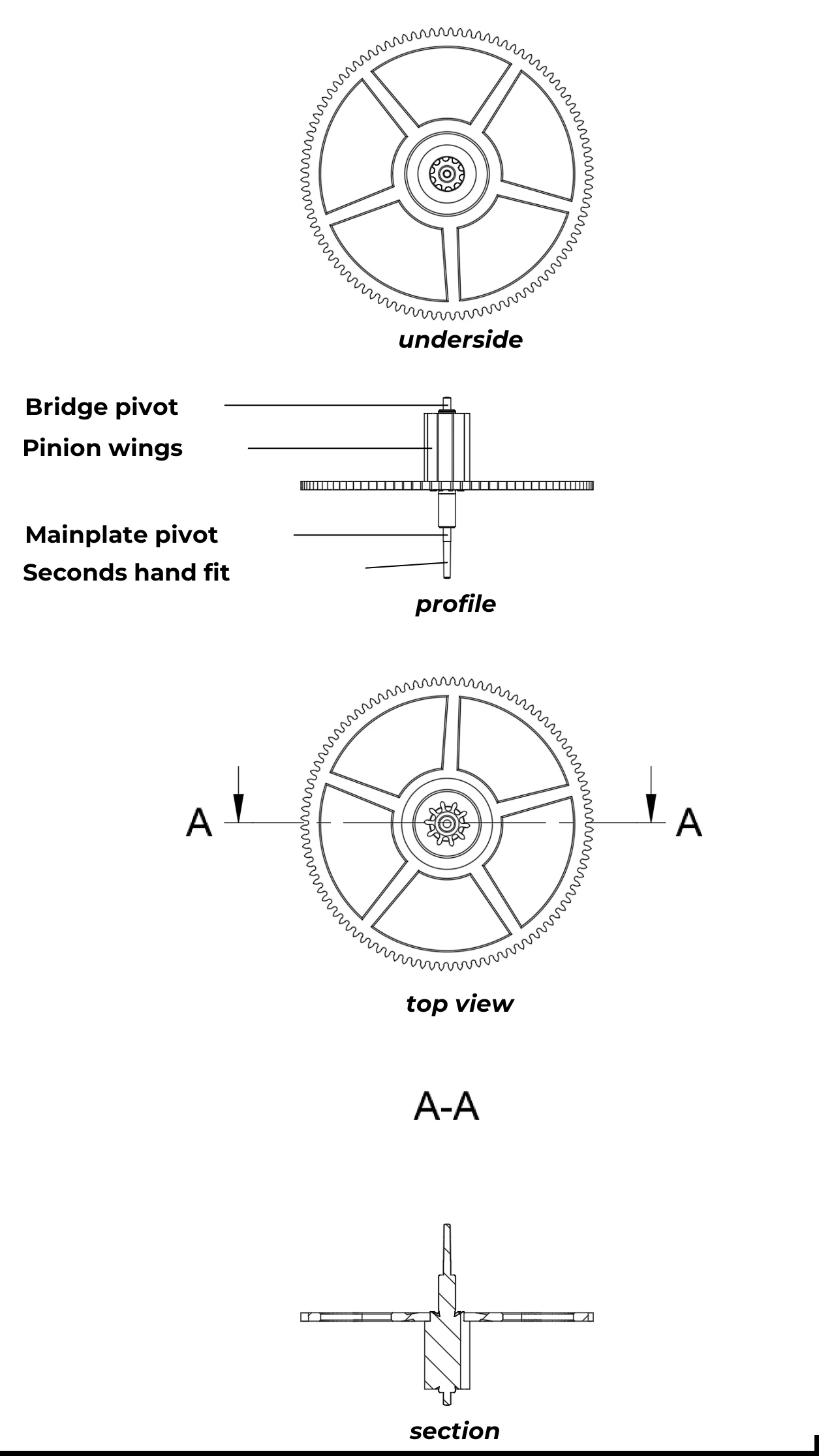
Figure 1
Diagram of a fourth wheel (seconds wheel) (with hand)
Click on the thumbnail to enlarge it
1. General description
The fourth wheel (seconds wheel) is a component belonging to the counting and transmission mechanism, ensuring the division of time into elementary units and allowing, depending on the construction, the display of seconds. Driven by the third wheel, it transmits the received energy to the escapement pinion.
2. Typology of fourth wheels (seconds wheels) (pointing and rotation speed)
Watch without a seconds hand
When the watch does not display seconds, its rotation speed is not imposed. Its role is then to set the pace of the train so that the center wheel makes one revolution per hour, fitting into the overall gear ratio of the finishing train. The dial is limited to displaying hours and minutes.
Fourth wheel (seconds wheel) with seconds hand
When the movement is designed to display seconds, the fourth wheel (seconds wheel) is required to make one revolution per minute. From then on, two display configurations are possible:
- Off-center second (small second)
In this configuration, the seconds hand is offset relative to the movement and the hour and minute display. The dial then features a small counter, usually offset at 6 o’clock, but sometimes placed elsewhere (at 9 o’clock or 3 o’clock). The construction is simple: the pinion of the fourth wheel (seconds wheel), already present in the normal wheel train, is simply extended by a pivot shaft passing through the main plate to carry the seconds hand. No additional transmission is needed. Only the positioning of the fourth wheel (seconds wheel) needs to be chosen to display the seconds at the precise desired location. - Center seconds (central seconds)
Central display of the seconds requires a more complex modification of the wheel train. Since the fourth wheel (seconds wheel) is not located at the center of the movement, additional gears must be added to bring the seconds display back to the center of the movement. The most common solution consists of extending the axis of the seconds pinion with a pivot shaft so that it emerges from its bridge. A wheel blank, called an edge wheel, is simply pressed onto the pivot shank of the seconds pinion. The edge wheel drives an intermediate wheel which in turn drives the center seconds wheel. The center seconds wheel passes completely through the center wheel, inside which it pivots. A simple gear ratio calculation between the edge wheel and the center seconds wheel allows the latter to rotate at the desired speed of 1 rpm. This construction requires careful stacking and an additional set of wheels, which increases assembly difficulty and sensitivity to friction.
3. Components
The fourth wheel (seconds wheel) is made up of two inseparable parts:
- The seconds pinion, it is driven by the third wheel.
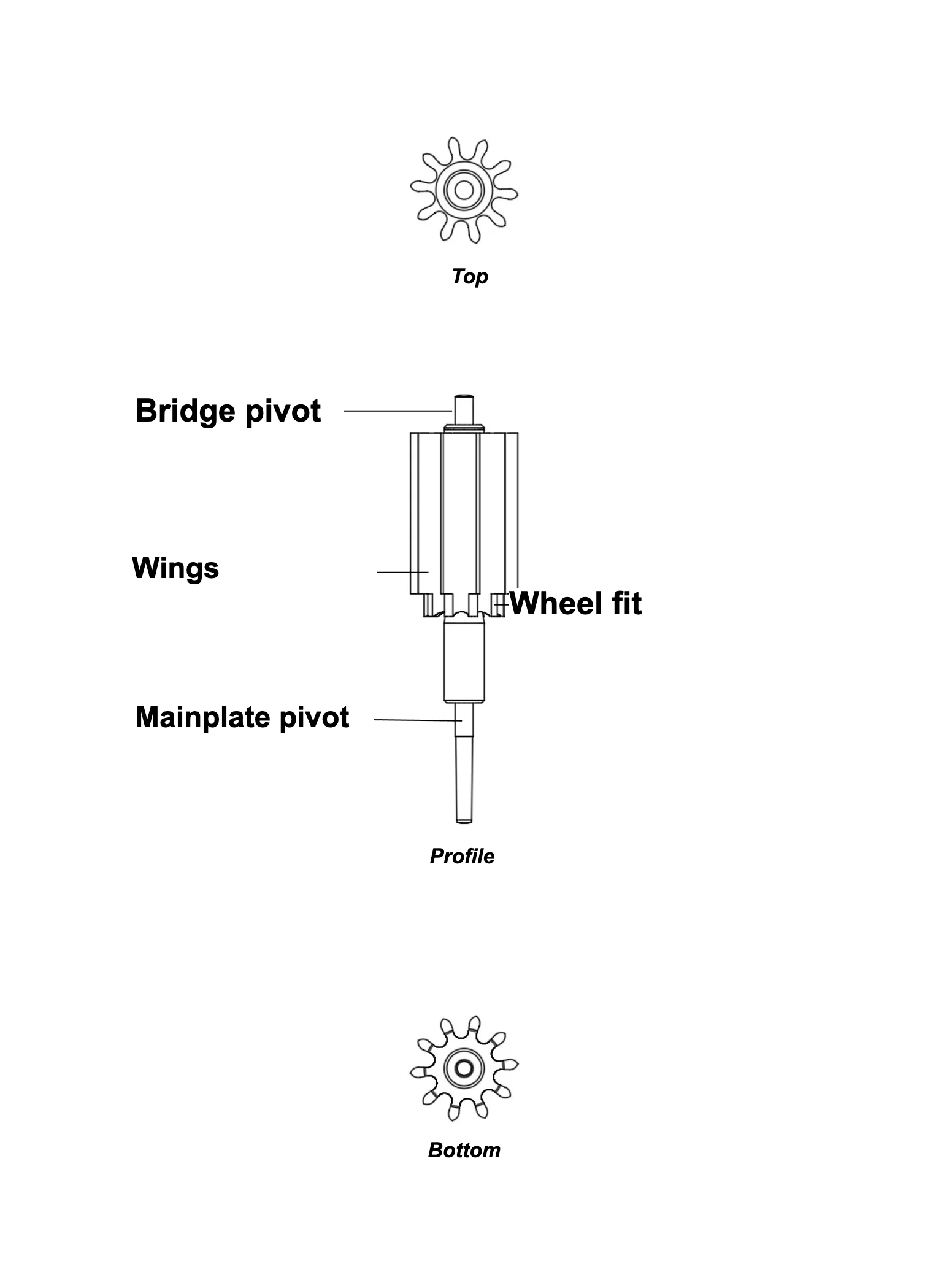
Figure 2
Diagram of a seconds pinion (with hand at 6 o’clock)
Click on the thumbnail to enlarge it
- The fourth wheel (seconds wheel), it drives the escapement pinion
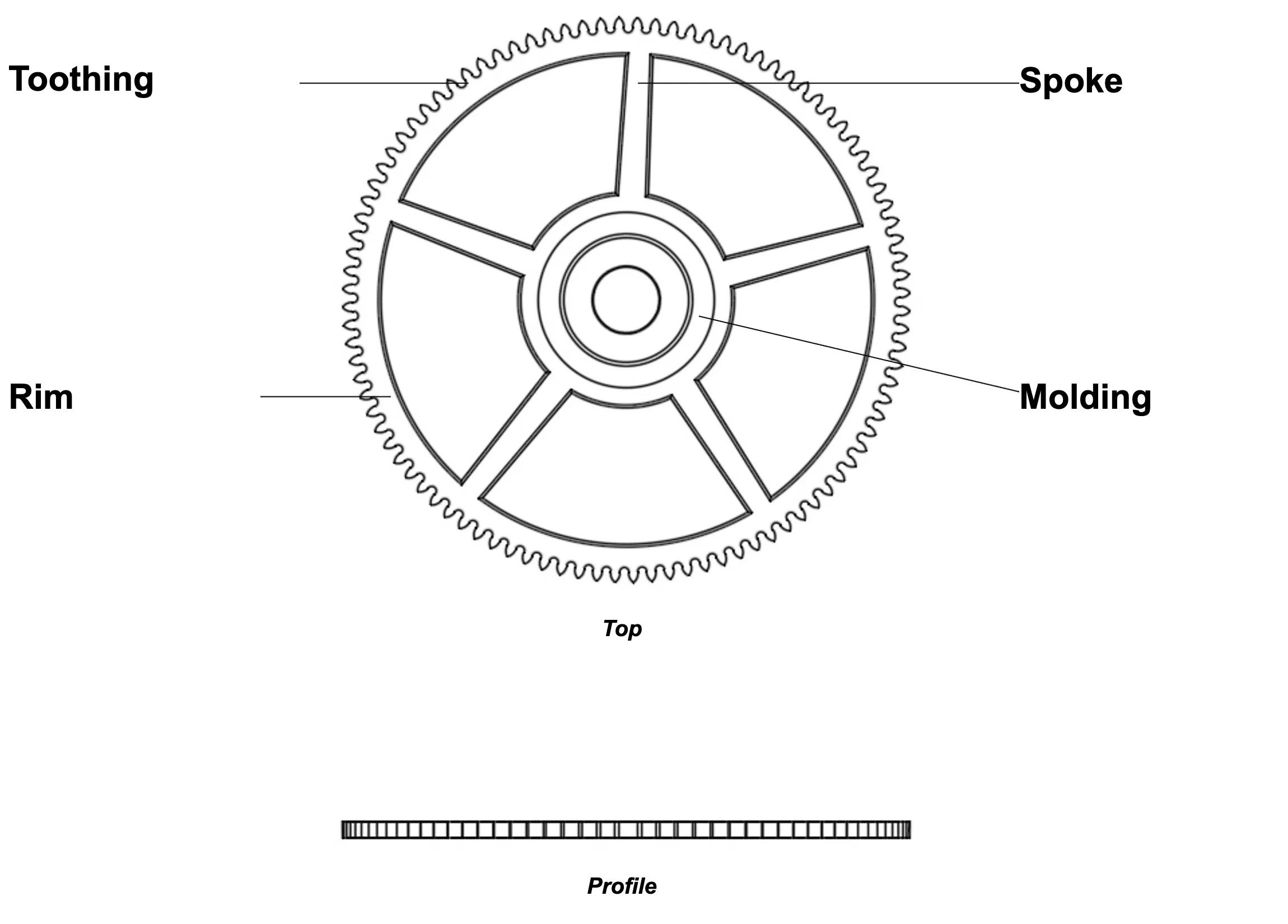
Figure 3
Diagram of a Fourth wheel (seconds wheel)
Click on the thumbnail to enlarge it
4. Materials
Like the other wheels in the train, the fourth wheel (seconds wheel) is generally made of gilded brass, machined or stamped with great precision, then softened and beveled according to the desired degree of finish. The pinion, made of hardened steel and polished, forms the axis of the wheel set. The wheel is firmly riveted to the pinion to form a perfectly integral assembly.
5. Handcrafted manufacture of a wheel (fourth wheel)
In unit or small-series production, the wheel blank is made of brass of horological quality, typically a rolled copper-zinc alloy (CuZn37), chosen for its mechanical characteristics, its machinability and its compatibility with subsequent surface treatments.
Manufacturing begins with the turning of a raw disc from a brass bar or strip. On a watchmaker’s lathe, the turner successively performs the facing of both sides, the turning of the outer diameter (total diameter of the future gear teeth) and the drilling of the central hole. This hole is then carefully reamed: its diameter is kept slightly smaller than that of the pinion’s collet in steel onto which the wheel will be riveted, so as to ensure a tight fit and torque transmission without slippage. Depending on the profile and quality of the wheel, a molding may be turned on one or both sides of the wheel.
In order to open up the spokes of the wheel (generally five in number), clearance holes are drilled in the intervals, then the material is hollowed out with the piercing saw (jeweler’s saw). The spokes are then filed and evened out by hand. This time-consuming operation helps reduce the inertia of the wheel and constitutes an aesthetic criterion.
The wheel blank thus prepared is then mounted on the chuck of a lathe or the spindles of a rounding or cutting machine. If it is a lathe, it is equipped with an indexing plate, allowing precise indexing of each angular position corresponding to the desired number of teeth. A module milling cutter — whose profile is matched to the module and the pressure angle of the gear teeth — cuts the teeth one by one in successive passes. For the finishing train, the modules are generally very small (in the order of 0.07 to 0.15 mm), which requires highly precise milling cutters and rigorous clamping of the part.
Finishing includes deburring of the sharp edges, the circling of the faces, the possible polishing of the moldings, the beveling/angling if applicable, then a surface treatment by galvanic gilding. This deposit of gold, of controlled thickness, improves corrosion resistance and gives the wheel its characteristic golden appearance. The riveting operation on the steel pinion is carried out using a riveting stake.
6. Industrial production of a wheel (fourth wheel/seconds wheel)
In industrial production, the wheel blank manufacturing is organized in continuous flow from a strip of brass rolled (CuZn37 or similar) supplied in coils. The first operation is progressive blanking (stamping) performed on a press with combined tools: in a single stroke, the strip is pre-pierced, openworked according to the wheel design, and cut to its final outline (including openworking of the spokes). This technique makes it possible to obtain several hundred blanks per minute with high reproducibility.
The central hole, intended for riveting onto the pinion made of steel, is obtained during blanking, but it is generally subjected to a follow-up reaming. The dimensional tolerance of the inner diameter is tight in order to ensure a controlled and consistent tight fit across all pinions of the same series. The flatness of the blank is also checked at this stage, with any residual warping eliminated by straightening.
Tooth cutting is performed on CNC cutting machines. For the common modules of the finishing train, the process used is cutting by generation with a hob cutter (hobbing), which produces an involute profile of great geometric regularity. For the finest modules, below 0.07 mm, some manufacturers use electrical discharge machining (EDM) wire cutting or laser cutting, which make it possible to achieve precisions otherwise difficult to obtain through conventional material removal.
Depending on the required quality level, deburring is performed continuously by tumbling in vibrating tubs loaded with suitable abrasive media, which removes cutting burrs without altering the tooth flanks. Traditional finishes (circling, beveling / angling, polishing) are the standard in high-end watchmaking. The surface treatment — usually a galvanic gilding — is applied to loose boards, ensuring a uniform coating thickness across all parts.
Quality control is integrated into the production flow. Vision systems measure the wheel profile, the tooth pitch, and the diameter of the press-fit hole in-line, and detect surface defects. The riveting operation on the steel pinion is then performed on an automatic press with controlled force, the force-displacement curve being recorded for each assembly, ensuring traceability and conformity of the fit.
7. Artisanal manufacturing of a seconds pinion
In unit production or small series, the pinion of the finishing train is made of free-machining watchmaking steel, a high-machinability alloy whose composition is adapted to mechanical stresses and to heat treatments specific to movement pinions. The part comprises, on either side of the toothed body, two pivots and, at the location intended for the wheel plate, a cylindrical seat topped by a riveting shoulder.
Turning is carried out on a precision watchmaker’s lathe. The watchmaker successively turns the various diameters of the pinion and rough-shapes the two pivots, whose geometric quality and surface finish directly determine the wheel train’s operation. The seat intended to receive the wheel plate is machined with a sliding fit relative to the diameter of the plate’s hole, so that the wheel can be freely positioned there before riveting. Beyond the seat, a thin shoulder — the rivet itself, properly speaking — is left protruding; it is this that will be pressed down during assembly to secure the wheel plate. The rough-shaped pivots are turned (fine turning) then their surface is work-hardened by burnishing.
The cutting of the pinion leaves is carried out on a lathe equipped with a dividing plate. A pinion-cutting milling cutter, with a profile suited to the module and the number of leaves (generally six to twelve for the finishing train), cuts each leaf through successive passes. This direct-division cutting process produces a profile close to the epicycloid or the involute, depending on the tooling used. The precise adjustment of the cutting depth is crucial for the future meshing with the brass wheel blank of the previous wheel (here the third wheel).
After cutting, the pinion undergoes heat treatment: oil or air quenching followed by tempering, in order to give the leaves the hardness necessary for wear resistance. The rough pivots are then finished (fine turning) and their surface is then work-hardened by burnishing.
The assembly of the wheel blank onto the seat is carried out using a riveting stake: the shoulder is upset using a shaped riveting tool, under visual inspection, until a regular rivet head flush with the face of the wheel is obtained.
8. Industrial production of a pinion (seconds pinion)
In series production, the pinion of the finishing train is manufactured by automatic profile turning, from a bar of free-machining watchmaking steel. This process allows the turning of the pivots, the arbor and all the diameters of the pinion to be carried out in a single setup, with high cadences and precise dimensional repeatability. The tolerances are defined right from the programming stage, ensuring the interchangeability of the pinions in assembly lines and in after-sales service.
The geometry of the wheel fit is machined with a sliding fit relative to the diameter of the hole in the wheel plate, so that the wheel positions itself without noticeable play, but without force. The riveting is calibrated in diameter and height so that the subsequent riveting operation produces a uniform upset, without risk of deforming the toothing or the wheel plate.
The cutting of the leaves is carried out on CNC cutting machines by generation with the hob cutter (hobbing), which produce an involute profile with a geometric regularity superior to cutting by direct division.
The heat treatment — followed by a controlled tempering — is carried out in a furnace under a protective atmosphere to avoid any decarburization of the functional surfaces. The pivots are then ground on a CNC cylindrical grinder using diamond or synthetic corundum wheels.
Quality control (dimensional and aesthetic) is generally integrated in-line. The riveting operation of the wheel plate is performed on an automatic press, whose force profile is recorded for each part: the force-displacement curve guarantees the compliance of the upsetting and constitutes a traceability element of the assembly.
9. Technical specifics
- The wheel plate is firmly riveted to the pinion. Thus, the wheel forms a perfectly unified assembly.
- The tooth ratio of the fourth wheel (seconds wheel) and of the entire finishing train is calculated in order to ensure a complete rotation of the center wheel in sixty minutes and, in the case of seconds display, of the fourth wheel (seconds wheel) in one minute. These conditions are essential for the direct drive of the cannon pinion and of the minute hand and, through step-down transmission, of the hour hand and the seconds hand. (see calculations counting and transmission mechanism).
This page was automatically translated from the French reference version using an artificial intelligence tool. Errors or inaccuracies may remain. If you notice any, especially if this is your native language, please feel free to report them to us at info@horopedia.org. Your contribution helps us improve the quality of the encyclopedia.
While awaiting their translation, images and videos remain temporarily displayed in French.
Thank you for your understanding.