
MENU
1. Table of main properties of gold (for an 18K alloy)
| Property | Typical value | Remarks |
|---|---|---|
| Density | ~19.3 g/cm³ | Very high |
| Elasticity modulus (E) | ~70–80 GPa | Low |
| Tensile strength | ~100–300 MPa | |
| Hardness (HV) | ~20–150 HV | Very low |
| Thermal conductivity | ~310–320 W/m·K | High |
| Electrical conductivity | ~45–48 MS/m | High |
| Thermal expansion | ~14–15 ×10⁻⁶ /K | Moderate |
| Melting point | ~1064 °C | |
| Magnetism | No | Non-magnetic |
| Corrosion resistance | Excellent | |
| Machinability | Excellent |
2. General description
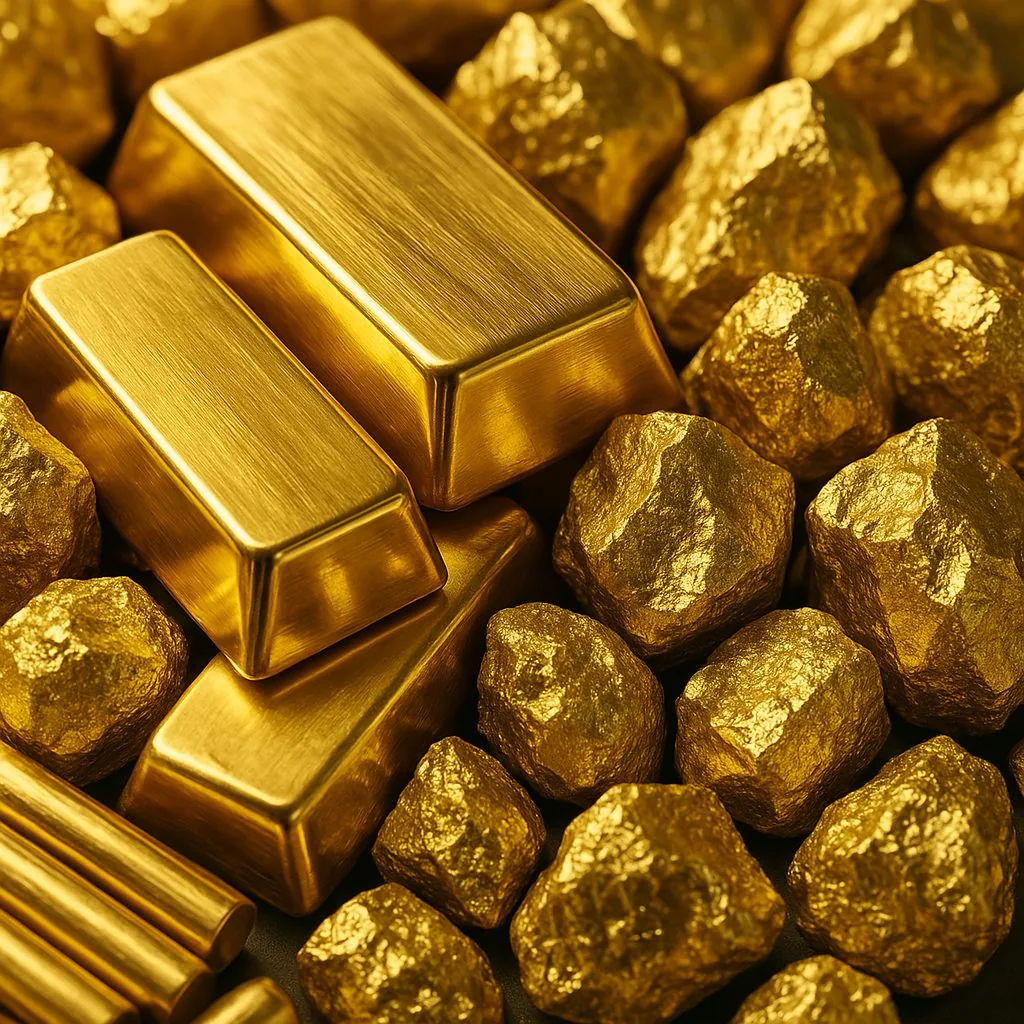
Gold is a precious metal used in watchmaking for several centuries, mainly for its aesthetic qualities, its corrosion resistance and its symbolic value. It is used to make cases, bracelets, External parts (case, dial, hands) (dials, hands, etc.) and, more rarely, certain technical parts, particularly wheel plates, or even bridges and mainplates.
In its pure form, gold is very ductile, but has low mechanical strength, which limits its use. Its alloys not only improve its mechanical properties but also allow its shade to be adjusted, giving rise to a wide variety of standardized colors.
3. Gold alloys in watchmaking
Yellow gold and rose gold (pink gold): standardized shades (2N to 5N)
In watchmaking and jewelry, gold shades are codified according to a standardized European scale, generally ranging from 1N to 5N, based on the proportion of Copper and Silver in the alloy.
👉 The higher the copper content → the redder the shade
👉 The higher the silver content → the paler yellow the shade
The main shades:
- 2N (light yellow gold)
Pale yellow shade, rich in silver
Discreet appearance, slightly greenish - 3N (standard yellow gold)
Balanced hue, the most classic in watchmaking
Good aesthetic compromise - 4N (rose gold (pink gold))
Pinkish hue, enriched with copper
Widely used in contemporary watchmaking - 5N (red gold)
Pronounced red hue
High proportion of copper
This standardization ensures color consistency between components and between manufacturers.
White gold
Obtained by adding white metals:
- Palladium (high-end alloy)
- Nickel (less commonly used today)
Characteristics:
- Grey-white hue
- Often coated with rhodium
- Good mechanical resistance
Depending on the nature and content of the alloyed metal, white gold (especially nickel alloys) sometimes needs to be rhodium-plated to achieve a perfectly white shine.
Other variants
- White gold (grey gold) → palladium-based alloys
- Green gold → gold and Silver
- Black gold → surface treatments or specific alloys
Modern technical alloys
Some manufactures develop proprietary alloys for various purposes:
- Increased scratch resistance
- Color stability over time
- Better mechanical strength
- Marketing argument
4. Notion of fineness and hallmarks
The fineness of gold
Fineness refers to the proportion of pure gold in the alloy.
- 24K (999‰) → pure gold
- 18K (750‰) → 75% gold
- 14K (585‰) → 58.5% gold
👉 In watchmaking, the standard is 18 carats, offering an optimal balance between purity and strength. A 22K alloy is often used for making the oscillating weights of automatic Movements.
The hallmark
The hallmark is an official mark guaranteeing:
- The title of the alloy
- Its legal compliance
- Sometimes its origin
There are:
- Title hallmark → purity of the metal
- Maker’s hallmark → manufacturer
5. Treatments and finishes
Gold can be:
- Polished
- Satin-finished or brushed
- Guilloché or engraved
- Rhodium-plated (white gold)
- Treated (vapor deposition coatings, etc.)
6. Watchmaking applications
Gold is used for:
- Cases
- Bracelets
- Dials
- Hands and Index (hour marker)
- Oscillating weights
- Wheel boards (rarely)
- Bridges and main plates of exclusive watches
This page was automatically translated from the reference French version using an artificial intelligence tool. Errors or inaccuracies may remain. If you notice any, especially if this is your native language, please do not hesitate to report them to info@horopedia.org. Your contribution helps us improve the quality of the encyclopedia.
While awaiting their translation, images and videos remain temporarily displayed in French.
Thank you for your understanding.