
MENU
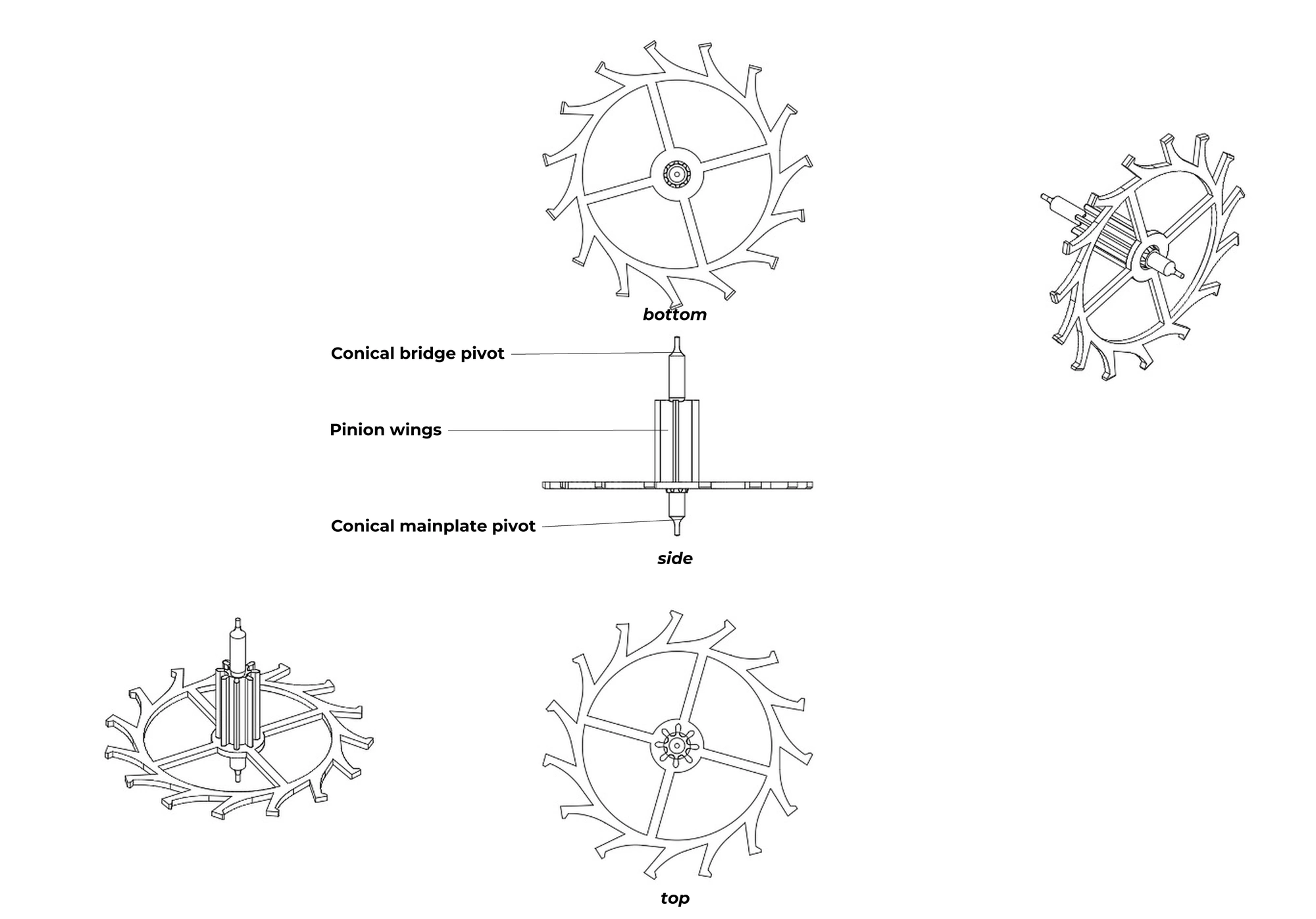
Figure 1
Plan of an escape wheel
Click on the thumbnail to enlarge it
1. General description
The term pallets wheel (or lever wheel) is also used to designate the escape wheel. In the kinematic chain of the movement, the escape wheel is located after the fourth wheel (seconds wheel). Although the escape wheel constitutes a single, integral component, its pinion belongs to the counting and transmission mechanism (finishing train), whereas its wheel is part of the distribution mechanism (escapement).
2. Components
The pinion
The pinion is similar to those of other wheels. It is driven by the seconds wheel and belongs to the counting and transmission mechanism (finishing train).
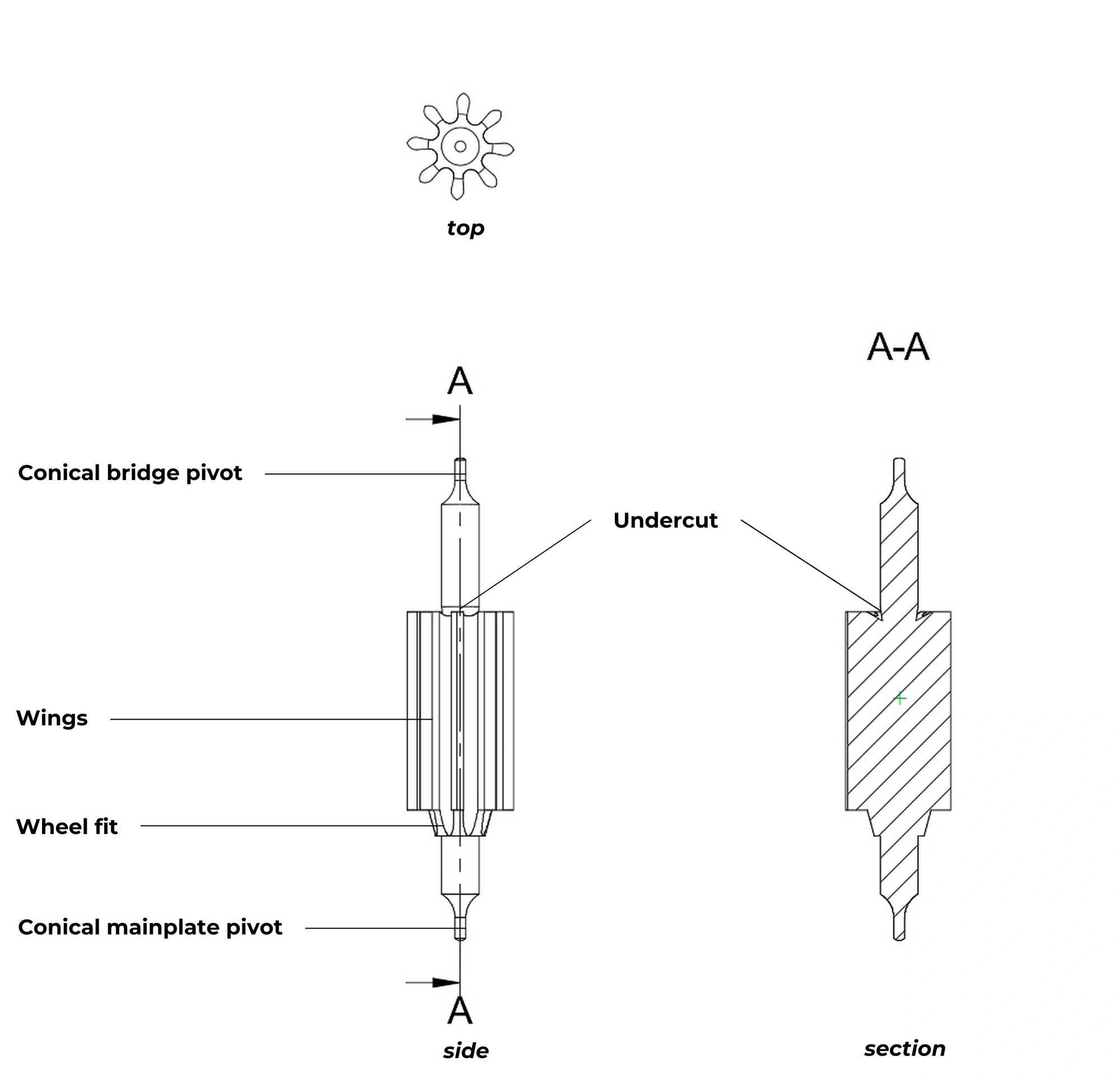
Figure 2
Diagram of an escape pinion
Click on the thumbnail to enlarge it
The wheel
On the other hand, the wheel plate differs in the shape of its teeth and the material used in its manufacture. Generally made of steel, the wheel plate may, depending on the manufacturing method and the type of escapement, be made of nickel-phosphorus (NiP)(UV-LIGA) or silicon (DRIE (Deep Reactive Ion Etching)). Steel will be preferred when the escape wheel transmits its impulse to pallets made of ruby/jewel (e.g. Swiss lever escapement). This combination of materials optimally limits friction in the case of the Swiss lever escapement which is used in more than 99% of modern watches.
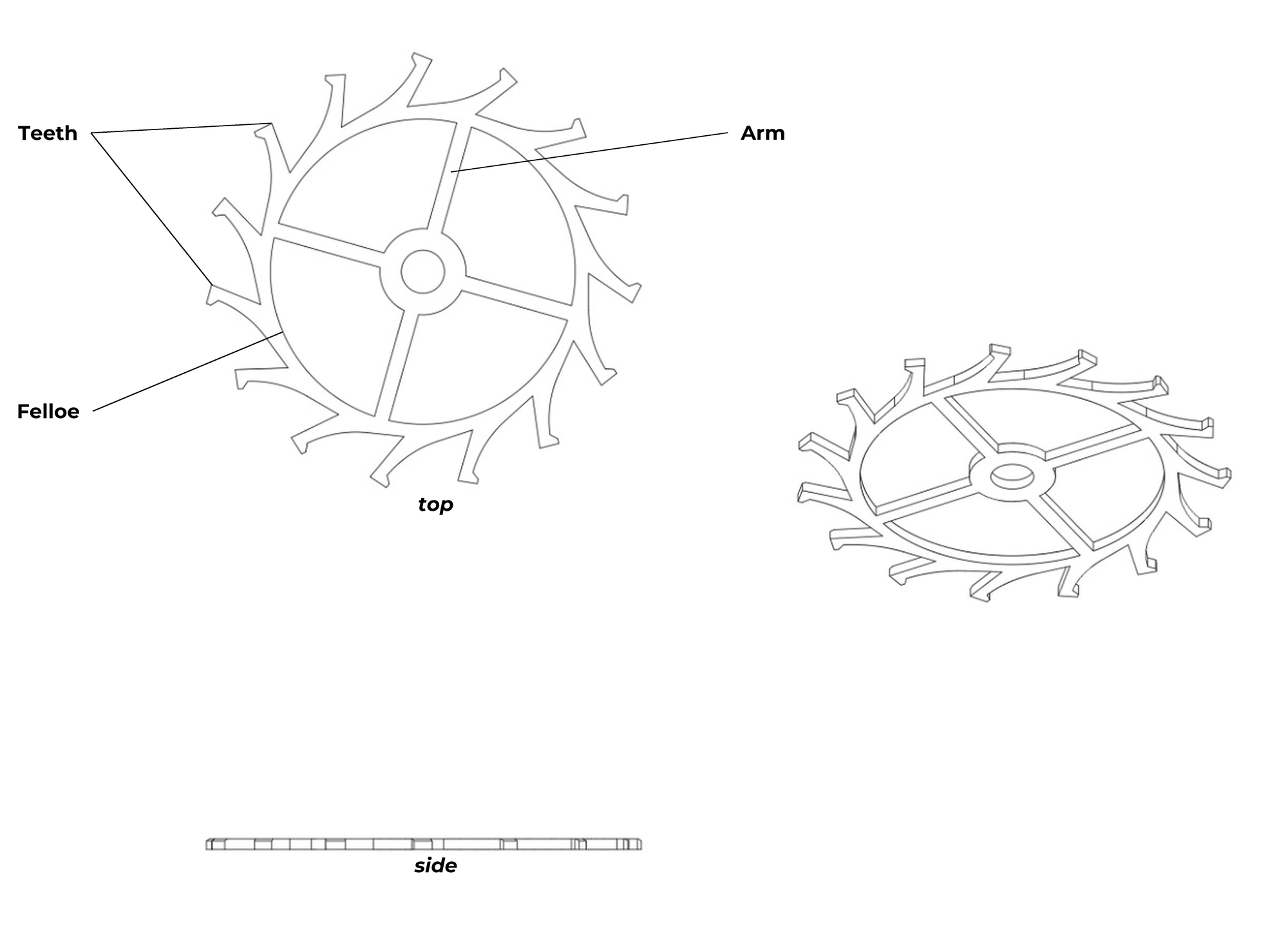
Figure 3
Diagram of an escape wheel
Click on the thumbnail to enlarge it
A 4-arm geometry
Due to their small size and the rigidity of their material, escape wheels generally have only four spokes (compared to five for the wheels of the finishing train). The wheel is thus all the lighter, lightness being a paramount quality for the escape wheel in particular.
A specific toothing
The particular toothing of the wheel is designed for its specific interaction with the pallets (lever). The pallets (lever), the escape wheel and the double roller make up the escapement which fulfills a dual role: that of stopping the movement when the balance freely performs its oscillation, and that of transmitting regular impulses to the regulating organ by transforming the rotational movement of the finishing train into an oscillatory movement of the regulating organ.
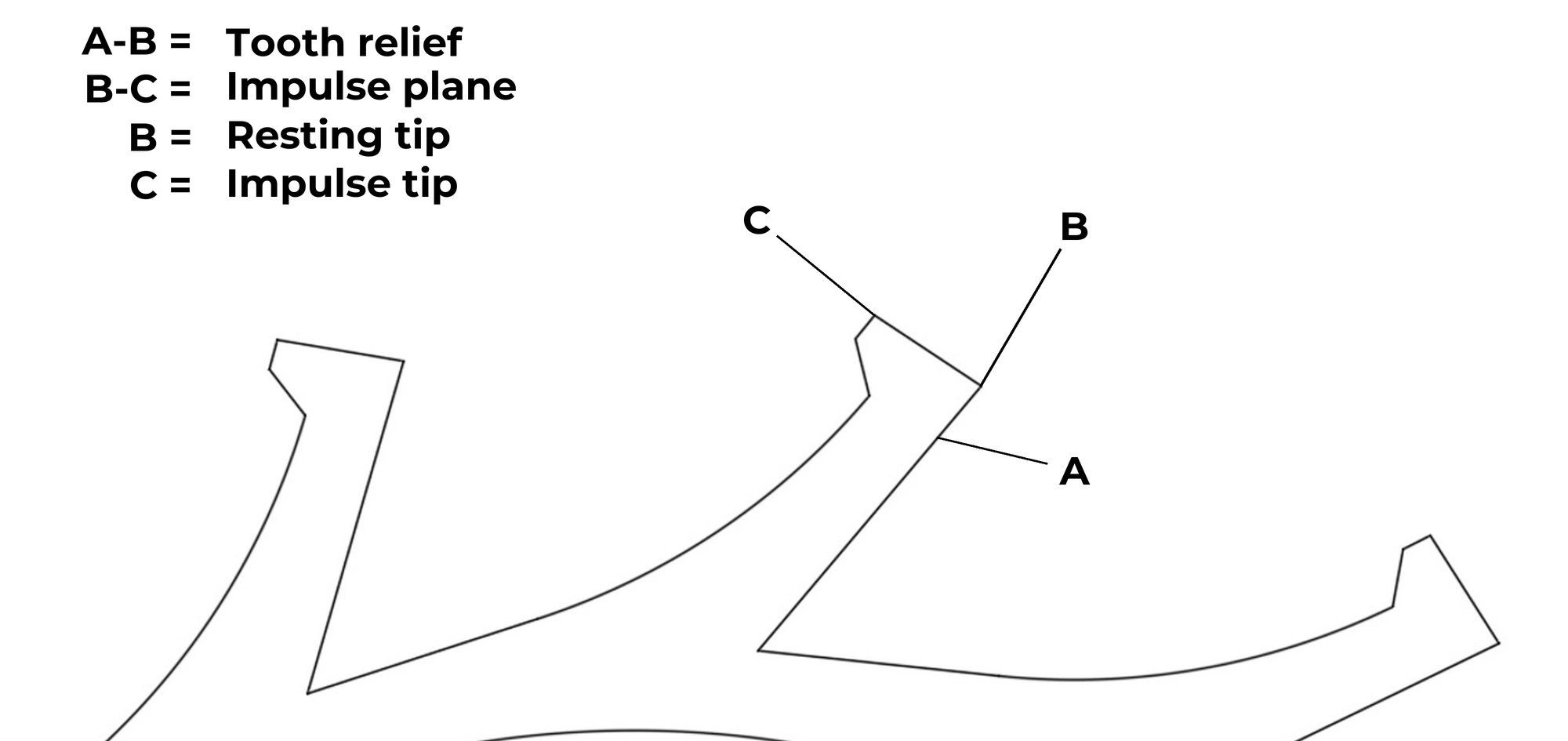
Figure 4
Geometry of the escape wheel
Click on the image to enlarge it
3. History
The first escapements appeared in China in the 8th century already. They would continue to evolve, undergo a multitude of variations, and remain the constant result of research and studies aimed at improving their performance. The pallets (lever) was invented in 1657 by Robert Hooke. It then only regulated clocks and became widespread, thanks to its precision and low energy consumption. One of the greatest challenges faced by horologists in the 18th century was to find types of escapement capable of functioning in a worn watch, while undergoing minimal influences due to the watch’s positions and shocks.
English horologists were the most inventive and prolific in terms of escapement. It is again to one of them, Thomas Mudge, that we owe the invention of the Swiss lever escapement. This escapement was subsequently produced for high-end watches before becoming widespread and definitively establishing itself between the end of the 19th century and the beginning of the 20th century. Industrialization made it possible to improve its precision and reduce manufacturing costs. The progress in escapement calculations and the performance of tools and machines made it possible, at the end of the 1960s, to increase the number of teeth of the escape wheel and thus achieve higher regulation/adjustment frequencies (up to 5 Hz). The latest and one of the most significant developments came at the very beginning of the 21st century with the horological application of silicon produced by a photo-lithographic process (DRIE (Deep Reactive Ion Etching) Engraving). The advantages of this industrial method are numerous: escape wheels no longer require costly milling cutters for cutting the teeth, the material can be made as light as possible, and it is non-magnetic.
4. Materials
Traditionally, the escape pinion is made of steel. Recent developments have explored the manufacturing of escape pinions in ceramics machined by femtosecond laser in order to produce completely non-magnetic escapements.
The escape wheel is also traditionally made of steel. The search for lighter materials, complex in their profiles and above all non-magnetic, saw the appearance, from the early 2000s, of wheels made of nickel phosphorus (using UV-LIGA technology) or in silicon (using DRIE (Deep Reactive Ion Etching) technology). These technologies are becoming increasingly widespread and tend to progressively replace the use of steel.
5. Traditional craftsmanship of an escape wheel
Depending on the type of escapement, different materials may be used for manufacturing the escape wheel blank, and the manufacturing operations may differ depending on the case. In the case of a Swiss lever escapement, the escape wheel will generally be made of steel. The craftsman will proceed using the same method as for a traditional wheel blank. Cutting the toothing, however, requires the use of different milling cutters, generally four in number. It can be carried out using a gear-cutting machine or a lathe fitted with a dividing plate. The cost of the milling cutters and the numerous operations required for its manufacture make the escape wheel a particularly expensive component to produce. Traditionally, the faces of the escape wheel are polished. This finish helps prevent the oil reducing friction between the escape wheel’s teeth and the pallets from spreading over the flat surfaces of the wheel. A surface treatment of the wheel called epilame coating also helps contain the oil in the teeth without it escaping onto the surfaces of the plate.
6. Industrial production of an escape wheel
Industrially, the escape wheel is turned and machined using an automatic lathe, which can also mill the arms of the plate. The cutting of the teeth is done on a gear-cutting machine and requires, in this case as well, the use of several cutters and as many cutting operations.
7. High-tech production methods for an escape wheel
Microfabrication technologies have profoundly transformed the production of certain watchmaking components, particularly the components of the escapement. Among these processes, manufacturing by UV-LIGA and that by Silicon engraving (DRIE (Deep Reactive Ion Etching)) make it possible to obtain escape wheels of extremely high geometric precision, difficult to achieve with traditional machining methods.
These processes are based on techniques derived from microelectronics and enable the production of parts with complex profiles, controlled surface finishes, and near-perfect industrial repeatability in materials known to be non-magnetic.
Unlike conventional methods (hobbing, milling, stamping), UV-LIGA and silicon processes:
- Eliminate mechanical stresses during manufacturing
- Concern non-magnetic materials
- Eliminate tool-related defects (milling cutter radius, burrs)
- Allow for superior precision and repeatability
They thus fall within an evolution towards high-precision horology, combining traditional know-how and advanced technologies.
The manufacturing of escape wheels by UV-LIGA and in silicon by the DRIE (Deep Reactive Ion Etching) method illustrates the integration of microfabrication technologies in contemporary horology. These processes make it possible to improve the precision, regularity and performance of escapements, while opening the way to new architectures.
They now constitute a complement to traditional methods, particularly in the field of high technical horology and industrial production of high-added-value components.
8. Traditional craftsmanship of an escape pinion
In single-unit or small-batch manufacturing, the pinion of the finishing train is made of free-machining watchmaking steel, a high-machinability alloy whose composition is adapted to mechanical constraints and to heat treatments specific to movement pinions. The part comprises, on either side of the toothed body, two pivots and, at the location intended for the wheel plate, a cylindrical seat topped with a riveting shoulder.
Turning is performed on a precision watchmaker’s lathe. The watchmaker successively turns the different diameters of the pinion and rough-machines its two pivots, whose geometric quality and surface finish directly condition the functioning of the wheel train. The seat intended to receive the wheel plate is machined with a sliding fit relative to the diameter of the plate’s hole, so that the wheel can be freely positioned there before riveting. Beyond the seat, a thin shoulder — the rivet head proper — is left protruding; it is this that will be swaged during assembly to secure the wheel plate in place. The rough-machined pivots are finish-turned (fine turning) then their surface is work-hardened by rolling.
The cutting of the pinion leaves is carried out on a lathe equipped with a dividing plate. A pinion-cutting milling cutter, with a profile suited to the module and the number of leaves (generally six to twelve for the finishing train), cuts each leaf through successive passes. This direct-indexing cutting process gives a profile close to the epicycloid or the involute depending on the tooling used. Precise adjustment of the cutting depth is decisive for the future meshing with the brass wheel plate of the previous wheel.
After cutting, the pinion is subjected to a heat treatment: oil or air hardening followed by tempering, in order to give the leaves the hardness necessary for wear resistance. The rough pivots are then turned (fine turning) and their surface is then work-hardened by rolling.
The assembly of the wheel plate onto the seat is carried out using a riveting stake: the shoulder is upset using a shaped riveting hammer, under visual control, until a regular rivet head flush with the wheel face is obtained.
9. Industrial production of an escape pinion
In series production, the pinion of the finishing train is manufactured by automatic profile turning, from a bar of watchmaking steel intended for profile turning. This process makes it possible to combine, in a single setup, the turning of the pivots, the arbor, and all the diameters of the pinion, with high production rates and precise dimensional repeatability. Tolerances are defined right from the programming stage, ensuring the interchangeability of pinions on assembly lines and in after-sales service.
The geometry of the wheel fit is machined with a sliding fit relative to the diameter of the hole in the wheel plate, so that the wheel is positioned without noticeable play, but without force. The riveting is calibrated in diameter and height so that the subsequent riveting operation produces a homogeneous upsetting, without risk of deformation of the toothing or the wheel plate.
The cutting of the leaves is carried out on CNC hobbing machines by hob cutter (hobbing), which produce an involute profile with a geometric regularity superior to direct-division cutting.
The heat treatment — followed by a controlled tempering — is performed in a furnace under a protective atmosphere to prevent any decarburization of the functional surfaces. The pivots are then ground on a CNC cylindrical grinding machine using diamond or synthetic corundum grinding wheels.
Quality control (dimensional and aesthetic) is generally integrated in-line. The riveting operation of the wheel plate is carried out on an automatic press, whose force profile is recorded for each part: the force-displacement curve guarantees the conformity of the upsetting and constitutes a traceability element of the assembly.
10. Technical specifics
- The wheel plate is firmly riveted to the pinion. Thus, the wheel forms a perfectly unified assembly.
- The tooth ratio of the escape wheel and of the entire finishing train is calculated to ensure a complete rotation of the center wheel in sixty minutes, an essential condition for the direct drive of the cannon pinion and the minute hand and, by reduction, the hour hand. (cf. calculations counting and transmission mechanism).
This page has been automatically translated from the French reference version using an artificial intelligence tool. Errors or inaccuracies may remain. If you notice any, especially if French is your native language, please feel free to report them to info@horopedia.org. Your contribution helps us improve the quality of the encyclopedia.
While awaiting their translation, images and videos remain temporarily displayed in French.
Thank you for your understanding.