
THE BARREL
Handcrafted manufacture of a barrel drum
The barrel is a set of several components, generally four in number: The barrel drum, the barrel drum cover, the barrel arbor, and the mainspring.
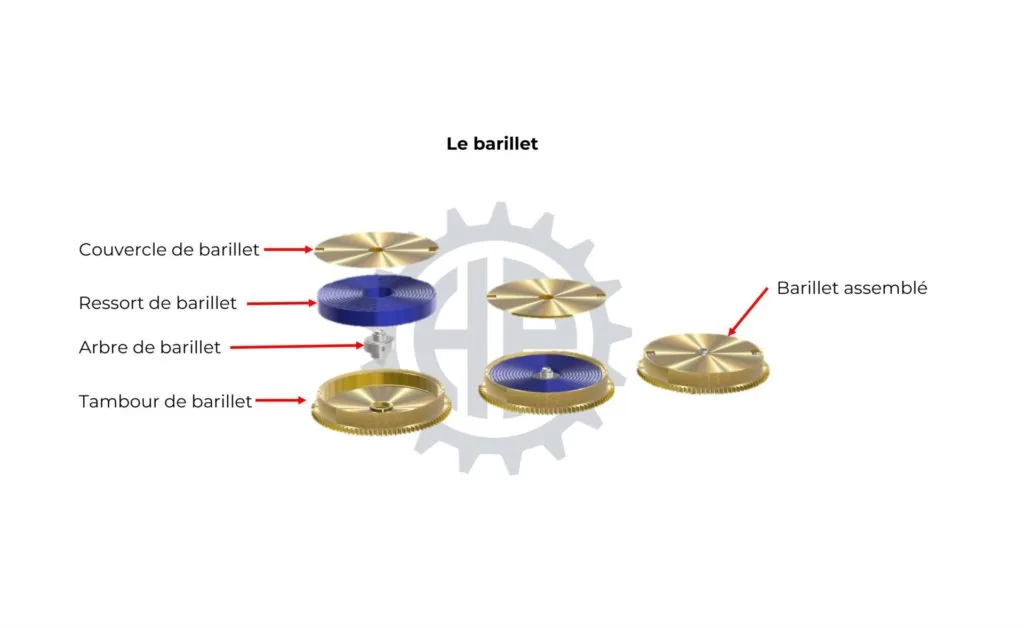
The role of the barrel is to store the energy accumulated during the winding (manual or automatic) of the watch and to gradually release it to the movement.
To assemble the barrel, the let-down spring is placed inside the drum. The mainspring is a blade made of steel coiled in a spiral capable of developing considerable force relative to its size. The Barrel arbor is then placed at the centre of the drum. The inner coil of the Mainspring is attached to the Arbor by a hook (on the Arbor) and notch (Mainspring) system. The assembly is then closed with the cover, which fits onto the Barrel drum. The role of the Barrel arbor is twofold. During winding, it allows the spring to be coiled around its circumference (and thus at the centre of the drum) in order to wind the spring and give the watch its full Autonomy. When winding the watch, the Winding mechanism drives the Ratchet wheel which is fitted onto a square machined at one end of the Arbor. The Barrel arbor also serves as the Axis and pivot for the Barrel, allowing it to rotate freely. The Mainspring is thus held to the Barrel arbor by a hook system, and its other end is fixed (by a notch and clamp system) to the inner wall of the Barrel drum, thereby allowing the spring to be placed under tension.
The force exerted by the spring on the drum wall once wound tends to rotate the entire barrel around its axis when the spring seeks to let down by unwinding. A toothing is milled on the largest diameter of the drum. This toothing drives the centre pinion and, consequently, the entire kinematic chain of the movement.
Once fully wound (tensioned), the spring reaches its maximum tension. If one then forces the winding mechanism, this inevitably causes the mainspring to break. Thus, as early as the 17th century, winding banking mechanisms (finger, Maltese cross, etc.) can be found. This is a system that blocks the winding mechanism just before the mainspring reaches its maximum tension.
Unfortunately, such a system cannot be applied to watches equipped with an automatic winding system. The mechanism of the automatic system is unable to detect the overtension of the mainspring or to stop feeding it once the spring reaches its maximum tension. To prevent the mainspring from breaking in such a situation, the mainsprings of automatic watches are equipped with a sliding clamp. This clamp, located at the outer end of the mainspring, hooks into a notch on the inner wall of the barrel drum. When the spring slightly exceeds its maximum tension, the clamp, due to its construction and the shape of the drum’s notch, comes out of its notch and slides along the inner wall of the drum before hooking into the next notch (several notches are made on the inner wall of the drum). Once the watch is fully wound, the wearer’s movements of an automatic watch keep the spring at maximum tension. The barrel thus delivers maximum and constant energy, ensuring better regulation quality.
In order to mitigate the risk of the Mainspring breaking, many hand-wound watches are now equipped with an “Automatic” type spring, allowing endless winding without any danger. This system requires a Sliding clamp. This ensures the spring is attached to the inner wall of the Barrel drum. As soon as the spring is under tension, the clamp “slides” to the next notch on the Barrel wall, thus protecting the spring from any breakage.
While manufacturing the Barrel drum, its cover, and the Barrel arbor does not present any major difficulty, the production of mainsprings requires very specific equipment and expertise. Their production is systematically outsourced, and only a few manufacturers share this market.
The quality of a Barrel therefore essentially depends on its spring. This must have optimal efficiency (as little energy loss as possible for an increased Power reserve) and develop a force as constant as possible throughout its unwinding (accuracy of the rate). Precise calculations incorporating the nature of its Alloy, its dimensions, and its Heat treatments allow for obtaining a Barrel that is efficient and suited to the intended use.
In order to increase the Power reserve and/or achieve a more constant force throughout the entire Power reserve, the number of Barrels can be multiplied. Similar to an electrical circuit, connecting Barrels in series will increase the Power reserve, while operating them in parallel will distribute more constant energy throughout the running duration.
Thanks to the robustness and generous dimensions of its Arbor, the Barrel is well suited to a suspended construction. Suspended construction refers to holding the Barrel by only one end of its Axis to the Main plate. The use of a Barrel Bridge is therefore no longer necessary, which often helps minimize the thickness of the Movement and improve its aesthetics. The recent development of ceramic micro ball bearings makes it possible to achieve fully satisfactory efficiency with this type of construction.
The barrel has existed since the earliest watches and has always been the essential source of energy for mechanical watches. Before the invention of the Winding mechanism, winding was carried out with a key positioned directly on the barrel arbor, which allowed it to be driven by a square. In the 18th and 19th centuries, suspended barrels are frequently found, lacking their usual Bridge.
With generous dimensions, the barrel drum then becomes a privileged medium of expression for decorators (engravers, enamellers, gem-setters, etc.). Over time, barrels and especially mainsprings have continued to improve. Their alloy will gain in performance (elasticity, consistency of development, banking of friction, etc.), their calculation (proper sizing for established criteria) will improve, as will their production methods and tools.
Mainsprings have always been produced by craftsmen and then by specialized companies. Today they are only produced using industrial processes. Today’s craftsman will therefore obtain the mainspring from a specialized manufacturer. However, he can easily machine the other three components of the barrel (the arbor in Steel, the drum and its cover generally in Brass) on a simple Lathe with which it will also be possible to cut the teeth of the drum as well as the Decoration of the three components.
Whatever the manufacturing method of the Movements and watches for which they are intended, mainsprings have always been produced by craftsmen and then by specialized companies. Today they are only produced according to industrial processes. The mainspring is manufactured from strips of material (Steel alloy). These steel strips first undergo numerous rolling operations and Heat treatments (annealed). These operations will allow the Mainspring to reach its final dimensions (Length, height, thickness) and to give it its mechanical properties (Elasticity, flexibility, Hardness). The notch for the Barrel arbor is cut by Stamping and the clamp riveted at the other end of the Blade. The next step consists of giving the Mainspring its final shape. It will then be wound around an Axis (estrapade process) and will undergo new Heat treatments in order to fix this shape.
The other components of the Barrel will easily be made using an Automatic lathe on which the toothing of the Barrel drum can also be cut. For better efficiency, however, it is preferable to carry out the cutting on a dedicated machine (gear-cutting machine) which will perform a much more precise cutting by Hobbing. Once the components are finished and decorated, the Barrel can be assembled. An operation carried out on an industrial scale (T-0).
This page has been automatically translated from the French reference version using an artificial intelligence tool. Errors or inaccuracies may remain. If you notice any, especially if this is your native language, please feel free to report them to info@horopedia.org. Your contribution helps us improve the quality of the encyclopedia.
While awaiting translation, images and videos remain temporarily displayed in French.
Thank you for your understanding.