
DRILLS
What is a drill used for?
The drill is a rotary cutting tool used to produce a cylindrical hole through material removal. In watchmaking, where dimensions are frequently below one millimetre and where precision is measured in hundredths — or even microns — the tool must deliver perfectly cylindrical and straight holes, free of burrs, and above all reproducible from one component to the next. The choice of drill — through its geometry, its material and its coating — directly governs the quality of the hole obtained, the surface finishing, the dimensional accuracy, and the service life of the tool. It is therefore a modest-looking tool, yet a decisive one in the manufacturing chain of both movement components and watch case parts.
The main drill profiles
Several geometries are distinguished, each suited to a specific type of machining operation.
The twist drill is by far the most universally used form. It consists of a shank (the section gripped by the chuck), a cylindrical body running two helical flutes used to evacuate the chips, and a point formed by the two main cutting edges joined by a transverse edge — the chisel edge, which is part of the drill web. The point angle is typically 118° for general-purpose work; it is opened up to 130° or 140° for hard steels and stainless steels, and reduced to 90°–100° for soft alloys and plastics. The helix angle, in turn, governs chip evacuation: a low helix (modified Type N, 10°–19°) suits brass and bronze, a normal helix (25°–30°) suits steel, and a high helix (35°–45°) suits aluminium and polymers.
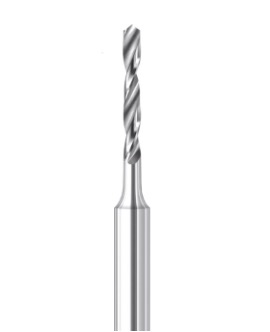
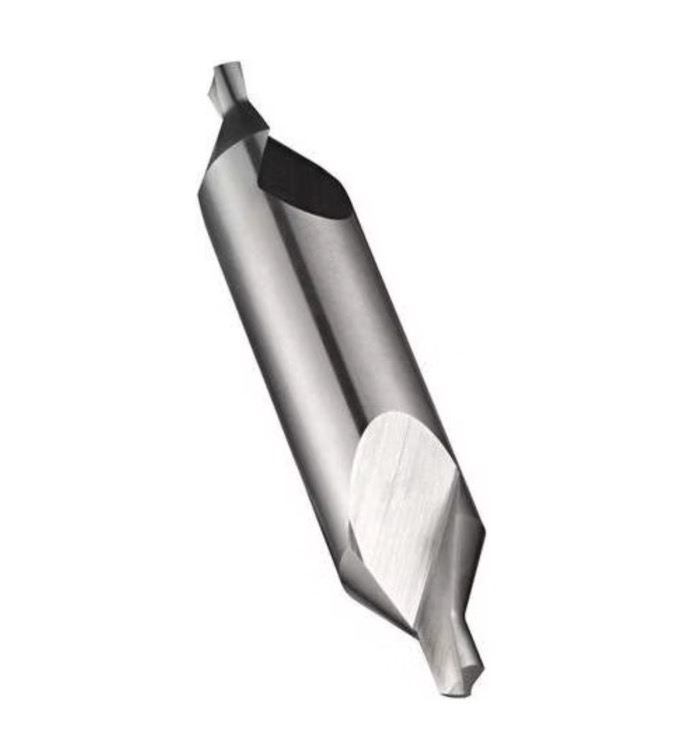
The spot drill (or centre drill) is used to initiate the drilling operation by creating a precise cone that subsequently guides the twist drill. Its short, rigid geometry prevents buckling (the drill wandering off centre). The standard centre drill combines, on a single shank, a cylindrical pilot tip and a cone, usually at 60°.
The spade drill — sometimes called a flat-point drill, or langue d’aspic (“asp’s tongue”) in traditional watchmaking vocabulary — remains a classic of hand operations. Forged and then sharpened by hand by the watchmaker, it features a symmetrical spear-shaped point that penetrates the material without lateral drift. It was historically driven by a bow, and later by a hand drill stock; it still has its place today for delicate retouching work and for reworking small holes where very fine control of the cutting attack is required.
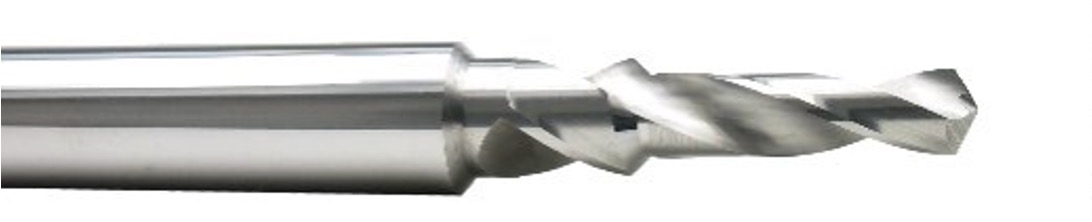
The step drill makes it possible to produce, in a single pass, a hole with several successive diameters — for example, to accommodate together a screw head and the through-hole for its thread.
Materials and coatings
The tool material is chosen according to the workpiece material to be drilled, the target cutting speed and the expected tool life.
Carbon steel, historically used in watchmaking for the very small drills sharpened by hand, retains an excellent cutting capability provided that the work is carried out at low speed. Its tempering temperature, close to 200 °C, however limits its use in modern high-speed machining.
High-speed steel, designated HSS (High Speed Steel) or HS in the European standards, is the current standard for the majority of small-diameter drills. It accepts considerably higher cutting speeds thanks to its hot hardness (up to about 550 °C) and offers a good compromise between hardness, toughness and cost.
Cobalt high-speed steel (HSS-Co, typically containing 5 to 8 % cobalt) displays an increased hot hardness; it is preferred for heat-treated steels, stainless steels and the tough alloys frequently encountered in the external parts of watches (cases, case backs, bezels).
Solid carbide, based on tungsten carbide sintered with a cobalt binder, is today widely used on high-speed machining centres. Its very high hardness and its thermal stability allow cutting speeds four to ten times higher than those of HSS. Its brittleness, however, demands a high level of spindle rigidity, careful guidance and the absence of impacts — which rules out manual use.
Polycrystalline diamond (PCD) and cubic boron nitride (CBN) remain reserved for very specific applications: drilling ceramics, sapphire or composite materials used in certain external watch components.
Modern coatings significantly extend tool life and often allow dry or lightly lubricated drilling. Titanium nitride (TiN, gold-coloured), titanium-aluminium nitride (TiAlN, grey to anthracite), chromium nitride (CrN) and diamond-like carbon (DLC) are the most common. Each has its own surface hardness and hot hardness, to be chosen according to the tool–material–speed combination retained.
Means of implementation
Depending on the precision of the operation and the targeted output rate, the drill may be driven by various pieces of equipment, from the most manual to the most automated.
The hand chuck (a drill holder held and driven by hand) remains the reference tool for retouching work and occasional drilling at the bench. The watchmaker mounts on it a spade drill or a very small-diameter twist drill and turns the chuck between the fingers, or with the help of a bow. The tactile sensitivity allows very fine control of the feed and limits the breakage of fragile drills.
The sensitive bench drilling machine provides motorised rotation, while the feed remains manual and very progressive. Its short stroke and rigidity suit holes from a few tenths to a few millimetres, common in watchmaking.
The pillar drill offers higher power and angular accuracy, with an adjustable table and a downfeed controlled by lever or handwheel. It is used for larger diameters or repeated drilling on a series of blanks, and readily accepts standard HSS drills.
The watchmaker’s lathe, the pivoting lathe or the engineer’s lathe make it possible, by means of a tailstock, to drill along the axis of a workpiece set in rotation — the ideal situation for obtaining a hole perfectly coaxial with a cylinder, for example on an arbor, a barrel or a screw.
Numerically controlled machines — CNC lathes, machining centres and programmable drilling machines — provide the production rates and repeatability required in industrial manufacturing. They allow the use of carbide drills at very high speed with internal or external high-pressure coolant, and the combination of drilling with other operations (milling, tapping, boring) in a single workpiece setup, ensuring a remarkable dimensional consistency.
Parameters and best practices
Beyond the choice of tool, the success of a watchmaking drilling operation rests on three essential parameters: the cutting speed (expressed in metres per minute, dependent on the tool–material pairing), the feed per revolution (often less than 0.02 mm for the very small diameters) and lubrication. A fluid neat cutting oil or a suitable emulsion prevents seizing, evacuates heat and improves the surface finish of the hole. Mounting concentricity, spindle rigidity and the quality of the sharpening also remain essential conditions: an off-axis or poorly sharpened drill will produce an oval, conical or off-centre hole — defects unacceptable on a watch component.
Ultimately, the drill is never a mere interchangeable consumable: its geometry, its material and its method of use form a coherent system on which the quality of every drilling operation depends. Mastery of these parameters is what distinguishes professional watchmaking practice, whether artisanal or industrial.