
HAND CHUCKS
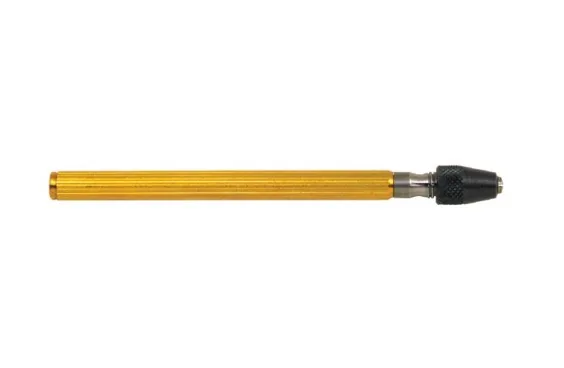
What are hand chucks used for?
In horology, hand chucks refer to a family of portable holding tools intended to immobilize a small cylindrical component in order to present it to the working tool. Unlike a Lathe or Drill chuck, which is attached to a machine and subjected to motorized drive, the hand chuck is held directly by the operator; it ensures a precise and reproducible grip for operations carried out manually at the Bench.
In its most common form, the hand chuck consists of a cylindrical body made of Steel or Brass, extended on one side by a knurled handle that facilitates gripping and rotation, and, at its opposite end, by a clamping system. This clamping is generally provided by a split collet, compressed around the component by screwing a threaded ring. To accommodate the multiple diameters encountered in the Movement — from the finest wire to rods, including screw shanks — a single chuck can accept a set of interchangeable collets, each calibrated to a given diameter.
The Horologist (watchmaker) uses hand chucks in a wide variety of operations. Filing, Polishing, Burnishing and smoothing of cylindrical components benefit from firm and strictly axial support: the component, held in the collet, is driven in rotation by the simple movement of the operator’s fingers, while the other hand guides the Burnisher, the Buff or Abrasive paper. This combination of steady manual rotation and controlled tool contact is particularly suited to finishing pivots, rods and Screws, where cylindricity and surface condition directly determine the quality of running. The Hand chuck is also used for marking, visual Testing, or simply holding a component during examination under a loupe.
Several variants complete the Horologist (watchmaker)’s Bench: short chucks, known as “pocket” chucks, for quick operations, or multi-collet chucks allowing several components to be mounted in parallel. In these respects, Hand chucks are among the most versatile holding tools on the horological Bench: modest in appearance, they are in fact involved in the vast majority of finishing and fitting operations on rotating components.
This page has been automatically translated from the reference French version using an artificial intelligence tool. Errors or inaccuracies may remain. If you notice any, especially if this is your native language, please feel free to report them to info@horopedia.org. Your contribution helps us improve the quality of the encyclopedia.
Pending their translation, images and videos remain temporarily displayed in French.
Thank you for your understanding.