
THE SAPPHIRE FILE
When is a sapphire file used?
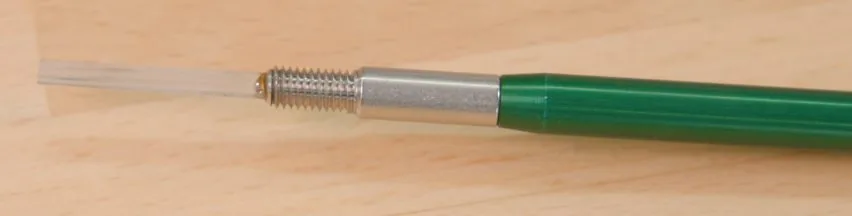
The sapphire file is a finishing tool made from a single crystal of synthetic sapphire — corundum, Al2O3 — cut in the shape of a bar, blade, or rod and generally mounted on a handle. Its primary characteristic, a Hardness of 9 on the Mohs scale, places it immediately below Diamond and destines it for working hardened Steels and components that have already undergone thermal hardening, on which classic Steel Files would quickly lose their sharp edges.
Contrary to what its name suggests, the sapphire file does not “file” by tearing away material like a toothed file. It acts through very fine abrasion and superficial micro-cold working, engaging only a thin layer with each pass. Its working surface — either Polished or given a fineness of grain controlled by lapping — allows for the removal of minute amounts of material while restoring a particularly regular surface finish. The tool, practically wear-resistant under its conditions of use, durably retains its reference geometry: an essential quality when seeking perfect flatness or straightness.
Sapphire files find their most widespread uses in pivot burnishing operations, Decoration and finishing of Movement components. Beveling / Angling sometimes uses the sapphire file for the final pass, which smooths and polishes the edge after the roughing stages carried out with a Steel File and then with buffs. Sapphire work, carried out flat or on edge, gives these surfaces an almost mirror-like polish while preserving the precision of sharp angles.
Beyond decoration, the sapphire file is used in certain fitting operations where dimensional precision is paramount: reworking a bearing surface, finishing a bearing face on a hardened component, or completing a surface intended to receive a surface treatment. In these respects, it complements rather than replaces more traditional tools such as the steel file, the burnisher or the buff, and forms part of the progressive chain of finishing operations specific to fine watchmaking.
This page has been automatically translated from the French reference version using an artificial intelligence tool. Errors or inaccuracies may remain. If you notice any, especially if French is not your native language, please feel free to report them to info@horopedia.org. Your contribution helps us improve the quality of the encyclopedia.
While awaiting their translation, images and videos remain temporarily displayed in French.
Thank you for your understanding.