
GENEVA STRIPES
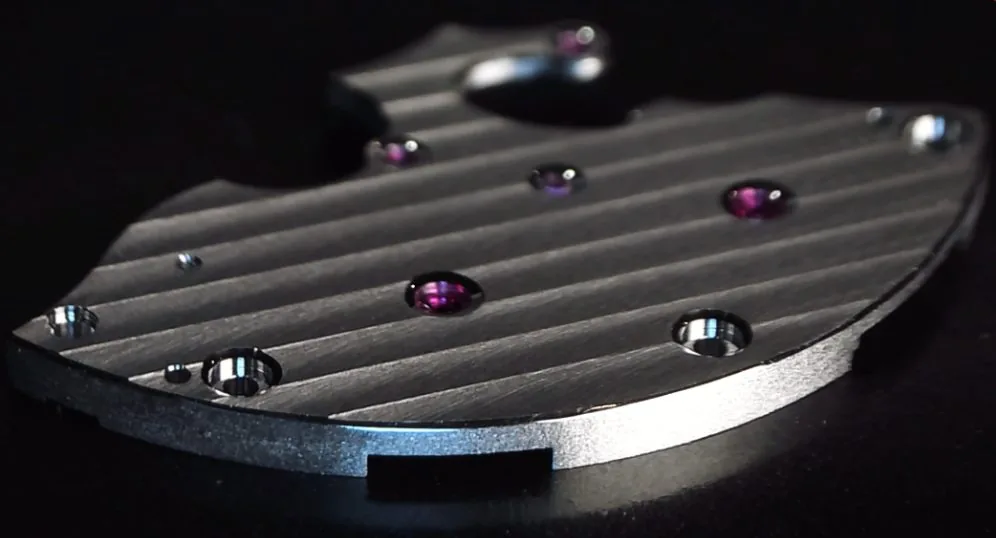
Figure 1
Bridge decorated with Geneva stripes
Click on the thumbnail to enlarge it
1. Definition
Geneva stripes form a decorative pattern applied to the flat surfaces of the movement. They are obtained using a circular abrasive, pressed down, then moved linearly across the surface. The diameter of the abrasive determines the radius of curvature of the lines. The resulting lines are parallel or concentric and slightly overlap. The spacing between each line determines the width of the pattern.
2. Origin and history
The motif takes its name from Geneva, the historic center of watchmaking. It appeared in the early 19th century as a technique for embellishing quality movements. Originally, it aimed to eliminate irregularities left by manufacturing. Industrialization then made it possible to reproduce it with increased precision, while reducing execution time.
3. Affected surfaces
Geneva stripes mainly decorate the bridges, or even the plates. They are also found, more rarely, on oscillating weights or on certain dials. Their presence traditionally testifies to the quality of the movement’s finishing.
4. Methods of execution
The quality of the pattern depends on the nature and fineness of the abrasive used. Abrasive papers, lapping pastes, and diamond tools are commonly used. The process can be carried out on a simple lathe, on a dedicated machine, automated or not. It can also be integrated directly into the machining center that manufactures the component.
This page has been automatically translated from the reference French version using an artificial intelligence tool. Errors or inaccuracies may remain. If you notice any, especially if this is your native language, please feel free to report them to us at info@horopedia.org. Your contribution helps us improve the quality of the encyclopedia.
While awaiting their translation, images and videos remain temporarily displayed in French.
Thank you for your understanding.