
MENU
1. General description
The gasket / seal is a fitting inserted between two components to ensure their water resistance (e.g. the case back gasket / seal guarantees the water resistance between the case back and the case middle). Their shape, cross-section and material may vary depending on the design of the watch or the component, as well as on their function.
The palette of plastics used for manufacturing gaskets / seals is very wide today. The material may be elastic (vulcanized rubber type) for case back or bezel gaskets / seals, for example O-ring type (round section). They will be rigid and I-shaped in section to ensure the water resistance of a crystal (watch glass) on its case back or on its bezel. In these cases, the compression of the gasket / seal during the fitting of the crystal makes it possible to obtain the required water resistance and to ensure the fixing of the crystal to the bezel.
When the space for a gasket / seal is too limited, or the shape of the components in contact is complex, certain specific adhesives may be used. They will ensure the fixing of the bonded components and their perfect water resistance.
By definition, the sealing gasket is the last barrier against external elements. As such, it must be resistant not only to dust and moisture, but also to UV rays and common chemicals. The lifespan of gaskets is limited and their effectiveness must be checked periodically during regular maintenance.
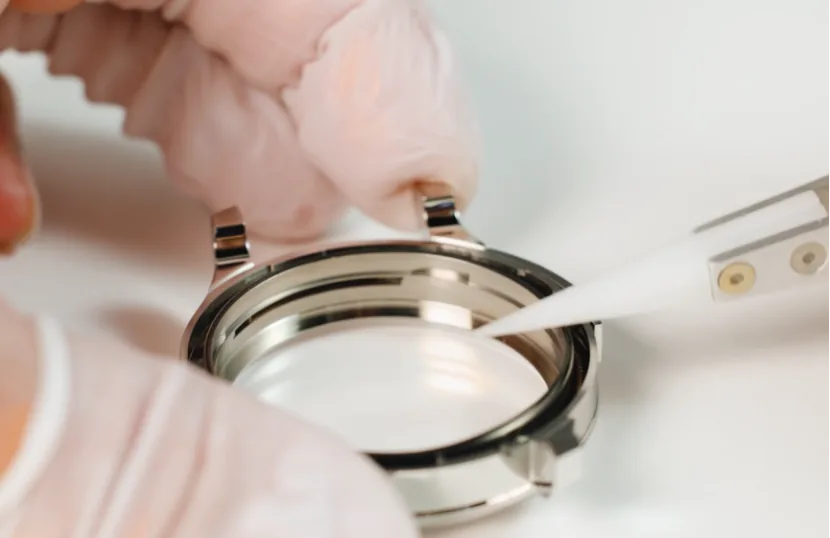
Figure 1
Fitting an O-ring gasket / seal on the case back
Click on the thumbnail to enlarge it
2. History
Initially, the materials used to make the gaskets were mainly cork, leather and lead. They will endure until the middle of the century before being supplanted by elastomers and plastic materials. Their properties, resistance and longevity keep evolving in parallel with discoveries and the development of new materials.
The first patents relating to watch water resistance appeared at the end of the 19th century. The first waterproof watch, a Depollier, was the subject of military research as early as 1915 in the context of the First World War. It was tested in 1918, then ordered in a quantity of 10,000 units by purchase order no. 160615 of the United States War Department, thanks to the patent of May 15, 1917, approved by the United States Patent Office on September 11, 1917, under no. 1,239,467.
3. Industrial production of gaskets / seals
Gaskets / seals mainly come from the production of specialized subcontractors. Depending on their shape and material, different materials can be used. Injection molding allows elastic O-ring gaskets / seals to be produced. When the material is hard enough and its cross-section is complex, the gaskets / seals are machined from bars or discs of raw material. Finally, the stamping or laser cutting is preferred for manufacturing flat gaskets / seals.
This page has been automatically translated from the French reference version using an artificial intelligence tool. Errors or inaccuracies may remain. If you notice any, especially if French is your native language, feel free to report them to info@horopedia.org. Your contribution helps us improve the quality of the encyclopedia.
While awaiting their translation, images and videos remain temporarily displayed in French.
Thank you for your understanding.