
MENU
1. Table of the main properties of brasses
| Property | Typical value | Remarks |
|---|---|---|
| Density | ~8.4–8.7 g/cm³ | High |
| Modulus of elasticity (E) | ~90–110 GPa | Moderate |
| Tensile strength | ~300–600 MPa | |
| Hardness (HV) | ~80–200 HV | Moderate |
| Thermal conductivity | ~100–130 W/m·K | Good |
| Electrical conductivity | ~15–30 MS/m | Moderate |
| Thermal expansion | ~18–22 ×10⁻⁶ /K | Moderate |
| Melting point | ~900–940 °C | Depends on the alloy |
| Magnetism | No | Non-magnetic |
| Corrosion resistance | Good | |
| Machinability | Very good |
2. General description
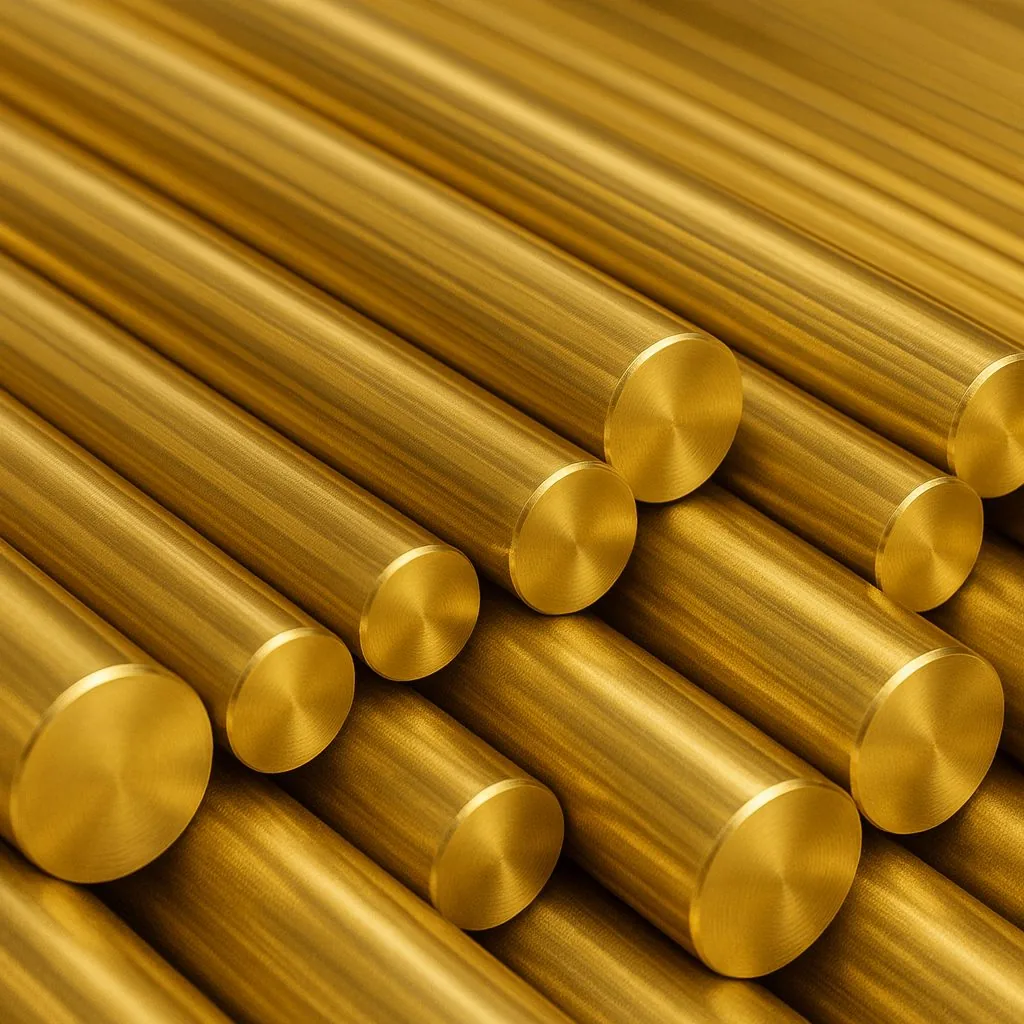
Brasses are alloys of Copper and zinc, whose zinc content generally ranges from 5% to 40%. In watchmaking, they are one of the most widely used materials, particularly for the components of the movement, due to their excellent machinability, dimensional stability and good corrosion resistance.
Historically, brass established itself as the base material for manufacturing plates, bridges and wheel plates, and remains widely used today in the watchmaking industry, both for technical and aesthetic reasons.
3. History
Brass appeared as early as prehistoric times. However, it was under the Roman era (approx. -100) that its production process was mastered and it began to be produced intentionally. It was notably used to make coins, including Roman sesterces. From the Middle Ages onwards, its use extended to the manufacture of cauldrons, tableware and boilers. Its properties (ductility, malleability, corrosion resistance) have made it an alloy historically and enduringly prized by watchmakers.
4. Types of brass used in watchmaking
Classic Brasses (CuZn)
Standard brasses are composed mainly of copper and zinc.
Use:
- Plates
- Bridges
- Wheel boards
- Dials
- Hands
- etc.
Characteristics:
- Good mechanical resistance
- Excellent finishing capability
- Characteristic yellow colour
Leaded brasses (profile turning brasses)
These brasses contain a low lead content (1 to 3%) in order to improve machinability.
Use:
- Turned parts (screws, pins, etc.)
- Industrial production
Characteristics:
- Very easy machining
- Formation of short chips
- Less suitable for heavily stressed parts
The European REACH regulation, aimed at reducing the use of chemical elements harmful to health and the environment, is now leading players in the watchmaking industry to seek substitute alloys for lead-based brass.
Special brasses (modified alloys)
Some brasses are enriched with alloying elements (tin, aluminium, silicon) in order to improve:
- Mechanical resistance
- Wear resistance
- Corrosion resistance
5. Heat treatments and surface treatments
Brass is rarely left untreated in a watch movement. It generally receives surface treatments to improve its properties:
- Nickel plating → protection and finishing base
- Gilding (yellow, pink Gold) → aesthetics and protection
- Rhodium plating → white appearance and corrosion resistance
- Various electroplating treatments (galvanic treatments) (ruthenium, NAC, etc.)
- Vapour deposition (PVD, CVD)
These treatments also contribute to the aesthetics of movements.
After machining, but especially after Stamping, brass often requires heat treatments, such as annealing, in order to let down the tensions that appeared in the material as a result of mechanical stresses.
6. Watchmaking applications
Brasses are mainly used for:
- Plates→ structure of the movement
- Bridges → maintaining organs
- Wheel plates → lightness and ease of machining, coefficient of friction
- Dials → base for decorative treatments
7. Advantages and limitations
Advantages
- Exceptional machinability
- Good dimensional stability
- Natural corrosion resistance
- Non-magnetic material
- Controlled cost
Limitations
This page has been automatically translated from the reference French version using an artificial intelligence tool. Errors or inaccuracies may remain. If you notice any, especially if this is your native language, please feel free to report them to info@horopedia.org. Your contribution helps us improve the quality of the encyclopedia.
While awaiting their translation, images and videos remain temporarily displayed in French.
Thank you for your understanding.