
MENU
1. General description
The bezel is to the dial what the frame is to a master’s painting. It defines its outline and concentrates the light on it to draw the eye. The shape of the bezel generally adapts to that of the case and knows no other limits than the creativity of the designers. Technically, the bezel closes the upper part of the case and carries the crystal that overhangs the dial. The water resistance of its gaskets at the case middle and the crystal is therefore essential.
From the earliest pocket watches to the latest horological creations, the bezel has always been a favored surface for decoration (setting (stone/jewel setting), engraving, enamelling). Over time, the bezel has become a support for information. Its inner circumference (visible beneath the watch’s crystal) frequently bears one or more scales (hours, minutes, seconds, tachymeter scale, pulsometer, etc.). These scales may be engraved, printed, or set (appliques, stones, etc.). More rarely, it is the outer circumference of the bezel that is engraved (e.g. the hour index) and then sometimes lacquered.
When it is circular in shape, the bezel can sometimes be rotating. In this case, the crystal (watch glass) is generally directly fixed to the case middle, the bezel then being nothing more than a rotating ring. The best-known application of this system is the unidirectional rotating bezel of diving watches, but a multitude of other applications exist.
By engraving an angular scale on a rotating bezel, the watch becomes an excellent means of navigation. In other examples, the rotating bezel becomes a slide rule, general-purpose or specialized. Even rarer, but perfectly illustrating the extent of the fields of application offered by the bezel, it sometimes substitutes for the crown. This way, you can wind and set the time on your watch by turning the bezel.
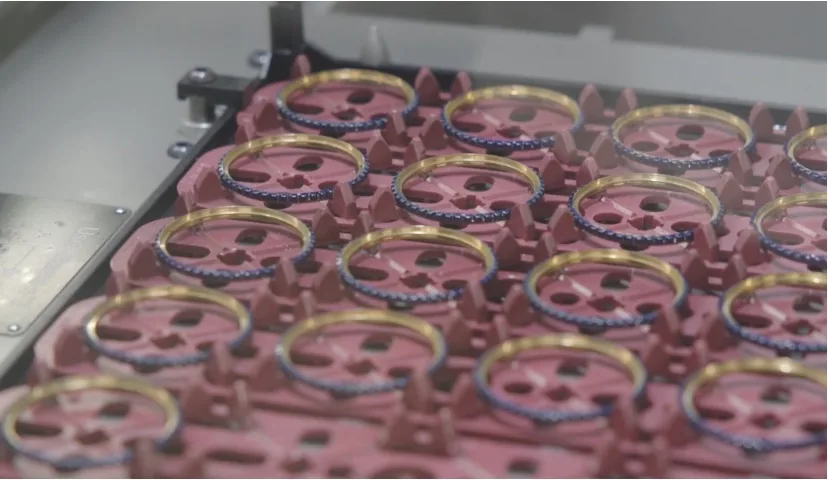
Figure 1
Bezels being manufactured
Click on the thumbnail to enlarge it
2. History
From the 17th century onwards, watch cases, which had until then been fairly primitive, became more refined and technical. Three-part construction (case middle, bezel and case back) became widespread.
As with case backs, the bezel is frequently connected to the case middle by a hinge. The bezel can be opened by a tab and pivot on its hinge, like a window. Later, bezels were sometimes welded to the case and, more generally, secured by a notch (snap closure).
In modern constructions, it is often preferred to screw the bezel directly to the case middle. Generally, the screws engage under the case middle and tighten under the bezel. The case back then covers the bezel screws, which become completely invisible (both on top and underneath) once the watch is closed.
In other cases, the screws engage from the top of the bezel, passing through it to tighten into the case middle. In this case, the screws are visible.
With the crystal (watch glass) it carries, the bezel is the component most exposed to shocks. It is therefore not surprising that the bezel is frequently a testing ground for new materials (hardness, scratch resistance, UV resistance, grip, etc.), to the point that some designers now design bezels as “shields” or shock absorbers protecting the other elements of the case and the movement.
3. Artisanal manufacturing of a bezel
Depending on its design or technical specificities (water resistance, function, etc.), the bezel of a case may require ingenuity and know-how. However, like the case back, the bezel is often relatively simple to manufacture and does not require significant resources. A lathe bench will, in many cases, be sufficient to machine a circular bezel, whereas a milling machine will allow the creation of shaped bezels (square, tonneau, among others). The working time required by such a method, as well as the desired quality, often lead watchmakers to decorate their bezels using artisanal processes (engraving and/or setting (stone/jewel setting) by hand, enamelling).
4. Semi-industrial production of a bezel
The manufacturing of a bezel is very similar to that of case backs. Thus, as with the industrial method, machining centers (CNC) are already mostly used for such production volumes. What mainly differentiates the two production methods are the finishing, decoration, and even assembly steps for the most complex bezels.
For small series of watches of a certain level of range, an engraving done by hand is still often preferred over mechanical or chemical engraving. The placement of stones in a setting (stone/jewel setting) is done by hand rather than by machine, as is the assembly of the various components (e.g., the ceramic insert of a diving watch bezel).
5. Industrial production of a bezel
On an industrial scale, bezels are mostly manufactured on machining centers (CNC). However, stamping may be preferred over machining, particularly for non-circular bezels. In this case, machining operations subsequent to stamping will be necessary.
For more complex bezels, the assembly of their various components will be carried out on often automated assembly lines.
6. High-tech production of a bezel
Cutting-edge technologies are distinguished from craft, semi-industrial, and industrial methods by the materials used rather than by their production volumes. Injection and sintering are mainly used to shape materials such as plastics and composites, although standard machining and/or polishing operations may sometimes be necessary afterward. The manufacturing process for cases made of sapphire (synthetic corundum and its derivatives), and therefore of bezels, is similar to the industrial method (machining / polishing). However, the hardness of sapphire requires the use of high-tech machines and tools.
This page has been automatically translated from the French reference version using an artificial intelligence tool. Errors or inaccuracies may remain. If you notice any, especially if this is your native language, please feel free to report them to us at info@horopedia.org. Your contribution helps us improve the quality of the encyclopedia.
While awaiting their translation, images and videos remain temporarily displayed in French.
Thank you for your understanding.