
MENU
1. General description
The minute wheel (motion work) consists of a solid wheel plate in Brass riveted to a pinion in Steel. The axis of the assembly is drilled and pivots on a tenon driven in on the Dial of the Main plate and located close to the pointing of the Hand of the minutes (generally at the center). The role of the Minute wheel (motion work) is to reduce, through its gear ratio, the rotation speed of the Cannon pinion (which carries the minute hand and drives the Minute wheel) so that the minute pinion drives the Hour wheel (superimposed on the Cannon pinion and which carries the hour hand) twelve times slower (for a 12H Dial). A Bridge of the motion work with a small thickness generally holds the Minute wheel (motion work) and the intermediate wheels while limiting the vertical Shake (play) of the pinion.
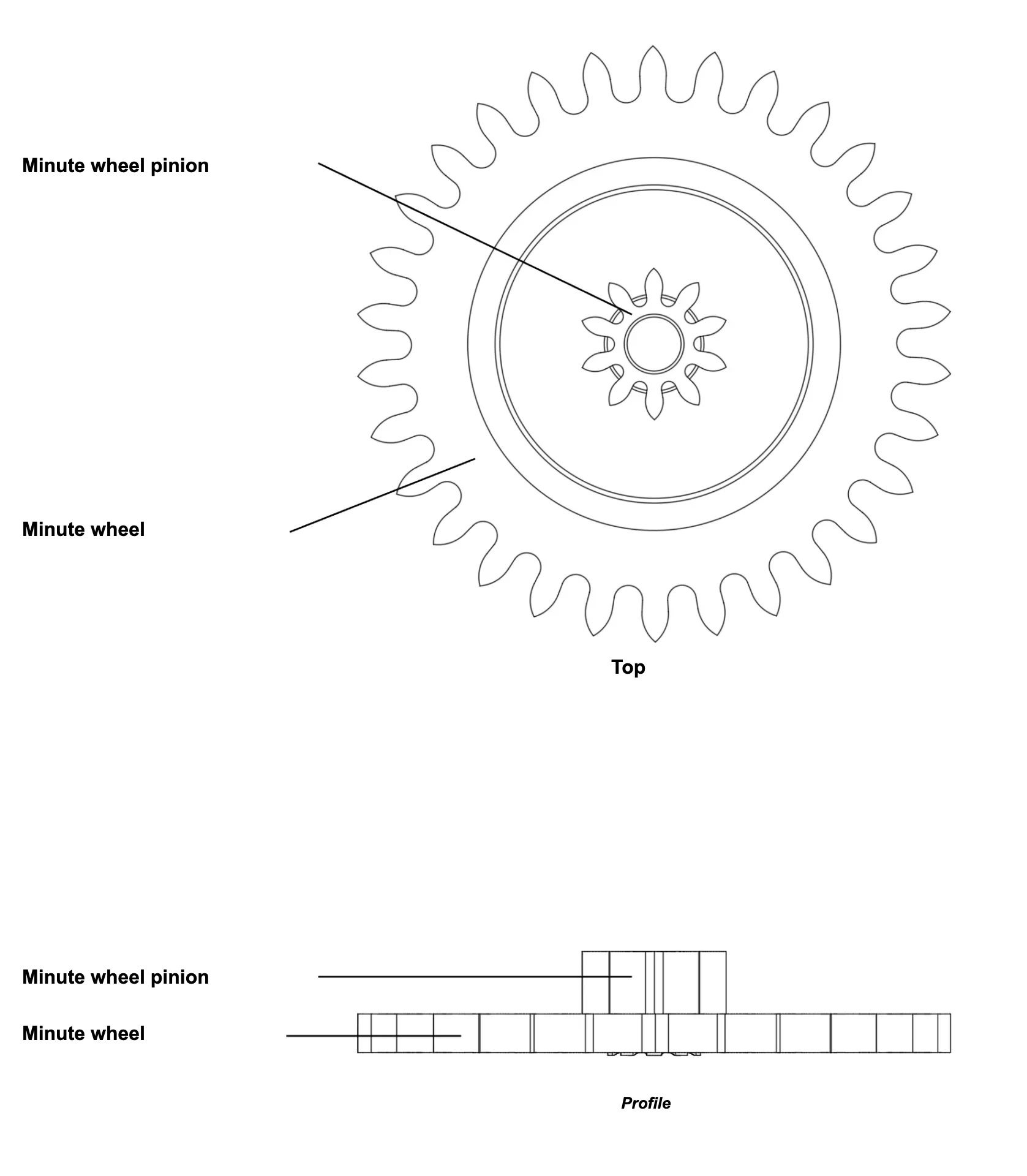
Figure 1
Diagram of an assembled Minute wheel (motion work)
Click on the thumbnail to enlarge it
2. History
The appearance of the Minute wheel is intrinsically linked to that of theHand of minutes, from which it originates. The first minute Hands were observed at the end of the 16th century. It was not necessary, however, to wait for the minute to be displayed at the center for the Minute wheel to exist and fulfill its primary role. The fundamental role of the Minute wheel is to multiply the rotation speed of the minute Hand relative to that of the hours. Due to the simplicity of the solution it provides to fulfill this role, the Minute wheel has not undergone significant evolution since its appearance.
3. Artisanal manufacture of a Minute wheel (motion work)
The Minute wheel consists of a solid plate made of Brass and a pinion in Steel. Traditionally, both components of this wheel can be made on a Lathe. Their teeth can also be cut there using an offset milling cutter and a dividing plate. A turned seat at the base of the pinion allows the wheel’s disc to be riveted to it once both components are finished.
4. Industrial production of a Minute wheel (motion work)
The method described here can also, depending on the production volumes involved, be applied on a semi-artisanal scale (small batches) and an industrial scale (fashion and high production volumes). The Automatic latheis the most appropriate machining solution to produce the minute wheel plate and its pinion (including tooth cutting). The two components will then be decorated by hand or industrially, depending on the desired finishes, before the plate is riveted to its pinion. Producing the wheel plate by stamping would not really offer any advantage, since cutting the teeth would then require a subsequent operation on a gear-cutting machine.
This page has been automatically translated from the reference French version using an artificial intelligence tool. Errors or inaccuracies may remain. If you notice any, especially if this is your native language, please do not hesitate to report them to info@horopedia.org. Your contribution helps us improve the quality of the encyclopedia.
While awaiting their translation, images and videos remain temporarily displayed in French.
Thank you for your understanding.