
MENU
1. Definition
Circular graining is a decorative pattern applied to the flat surfaces located at the bottom of the recesses and clearances of a watchmaking component. It consists of an interlacing of abraded discs whose concentric lines overlap in a regular linear or circular pattern.
The visible external surfaces of a component can receive a wide variety of finishes, such as Geneva stripes or satin finish. Recesses and concave clearances, on the other hand, do not allow for this type of decoration. Circular graining finds its own purpose here and remains the preferred finish for the hollowed-out parts of a main plate or a bridge.
2. Technical role and origin
Circular graining dates back to a time when the water resistance of watch cases was still limited. It has the particularity of trapping dust particles within the relief of its concentric scale-like pattern, thus preventing them from falling into the train (wheel train) and escapement.
This function explains the persistence of circular graining on today’s high-end movements, even though water resistance of cases has become widespread. The areas of the main plate and bridges surrounding the train (wheel train) remain traditionally grained, as does the inner face of the case backs. This practice perpetuates the original technical usefulness of circular graining, which has now become a quality criterion and an aesthetic guide mark.
3. Aesthetic function
Circular graining takes its name from the appearance it gives to the worked surface: a regular succession of small overlapping circles, evoking the alignment of pearls or scales. Light reflects differently on each disc, producing a matte, nuanced effect that contrasts with the polish of an angle or the shine of a polished screw.
This decoration gives visual unity to the parts of the movement that cannot receive any other finish due to their concave relief. It signals, just like the Geneva stripes, the Guilloché (engine-turning) or the Beveling / Angling, the care given to the finishing of a movement, including on surfaces that are barely visible or hidden beneath other components.
4. Components that can be circular grained
Circular graining is mainly applied to the recesses of the main plate and bridges, which house the jewels, pivot shoulders or auxiliary mechanisms. Module plates also frequently receive this decoration.
The inner surface of case backs, historically circular grained to catch dust before it fell into the movement, still retains this finish today out of tradition, even on cases with good water resistance.
These surfaces share a recessed or hollowed-out relief, unsuited to finishes intended for external surfaces.
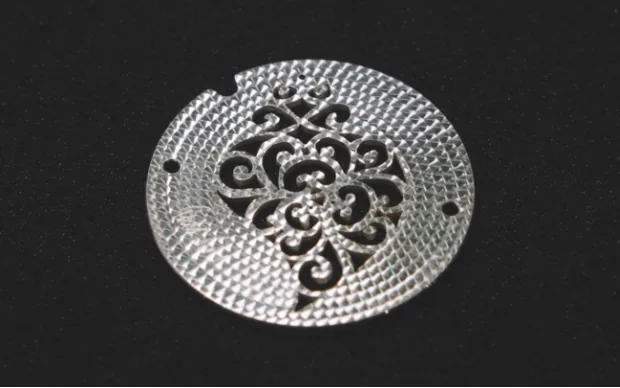
Figure 1
Circular grained and openworked module plate
Click on the thumbnail to enlarge it
5. Production methods
Handcraft method
Handcrafted circular graining is performed by hand, using a sensitive drill. The horologist (watchmaker) applies a tool loaded with abrasive onto the surface, through successive and regular pressures, each circular imprint slightly overlapping the previous one. The regularity of the pitch between the circles determines the quality of the pattern obtained.
Industrial method
In series production, circular graining is performed by machine to increase productivity. Dedicated machines reproduce a consistent pattern across a large number of components, at the cost of less variability than that obtained by hand.
6. Handcrafted circular graining (video)
7. Distinction from related decorations
Circular graining is distinguished from other watchmaking decorations by its area of application. Geneva stripes form straight bands reserved for flat, visible surfaces. Guilloché (engine-turning) consists of tracing repetitive geometric patterns, generally on dials, cases, or oscillating weights, using a Rose engine (guilloché lathe). Beveling / Angling, for its part, chamfers the sharp edges of a component.
Only circular graining is suitable for concave hollows and recesses, which explains its almost systematic presence on high-quality movements, even when these areas remain invisible once the movement is assembled.
This page has been automatically translated from the French reference version using an artificial intelligence tool. Errors or inaccuracies may remain. If you notice any, especially if French is your native language, please feel free to report them to info@horopedia.org. Your contribution helps us improve the quality of the encyclopedia.
Until they are translated, images and videos remain temporarily displayed in French.
Thank you for your understanding.