
TESTIMONIALS FROM PROFESSIONALS AND NEW TECHNICAL CONTENT ON HOROPEDIA.ORG
For the 2026 back-to-school season, the online encyclopedia Horopedia.org is enriched with new content to convey, document, and showcase watchmaking culture. A new section dedicated to professional testimonials is being launched, while an original 3D animated video deepens the understanding of basic mechanical principles. Two complementary additions, in the service of learning and inspiration.
A new “Testimonials” section to give a voice to those who shape watchmaking: interview with a watch designer
Horopedia continues its mission of knowledge transmission by launching a new section entitled “Testimonials“, accessible from the Training & Careers menu. This section brings together video interviews with watchmaking professionals, from diverse backgrounds representative of the richness of the horological ecosystem.
Through their personal accounts, they share their training, their daily work in the field, the realities of their profession, and their vision of watchmaking. These testimonials highlight the passion, commitment, and expertise that keep this art alive every day — inspiring journeys for future generations.
First testimonial: Emmanuel Gueit, watch designer
The first video published in this new section is dedicated to Emmanuel Gueit, watch designer. Son of Jean-Claude Gueit, one of the founding fathers of contemporary watch design, Emmanuel developed an early sensitivity to the way watches combine art and precision.
In this interview, he looks back on his journey, his approach to the profession, and his relationship with design. More visionary than draughtsman, he is above all passionate about the expression of hours, minutes and seconds, as well as the ability of design to give a strong identity to a complex object. A rich and inspiring testimony, shedding light on a profession that is often little known.
“The first and most important thing is talent. You either have it or you don’t. (…) Above all, you need to be visionary and observant, but also have your own ideas and put them on a small wrist. (…) Designing a watch is like designing a car in miniature.”
A new 3D animated video on the motor organ (power source)
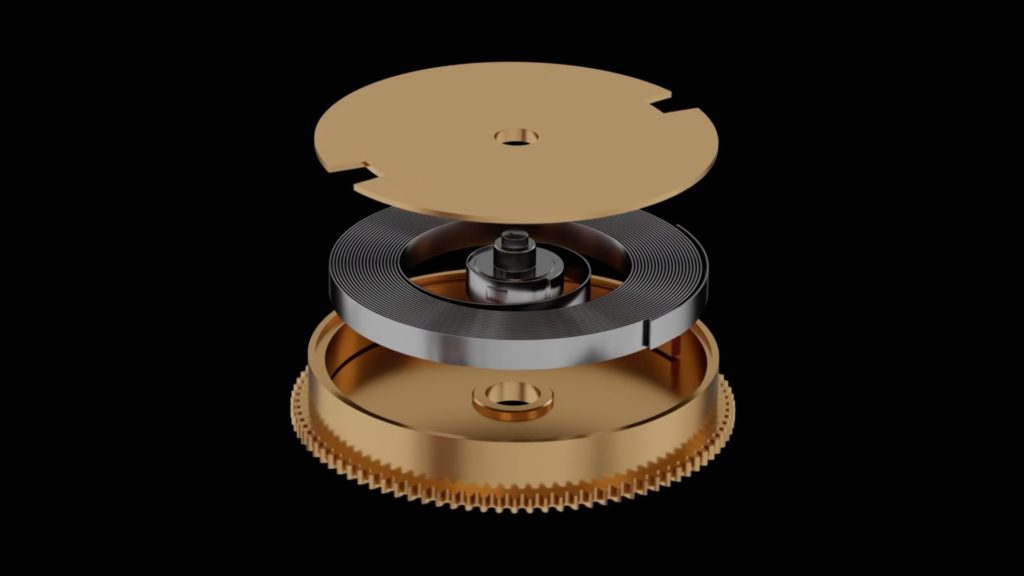
Another new feature this fall: the online publication of a educational video dedicated to the motor organ (power source), in the section Basic Mechanical Principles.
Placed at the beginning of the movement’s kinematic chain, the motor organ (power source) plays a fundamental role: storing the energy necessary for the movement’s operation and releasing it gradually.
Thanks to an approach entirely created in 3D animation, this video provides a clear and visual understanding of how this essential organ works. It notably presents the Barrel, a motor organ (power source) system used in certain small clocks and pendulums, as well as in all mechanical pocket and wrist watches.
This new content fully reflects Horopedia’s educational approach: making complex technical concepts accessible, through precise visual materials suited to all levels of knowledge.
►► Browse horopedia.org now, discover its new features and learn without limits about the world of horology!
►► To support our educational initiatives and contribute to the promotion of exceptional craftsmanship, become a patron! More information at: https://horopedia.org/fr/cercle/
ABOUT HOROPEDIA
The Horopedia Foundation was created in February 2023 and was granted public interest status. The Foundation’s Board is composed of Philippe Dufour (President), Dr. Helmut Crott, André Colard and Marc André Deschoux.
The Foundation manages Horopedia.org, the first online video encyclopedia on horology. The platform was launched in 2022 and quickly received unanimous support within the community.
To date, more than 100 multilingual documentary films on museums, watchmaking schools, horological tools and components, and the mechanical principles behind how they work can be found on Horopedia.org. To strengthen its educational mission, the platform also incorporates visual teaching materials to facilitate a better understanding of the information provided. The site offers nearly 1000 pages with detailed definitions of horological terms and historical anecdotes about significant horological inventions.
Horopedia.org meticulously covers all aspects of the fascinating watchmaking industry in French, English, and German. It offers detailed definitions of tools and complications, 3D images of movements, and in-depth video explanations on the production of components, their history, and their functions in a watch. A dedicated section of the site lists horological institutions, including schools and museums in Switzerland and around the world.
More recently, the Foundation unveiled its ambitious project: the Maison des Arts & de la Culture Horlogère (MACH). More than a museum, the MACH will be a living space for exhibition, transmission, and exchange around the art of watchmaking. Located in the heart of the Banking District, this house of 1,250 m² will span four floors, offering didactic, thematic and chronological exhibitions, complemented by a space dedicated to temporary exhibitions. Visitors will also be able to enjoy a shop, an auditorium and various interactive spaces designed to spark curiosity and encourage discovery. Open and lively, the MACH aims to become the crossroads of watchmaking in Geneva.
This page was automatically translated from the French reference version using an artificial intelligence tool. Errors or inaccuracies may remain. If you notice any, especially if this is your native language, please feel free to report them to us at info@horopedia.org. Your contribution helps us improve the quality of the encyclopedia.
Pending their translation, images and videos remain temporarily displayed in French.
Thank you for your understanding.