
MENU
Detent escapement (2.5 Hz)
Speed 1:4
Detent escapement (2.5 Hz)
Normal speed
1. History
The invention of the detent escapement is attributed to Pierre Le Roy around 1748, although its development was perfected by Thomas Earnshaw and John Arnold during the 18th century. These watchmakers were part of a quest for precision driven by the needs of maritime navigation, at a time when the exact determination of longitude represented a major strategic challenge.
The detent escapement quickly established itself as a preferred choice for marine chronometers, thanks to its very low interference with the balance. Used until the early 20th century, it is now rare in modern watchmaking, although some contemporary craftsmen still use it for exceptional pieces.
2. Description
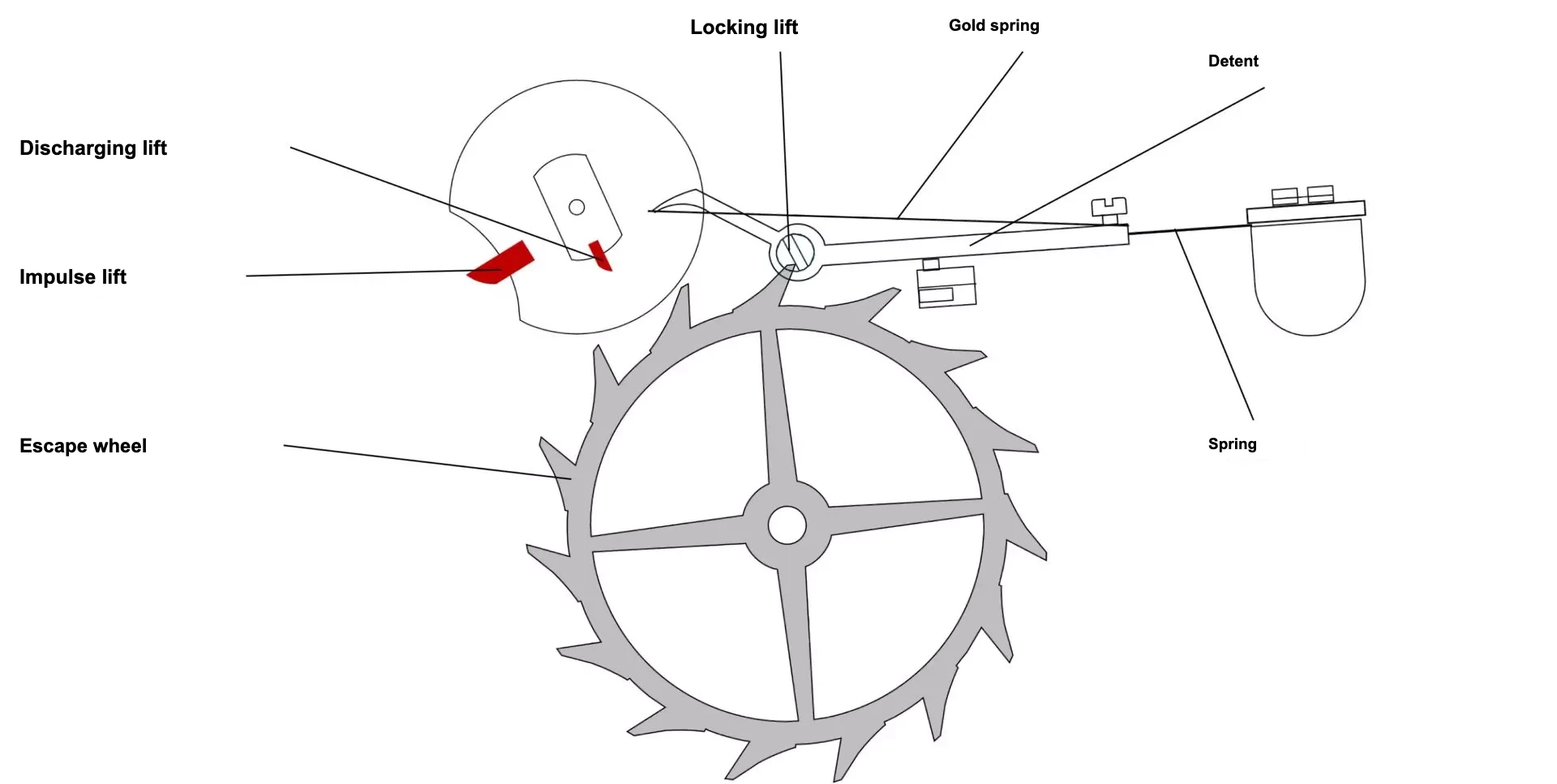
Figure 1
Click on the thumbnail to enlarge it
The Detent escapement is the first free escapement to have been developed. By isolating the escape wheel during its rest, the balance can perform its supplementary arc while being free of any contact and any friction with a component of the escapement. This is a single-impulse escapement, as only one impulse per oscillation is transmitted to the balance.
The Escape wheel generally has 15 teeth and is made of gold or even brass or German silver.
The detent serves to rest the escape wheel. It is made of steel and fitted with a thin spring that allows the unlocking of the escape wheel. This spring is made of gold in order to offer as little resistance as possible to the unlocking lift – and therefore to the balance – during the silent vibration.
There are two types of detent construction: The spring detent, whose thinned part acts as a spring (as described here). The pivoted detent is mounted on a pivoted axis and held against its stop by a spring.
3. Operation
The operation of the Detent escapement can be divided into five phases that unfold invariably according to the same cycle at each oscillation of the balance. These five phases are:
- Rest (descending supplementary arc)
- Unlocking (drop angle)
- Impulse
- Drop (impact)
- The silent vibration
1. Rest (descending supplementary arc)
During this phase, the Balance freely performs its descending supplementary arc without having any contact with the detent and the escape wheel. The escape wheel is then held stopped by the rest lift (Figure 2).
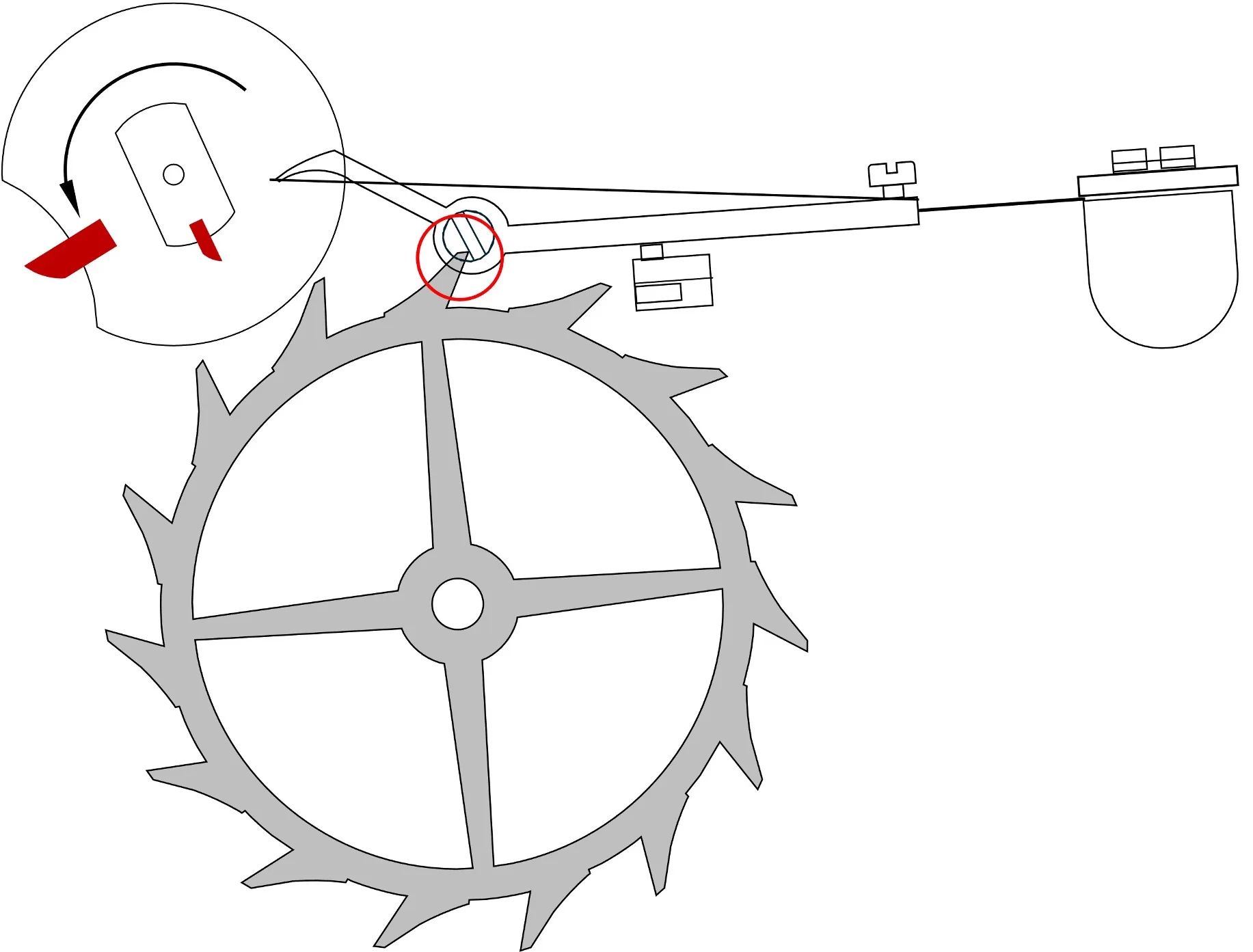
Figure 2
Click on the thumbnail to enlarge it
2. Unlocking (drop angle)
The unlocking phase begins when the unlocking lift comes into contact with the gold spring, which starts lifting the detent (Figure 3).
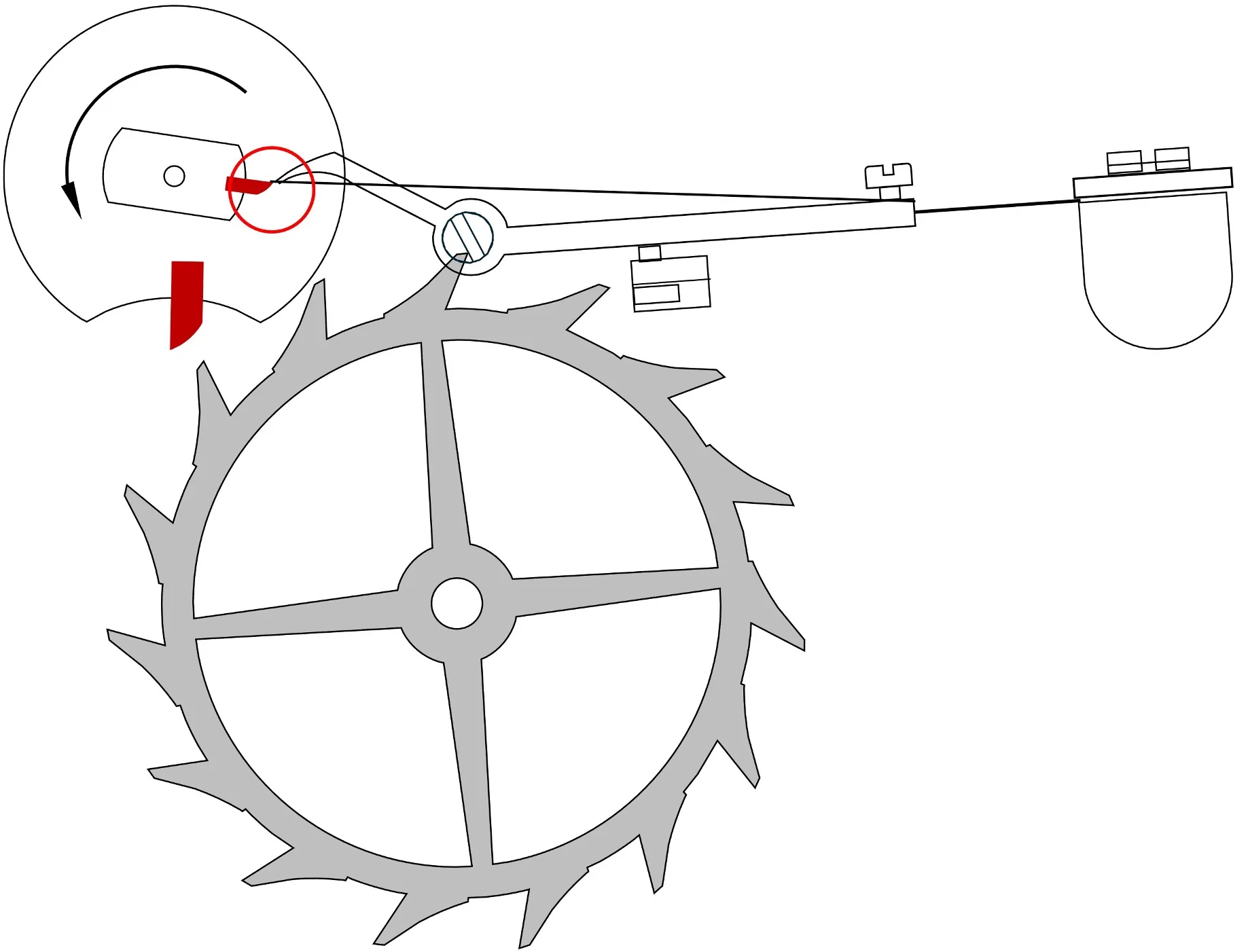
Figure 3 (start of unlocking)
Click on the thumbnail to enlarge it
It ends when the detent’s rest lift, raised by the unlocking lift, releases the tooth of the escape wheel (Figure 4).
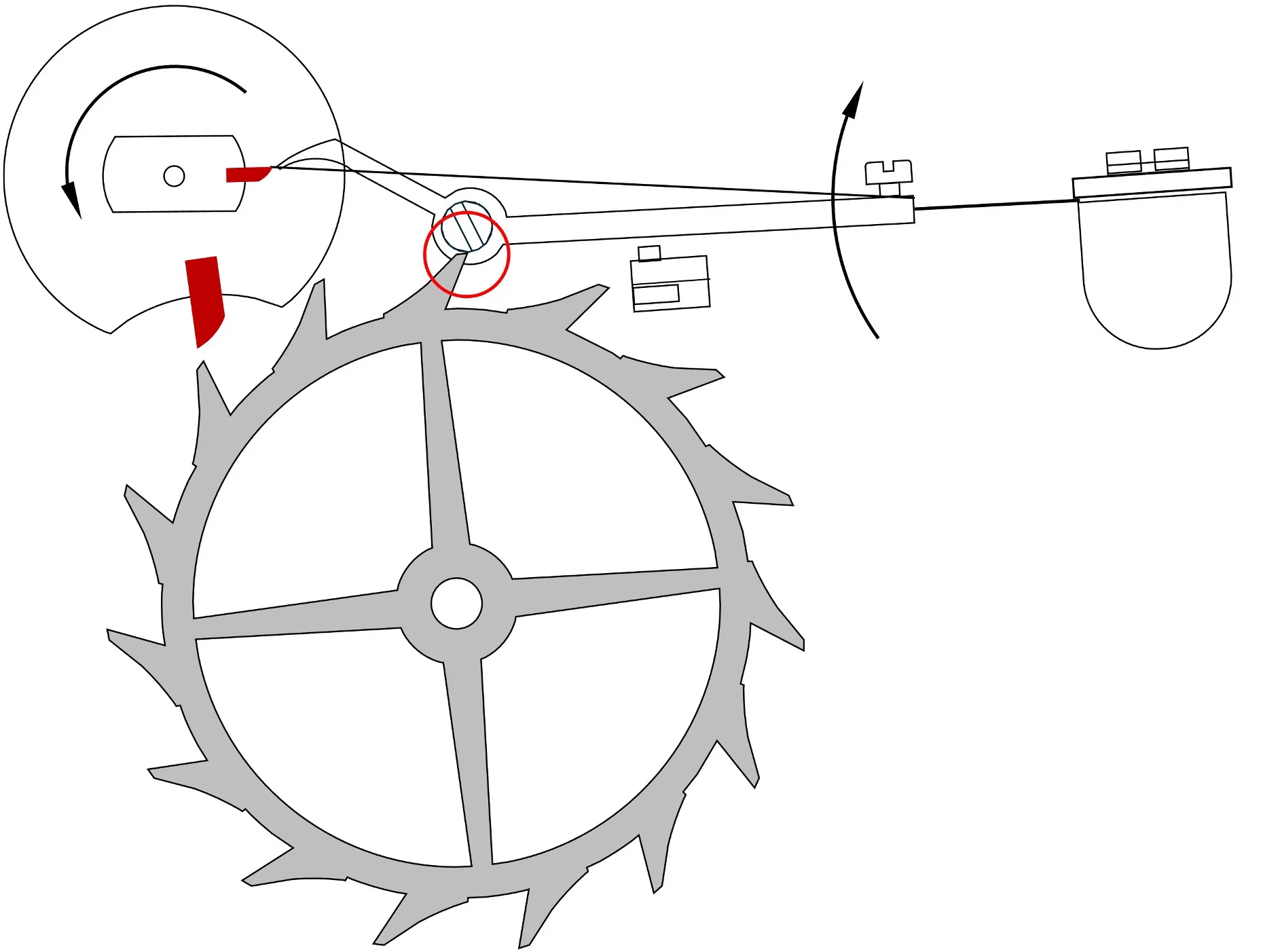
Figure 4 (end of unlocking)
Click on the thumbnail to enlarge it
3. The impulse
Following the unlocking, the escape wheel is released. One of its teeth catches up with the plate and comes into contact with the impulse lift, transmitting its energy to the balance (Figure 5).
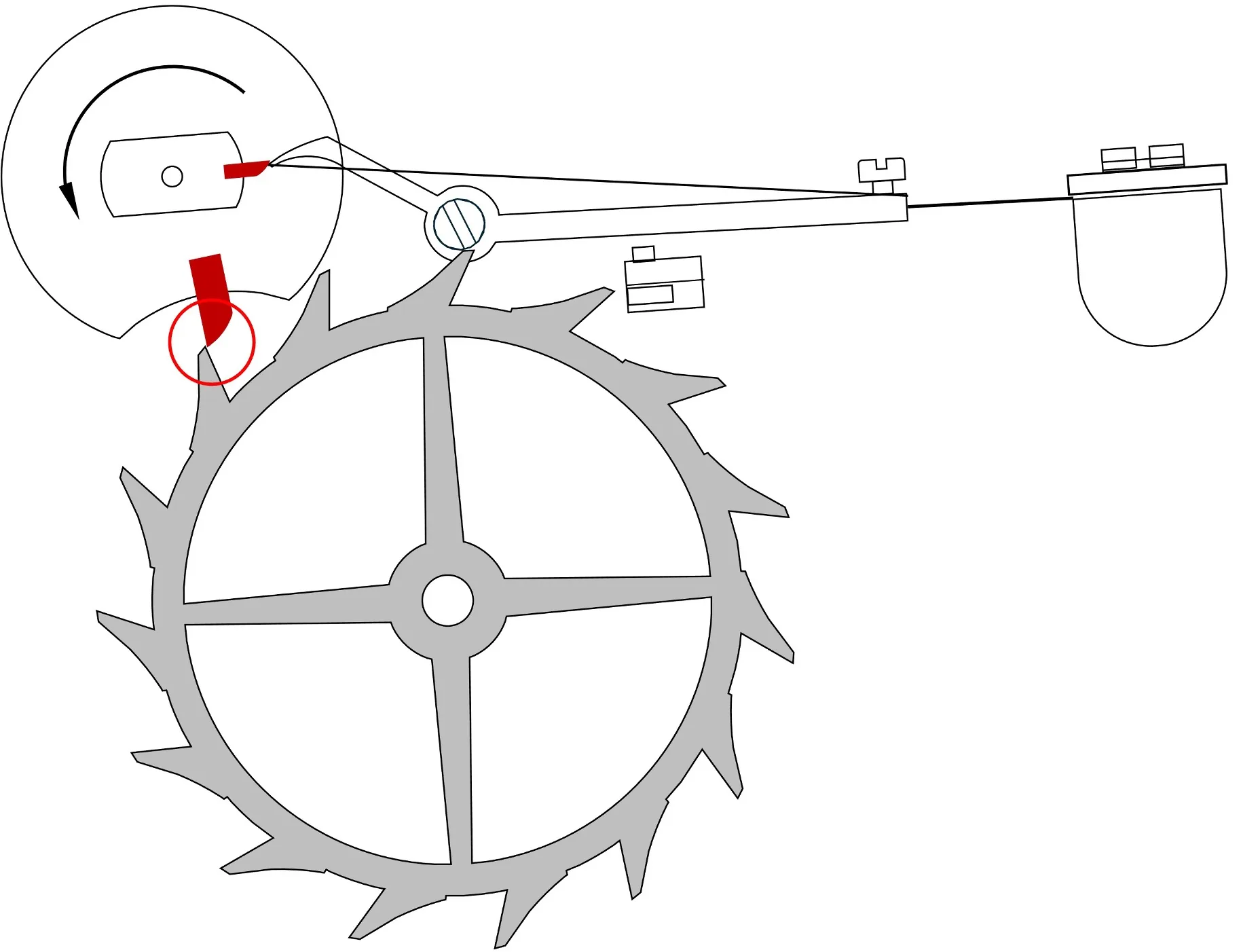
Figure 5
Click on the thumbnail to enlarge it
4. The drop (impact)
When the unlocking lift releases the gold spring and the detent, the detent, pulled back by its spring, falls back into contact with its stop. A tooth of the escape wheel then comes into contact with the resting lift. This is the drop (Figure 6). The balance then performs its additional ascending arc.
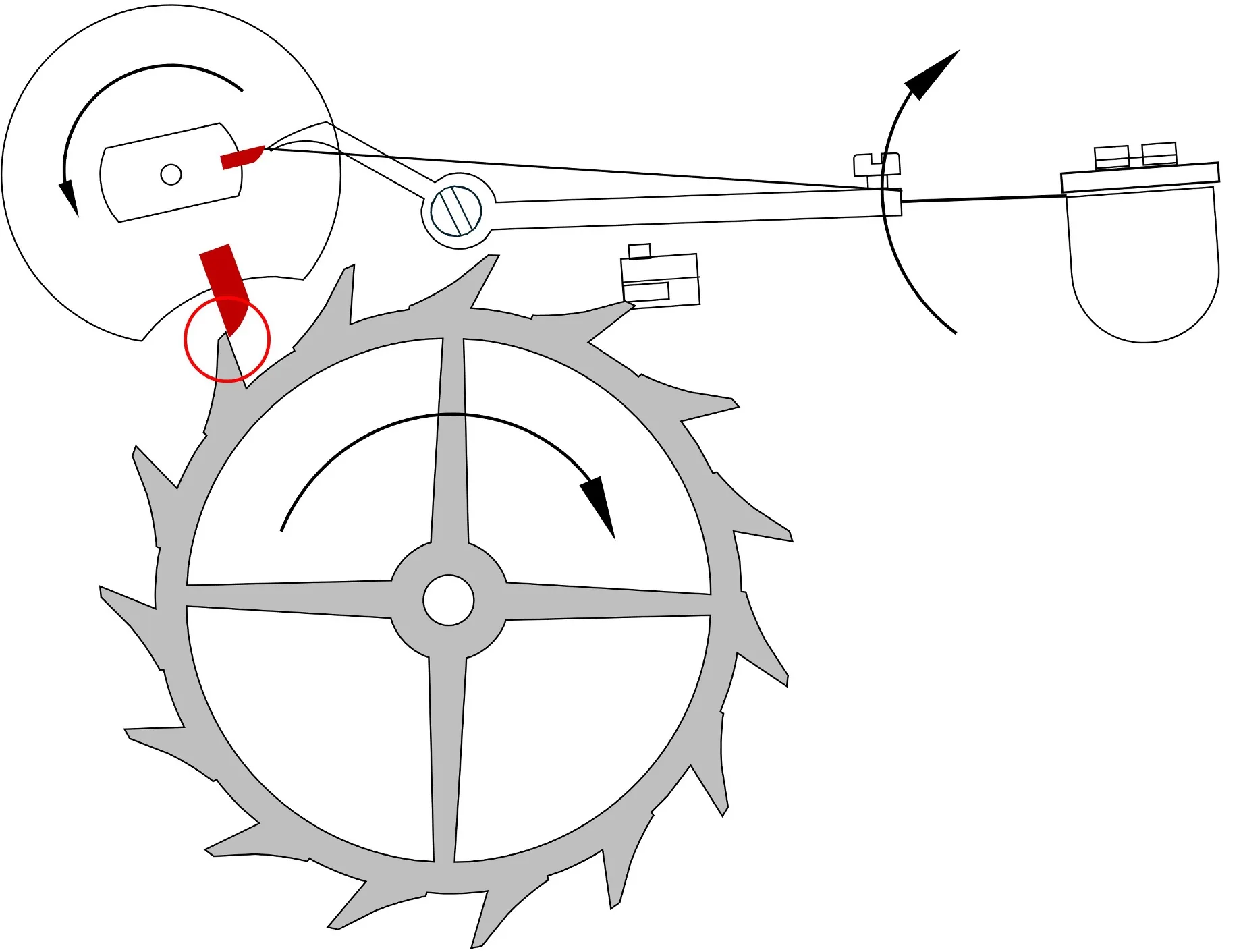
Figure 6
Click on the thumbnail to enlarge it
5. The silent vibration
Once its additional arc has been completed, the balance begins a full vibration without receiving any impulse (lost beat). During this phase, the curved back of the unlocking lift briefly comes into contact with the gold spring, whose low tension only negligibly disturbs the silent vibration of the balance (Figure 7).
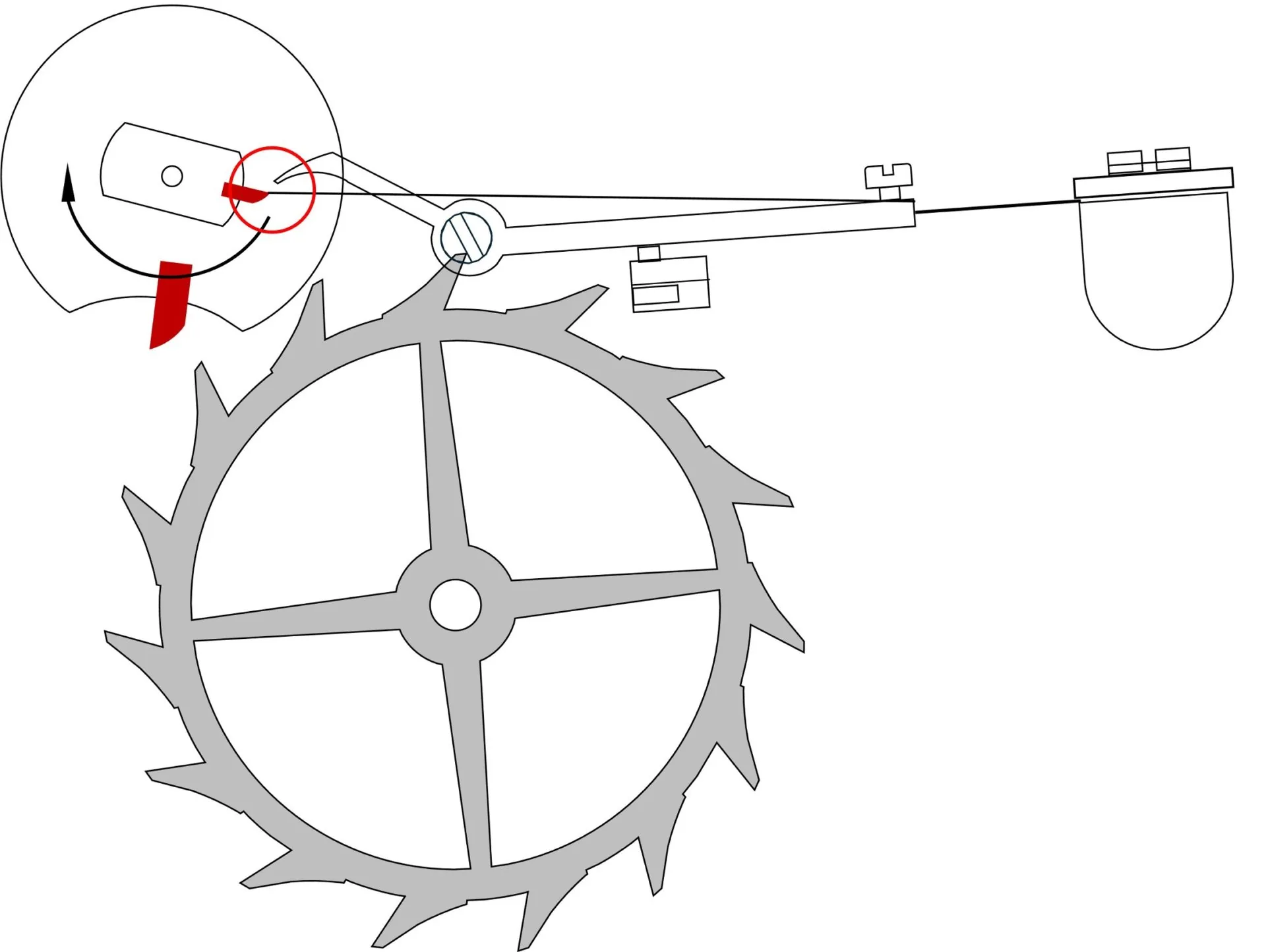
Figure 7
Click on the thumbnail to enlarge it
Note:
For a complete overview of how the detent escapement works, refer to the two animations at the top of this page.
4. Advantages and disadvantages
Advantages
- High chronometric precision: the total absence of friction during the supplementary arc of the balance promotes excellent isochronism.
- Direct impulse: energy is transmitted more efficiently than with a Swiss lever escapement.
- Freedom of the balance: the balance oscillates freely over a large part of its cycle, reducing mechanical disturbances.
Drawbacks
- Extreme sensitivity to shocks: a drop (impact) or a jolt can trip the detent or cause an unintended unlocking (drop angle), making the escapement unreliable when worn actively.
- Complexity of manufacturing and adjustment: assembly and adjustment require rare expertise, which limits its use to very high-end or experimental timepieces.
- Poor adaptability to the wrist: its sensitivity makes it hard to adapt to ordinary wristwatches, reserving it almost exclusively for fixed instruments (such as marine chronometers) or collector’s pieces.
This page has been automatically translated from the French reference version using an artificial intelligence tool. Errors or inaccuracies may remain. If you notice any, especially if French is your native language, please feel free to report them to info@horopedia.org. Your contribution helps us improve the quality of the encyclopedia.
While awaiting their translation, images and videos remain temporarily displayed in French.
Thank you for your understanding.