
MENU
1. Woven carbon fibre: material and manufacturing of a dial (video)
2. Table of main properties of woven carbon fibre
| Property | Typical value | Remarks |
|---|---|---|
| Density | ~1.5–1.7 g/cm³ | Very lightweight |
| Elasticity modulus (E) | ~70–300 GPa | Depends on orientation |
| Tensile strength | ~500–1500 MPa | Very high |
| Hardness | Variable | Depends on matrix |
| Thermal conductivity | ~5–20 W/m·K | Low to moderate |
| Electrical conductivity | Conductive (fibres) | Variable |
| Expansion coefficient | Very low | Directional |
| Magnetism | No | Non-magnetic |
| Corrosion resistance | Excellent | Very stable |
| Machinability | Difficult | Abrasive |
3. General description
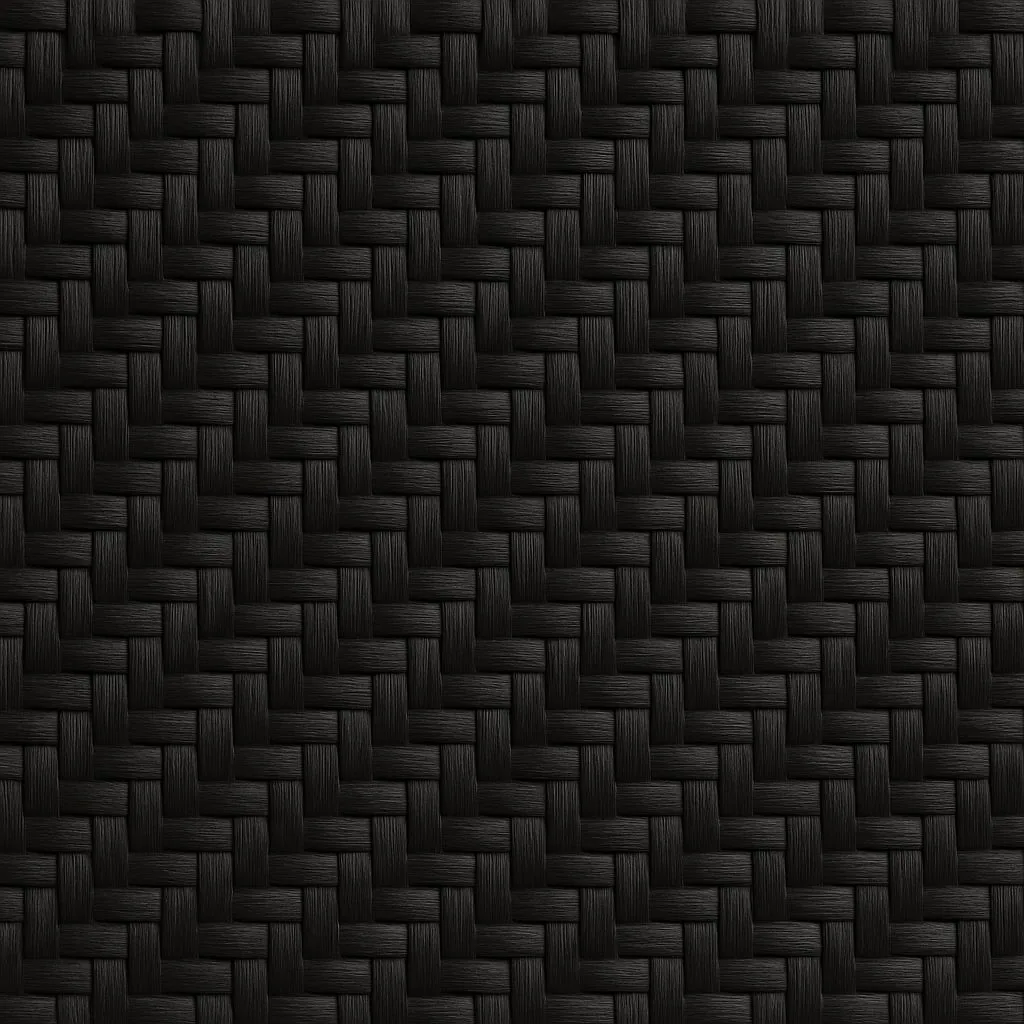
Woven carbon fibres are composite materials made of carbon fibres organised in a weave (weaving) and bound by a polymer matrix (most often epoxy resin). Relatively recently introduced in watchmaking, they are mainly used for their high mechanical properties, their very low mass and their distinctive technical aesthetics.
Unlike metals, it is not a homogeneous material, but an anisotropic composite whose properties depend on the orientation and type of fibre weaving.
4. Structure and types of weaving
Carbon fibres are organized according to different types of weaving, influencing mechanical properties and aesthetics:
Plain weave
- Regular checkerboard pattern
- Good dimensional stability
- Classic aesthetic appearance
Twill weave
- Characteristic diagonal pattern
- Better drapability
- Widely used in watchmaking
Unidirectional weave (UD)
- Fibres oriented in a single direction
- Maximum mechanical properties along this axis
- Less used for aesthetic reasons
5. Matrix and manufacturing
The fibres are impregnated with a polymer resin (the matrix), forming a composite:
- Resins polymers: two types of categories exist:
- Thermosetting resins: an irreversible chemical reaction that transforms the liquid resin into a solid. (Epoxy resin: the most common)
- Thermoplastic resins: liquefy under heat and harden upon cooling. (Peek resin)
The resin is then integrated with the fibres through various processes:
- Contact moulding
- Vacuum moulding
- Infusion
- Injection
The material then undergoes a curing cycle to polymerize and harden.
The part can then be machined, by milling, etc.
6. Watchmaking applications
Woven carbon fibre is used for:
- Watch cases
- Dials
- Plates and movement structures (rare)
- Aesthetic components
7. Advantages and limitations
Advantages
- Extremely lightweight
- Very mechanically resistant
- Non-magnetic
- Corrosion resistant
- Modern and technical aesthetic
- Good vibration absorption
Limitations
- Anisotropic properties (depend on orientation)
- Sensitivity to localized impacts (possible delamination)
- Difficulty of repair
- Possible aging of the polymer matrix
- Specific machining (abrasive for tools)
This page has been automatically translated from the French reference version using an artificial intelligence tool. Errors or inaccuracies may remain. If you notice any, especially if this is your native language, please feel free to report them to info@horopedia.org. Your contribution helps us improve the quality of the encyclopedia.
While awaiting their translation, images and videos remain temporarily displayed in French.
Thank you for your understanding.