
MENU
1. Forged carbon: material and manufacturing of a watch case (video)
2. Table of main properties of forged carbon
| Property | Typical value | Notes |
|---|---|---|
| Density | ~1.4–1.6 g/cm³ | Very lightweight |
| Modulus of elasticity (E) | ~50–150 GPa | More homogeneous, but lower than UD |
| Tensile strength | ~300–800 MPa | Lower than continuous fibres |
| Hardness | Variable | Depends on matrix |
| Thermal conductivity | ~5–15 W/m·K | Low |
| Electrical conductivity | Conductor (partial) | Variable |
| Expansion coefficient | Very low | Stable |
| Magnetism | No | Non-magnetic |
| Corrosion resistance | Excellent | Very stable |
| Machinability | Difficult | Abrasive |
3. General description
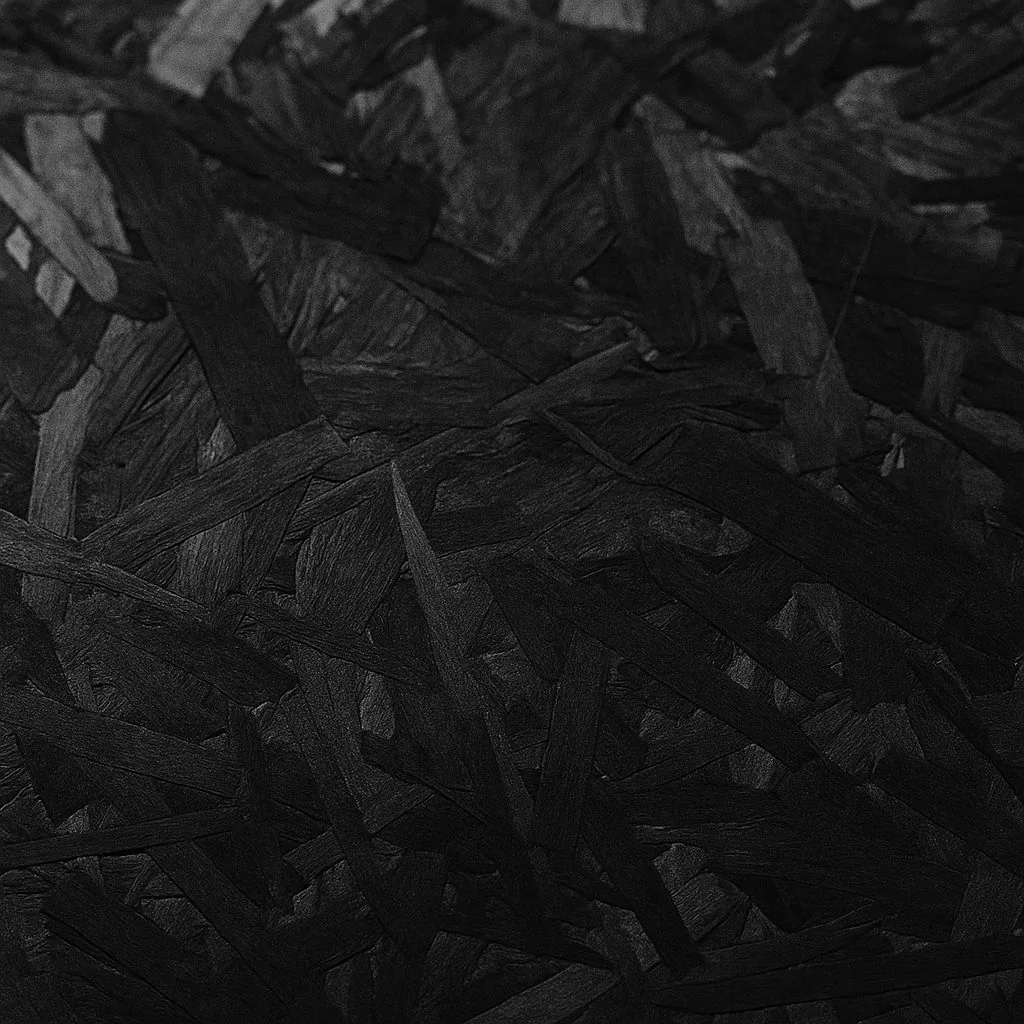
Forged carbon is a composite material made up of carbon fibre fragments randomly dispersed in a polymer matrix, usually an epoxy resin. Unlike woven fibres, its structure is not organised in a weave, but has an apparent isotropic distribution, giving a marbled or “flecked” visual appearance.
Introduced into watchmaking in the early 21st century, these fibres are particularly valued for their lightness, mechanical strength, and unique aesthetics, with each piece featuring a different pattern depending on the length of the fibres and their orientation.
4. Structure and manufacturing
Unlike woven fibres, frosted carbon is obtained by:
- Cutting carbon fibre into short fragments
- Mixing with a polymer resin
- Shaping by compression in a mould
- Polymerisation under pressure and temperature
Once the composite is moulded and polymerised, it can be cut (laser, water jet) and machined
This process makes it possible to obtain:
- Great freedom of shapes
- Good mechanical homogeneity
- Industrial repeatability
5. Specific characteristics
Forged carbon stands out for:
- A disoriented structure of the fibres
- A reduction in anisotropy
- A unique random aesthetic
- A better ability for complex shaping
Each piece features a unique visual pattern, comparable to a natural material.
7. Advantages and limitations
Advantages
- Very lightweight
- Good mechanical resistance
- More homogeneous properties than woven fibres
- Non-magnetic
- Corrosion-resistant
- Great freedom of shape
- Unique aesthetic (each piece is different)
Limitations
- Mechanical strength lower than that of continuous fibres
- Sensitivity to localised impacts
- Difficulty of repair
- Possible ageing of the polymer matrix
- Abrasive machining for tools
This page has been automatically translated from the reference French version using an artificial intelligence tool. Errors or inaccuracies may remain. If you notice any, especially if this is your native language, please feel free to report them to info@horopedia.org. Your contribution helps us improve the quality of the encyclopedia.
While awaiting their translation, images and videos remain temporarily displayed in French.
Thank you for your understanding.