
MENU
1. General description
This is a Bearing construction with Endstones, capable of absorbing shocks and preventing pivot breakage. It is intended mainly for Balance staff Bearings and, more rarely, for those of the escapement wheel (cf. Bearings with Endstones).
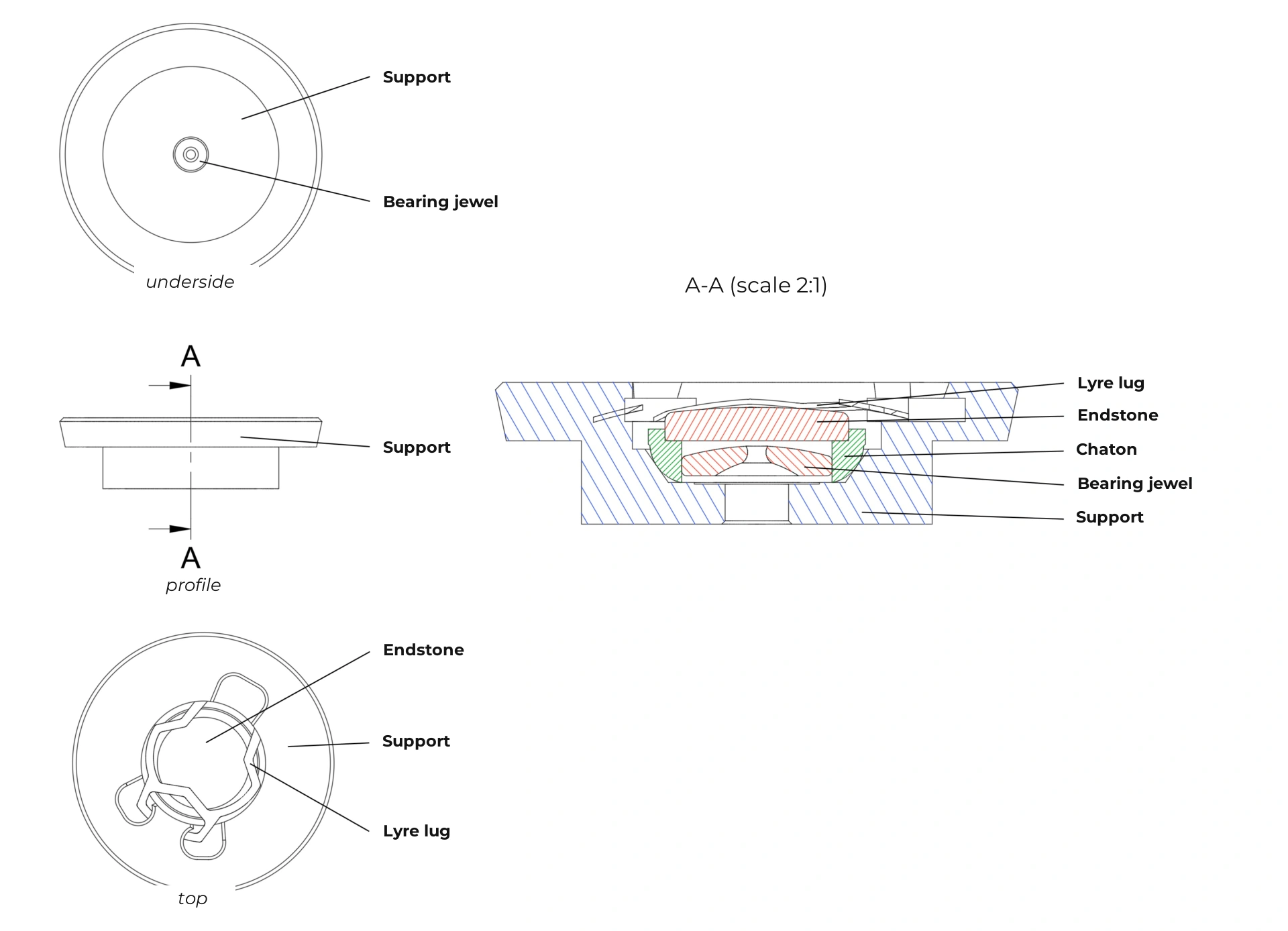
Figure 1
Diagram and cross-section of a shock-absorber bearing
Click on the thumbnail to enlarge it
Figure 2
Behavior of shock-absorbers during axial shocks (vertical displacement of the Balance staff)
Click on the animation to enlarge it
Figure 3
Behavior of shock-absorbers during radial shocks (tilting of the Balance staff’s Axis)
Click on the animation to enlarge it
2. History
Due to the significant Inertia of Balances and the small diameter of the pivots of their Axis, the breaking of the pivots of a balance staff due to shocks was common until the 19th century. It was in 1806 that Abraham-Louis Breguet filed the patent for the first shock-absorbing system, then called “pare-chute”.
3. Construction
The bearing jewel is firmly set into the lower part of the Chaton (jewel setting). It is drilled to allow the pivot to pass through. The endstone (flat and not drilled) is placed in the upper part of the removable chaton (jewel setting). The endstone is free, its diameter being slightly smaller than that of its seat in the chaton (jewel setting) (Figure 1). In the event of a drop (impact), this allows the endstone to absorb the shock by moving vertically along the pivot axis (Figure 2) and, simultaneously, to tilt 360° around this same axis (Figure 3). The chaton (jewel setting) itself is housed (with free fit) in the shock-absorber support, which is press-fitted into the bridge or the main plate. Finally, the chaton (jewel setting) is held in place against the bottom of the support by the blades of a removable spring: the lyre lug (Figure 1). It is the Lyre lug that absorbs shocks by allowing the Chaton (jewel setting) to move laterally and vertically within the support, and the Endstone jewel to move vertically relative to the Chaton (jewel setting) (Figures 2 & 3).
4. Lubrication
Most Shock-absorbers can be opened. In these cases, the Lyre lug can be opened or removed, allowing the Chaton (jewel setting) as well as the two jewels of the system to be easily extracted. The support, meanwhile, remains pressed into the Bridge or the Main plate. Once the Chaton (jewel setting) has been extracted, it is easy to remove the Endstone jewel from it and effectively clean each of the components.
Once it is clean, a Shock-absorber system can then be lubricated in two different ways:
- By opening the system and depositing Oil directly onto the flat of the Endstone jewel using an oil pick traditional. It then remains to delicately position the endstone jewel against the chaton (jewel setting), ensuring that the oil dosage and centering are correct. Finally, the chaton (jewel setting) is placed in its position in the support, and the assembly is closed using the lyre lug.
- It is also possible to assemble the entire system dry (without oil) directly onto the bridge or main plate and to lubricate the assembled shock-absorber using an automatic oiler by passing through the hole of the bearing jewel.
5. Fields of application
Shock-absorber systems are mainly used for the pivots of balance staffs and, more rarely, for those of escapement wheels.
This page has been automatically translated from the reference French version using an artificial intelligence tool. Errors or inaccuracies may remain. If you notice any, especially if this is your native language, please feel free to report them to info@horopedia.org. Your contribution helps us improve the quality of the encyclopedia.
Until they are translated, images and videos will remain temporarily displayed in French.
Thank you for your understanding.