
MENU
1. General Description
The straight line is a traditional mechanical instrument used in Guilloché (engine-turning) for engraving linear and repetitive geometric patterns on metal surfaces, particularly on Dials and the watch cases. Appearing during the 18th century, this machine relies on a system of cams, levers and carriages allowing the controlled movement of a graver along a straight line.
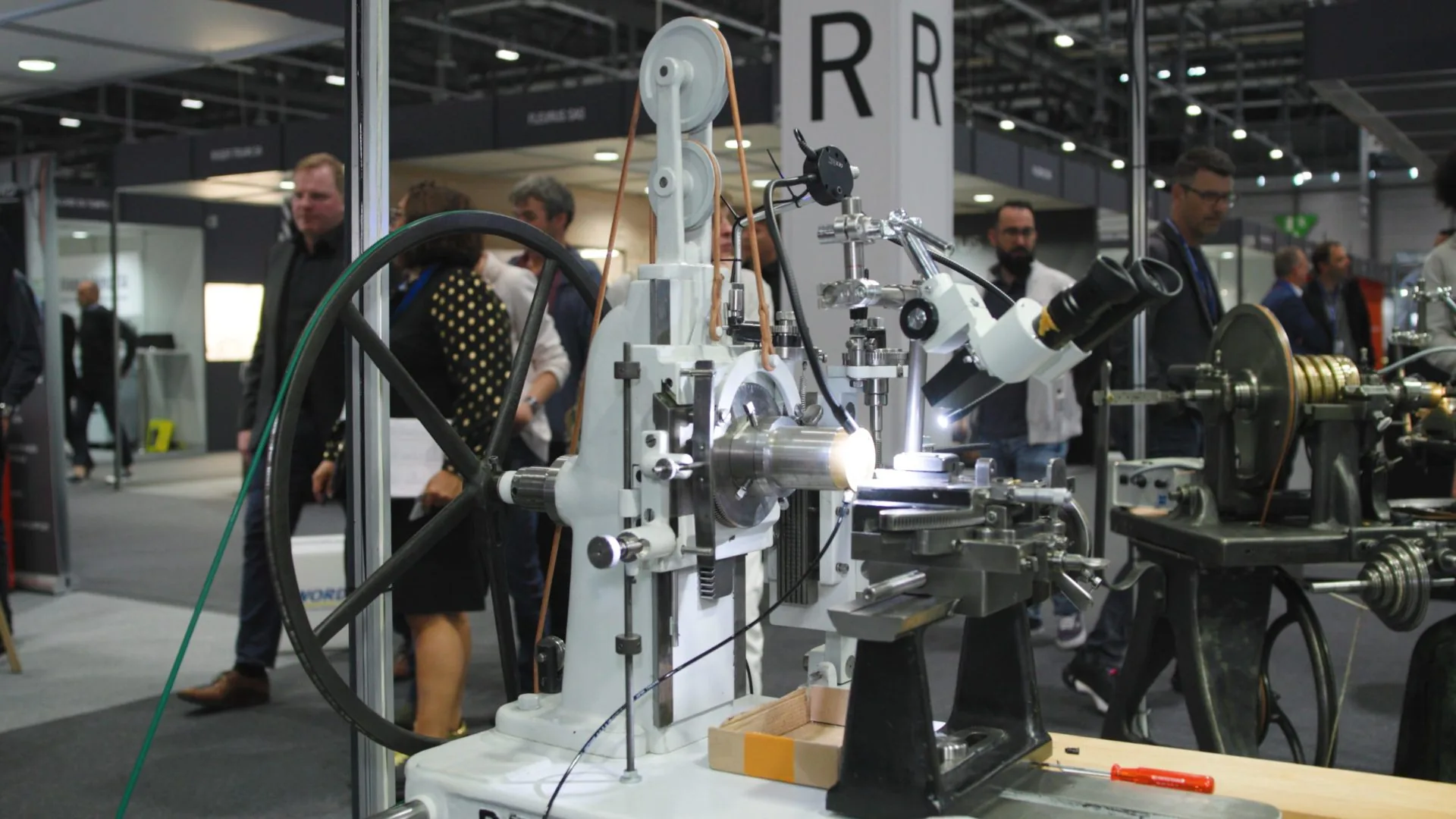
Figure 1
Straight line
Click on the thumbnail to enlarge
2. Operating principle
Unlike the Rose engine (guilloché lathe) which produces circular patterns, the straight-line machine executes exclusively rectilinear patterns. The main movement is provided by a longitudinal carriage, generally mounted on high-precision rails or slides. This carriage drives a graver holder that engraves the piece, often held on a movable table that can shift transversally to repeat the pattern at regular intervals.
The control of the pattern is provided by a cam (or model rule) fixed to the machine. This cam determines the amplitude and frequency of the undulations of the lines, allowing the creation of designs such as clous de Paris, parallel waves, basket weave, or even extremely fine straight lines. The depth and cutting pressure are, in turn, manually adjusted by the operator, giving each engraving a unique artisanal dimension.
3. Horological Applications
In horology, the straight line is mainly used to decorate dials, case backs, mainplates or, sometimes, bridges. The guilloché (engine-turning) pattern obtained is not merely decorative: it also plays a functional role by limiting reflections and improving the dial’s legibility.
Some manufactures still incorporate straight-line engines into their workshops today, reflecting a commitment to traditional craftsmanship and the transmission of artistic trades. Handling this machine requires years of experience and refined tactile sensitivity, as each pattern must be traced with extreme precision.
4. Mechanical Heritage
As with other guilloché instruments, old straight-line machines are now rare and carefully preserved. Their presence in a horologist’s workshop is often seen as a mark of authenticity and craftsmanship excellence. In the age of digital production, the continued use of these machines embodies a desire to perpetuate a traditional mechanical aesthetic.
This page was automatically translated from the French reference version using an artificial intelligence tool. Errors or inaccuracies may remain. If you notice any, especially if this is your native language, please feel free to report them to info@horopedia.org. Your contribution helps us improve the quality of the encyclopedia.
While awaiting their translation, images and videos remain temporarily displayed in French.
Thank you for your understanding.