
TEMPERATURE
Temperature is a physical quantity that reflects the state of thermal agitation of the particles making up matter. The more intense this agitation, the higher the temperature. It is measured using a thermometer.
Units of measurement
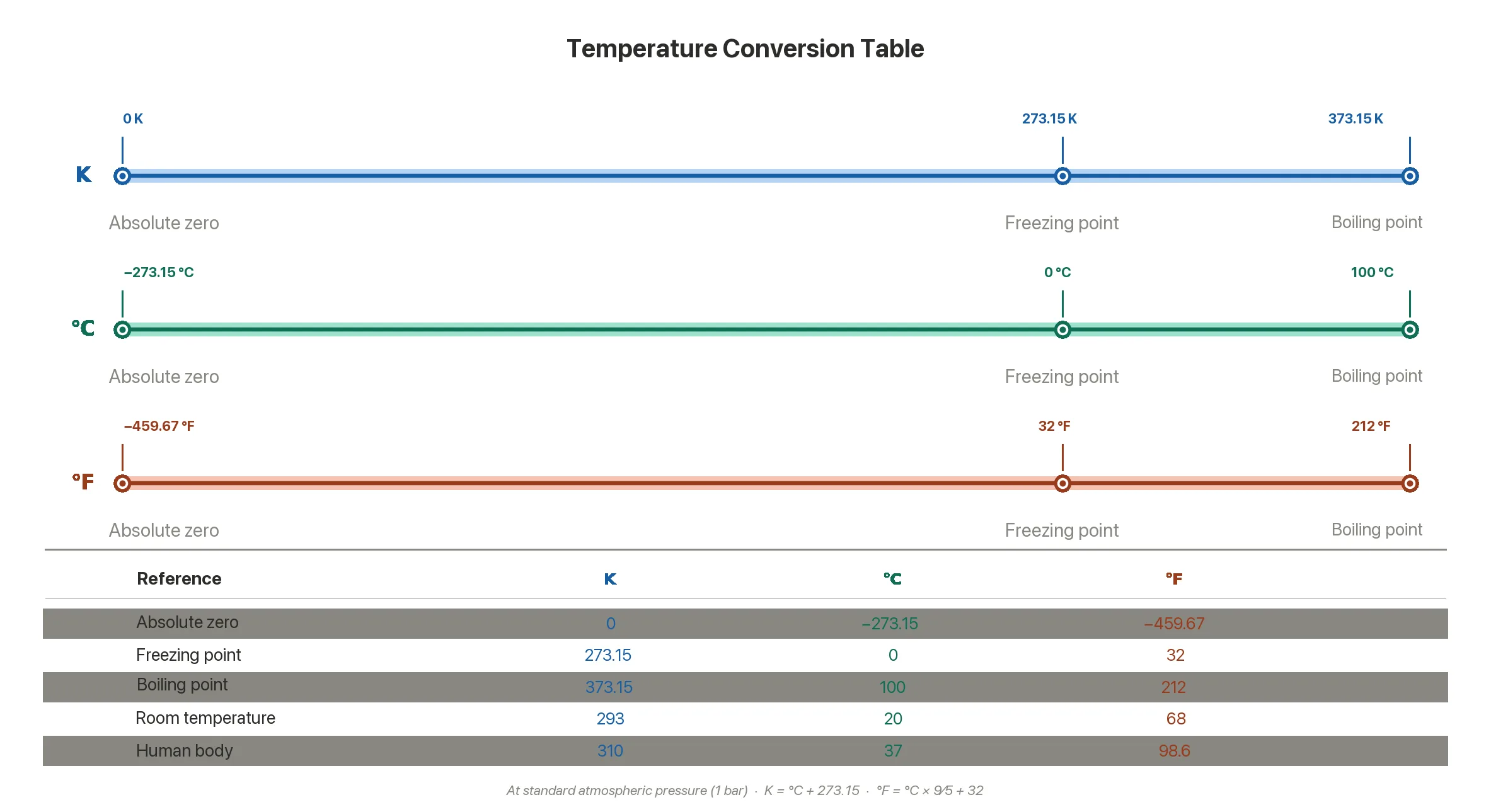
Three units coexist depending on the context and region of the world.
The Celsius degree (°C) is the most widespread unit in Europe and in most countries. Its scale is defined by two physical reference points: the melting point of water at 0 °C and its boiling point at 100 °C, both measured at an atmospheric pressure of 1 bar.
The Fahrenheit degree (°F) is used in the United States and in some Anglo-Saxon countries. Its scale, more tightly spaced, establishes the following correspondences: 0 °C = 32 °F and 100 °C = 212 °F.
The Kelvin (K) is the official unit of the International System of Units (SI). Its scale is identical to that of Celsius — a difference of 1 K corresponds exactly to a difference of 1 °C — but its origin is set at absolute zero, the theoretical temperature at which all thermal agitation ceases (−273.15 °C). Thus, 0 °C = 273.15 K.
Role in horology
Manufacturing and metrology
Machine tools used in horology commonly achieve precisions on the order of a micrometre (10⁻⁶ m). At this scale, dimensional variations induced by thermal fluctuations can compromise the conformity of machined parts. The thermal stability of production environments is therefore an essential condition for maintaining these tolerances.
Thermal expansion and material selection
Any solid material expands under the effect of heat and contracts under the effect of cold, according to a coefficient specific to each material: the coefficient of thermal expansion. In a horological movement, where components are adjusted with extreme precision, these dimensional variations can significantly alter the regulation and chronometric precision. The coefficient of expansion thus constitutes one of the determining criteria in the choice of materials, particularly for regulating organs.
It was precisely this problem that Charles-Édouard Guillaume solved with the discovery of Invar and Elinvar, two steel alloys with near-zero expansion. This work earned him the Nobel Prize in Chemistry in 1920 and marked a decisive advance for horological precision.
Heat treatments
Temperature also plays a central role in manufacturing processes. Heat treatments — quenching, tempering, annealing — modify the mechanical properties of metals and require precise measurement and testing of the applied temperatures. While industry uses sophisticated thermal measurement systems, traditional craftsmanship retains its own benchmarks: the experienced craftsman assesses the tempering temperature of steel with the naked eye, reading the succession of oxidation colours taken on by the heated metal — from straw yellow to steel blue — each shade corresponding to a characteristic temperature range.
This page has been automatically translated from the French reference version using an artificial intelligence tool. Errors or inaccuracies may remain. If you notice any, especially if this is your native language, please feel free to report them to info@horopedia.org. Your contribution helps us improve the quality of the encyclopedia.
While awaiting their translation, images and videos remain temporarily displayed in French.
Thank you for your understanding.