
MENU
1. General description
Function and position
It is generally to the case middle that the movement is attached. It is held in position there and perfectly protected. The lugs can be attached to it (soldered, or even screwed) or directly machined or stamped in the same block of material.
The case middle serves as a mounting support for most of the other elements of the case, such as the bezel and the case back.
Shapes
Like the case, the case middle can come in all shapes (round, square, tonneau, polygonal, etc.). The outer wall of the case middle, that is to say its circumference, is called the “case middle band”.
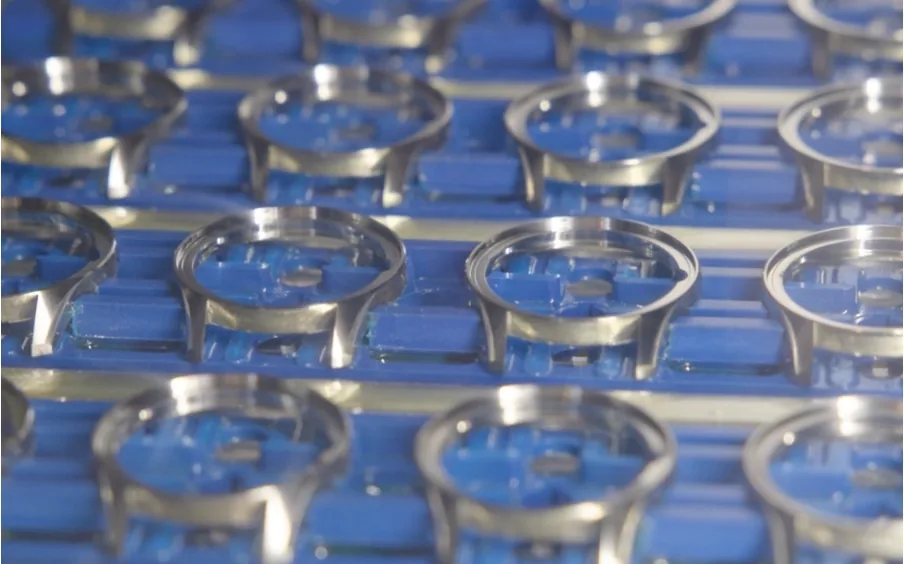
Figure 1
Case middles being manufactured
Click on the thumbnail to enlarge it
2. History
The case middle appeared in the 17th century with the first developments of pocket watches. They were the work of specialized craftsmen. Between the 17th and 19th centuries, many of them mastered the mechanical manufacturing of cases and the technique of enamel which often adorned the cases of the most prestigious watches. Thanks to its reputation established as early as the 16th century, Geneva was the foremost center of this craft, and the virtuosity of its cabinotiers remains, to this day, often unrivaled.
3. Artisanal manufacturing of a case middle
Traditionally, a case middle can be manufactured using a lathe and a milling machine. This method is still used by some craftsmen for the manufacturing of unique pieces or very small series, or even for prototyping.
4. Semi-industrial production of a case middle
This is the most widely used method today. In these cases, machining centers are used. This method is employed for both small and large series. Modern machining centers make it possible to automate production and carry out all manufacturing steps, with the exception of polishing and assembly.
It is also the method that allows the widest variety of materials to be worked. This method is considered industrial once production volumes reach a certain threshold. When the case is machined using this method, the lugs are often welded to the case middle.
5. Industrial production of a case middle
When it comes to producing case middles in large series, stamping remains a highly competitive and high-quality solution, even though this technique is one of the oldest used in watchmaking. Unlike machining centers, which require long hours of machine adjustment and programming, stamping allows production to be implemented very quickly once the tool (the die) has been manufactured. The greater the production (even fragmented), the lower its costs. Quality remains consistent and precise even after years of production. Unfortunately, not all materials are suitable for this method.
6. High-tech production of a case middle
The advent of plastic materials, then composites, and even synthetic sapphires, has led to the rise of new technologies. Injection manufacturing processes remain predominant in this field. In some cases, they make it possible to achieve a finished product.
In other cases, machining and/or polishing steps will be necessary. The evolution of materials and technologies should lead to the rapid emergence of new processes (photolithography, 3D printing, etc.) intended for production.
This page has been automatically translated from the French reference version using an artificial intelligence tool. Errors or inaccuracies may remain. If you notice any, especially if this is your native language, please feel free to report them to us at info@horopedia.org. Your contribution helps us improve the quality of the encyclopedia.
Pending their translation, images and videos remain temporarily displayed in French.
Thank you for your understanding.