
MENU
1. General description
The swan’s neck is an elegant spring made of steel, reserved exclusively for watches equipped with a hairspringflat and of a certain high-end quality level. Its name comes from its particular shape. The Swan’s neck screws onto the upper face of the Balance cock (Balance bridge) and “embraces” the tail of the Regulator. Technically, the Swan’s neck plays a dual role. It allows the Regulator to be pressed against the stop formed by the micrometric Screw associated with the Swan’s neck. Thus the Regulation / Adjustment established by the Horologist (watchmaker) always remains the same and is not at risk of being altered by a shock. The combination of the Swan’s neck and its micrometric Screw allows for achieving and maintaining a much finer Regulation / Adjustment than with a traditional system lacking the Swan’s neck-micrometric Screw tandem.
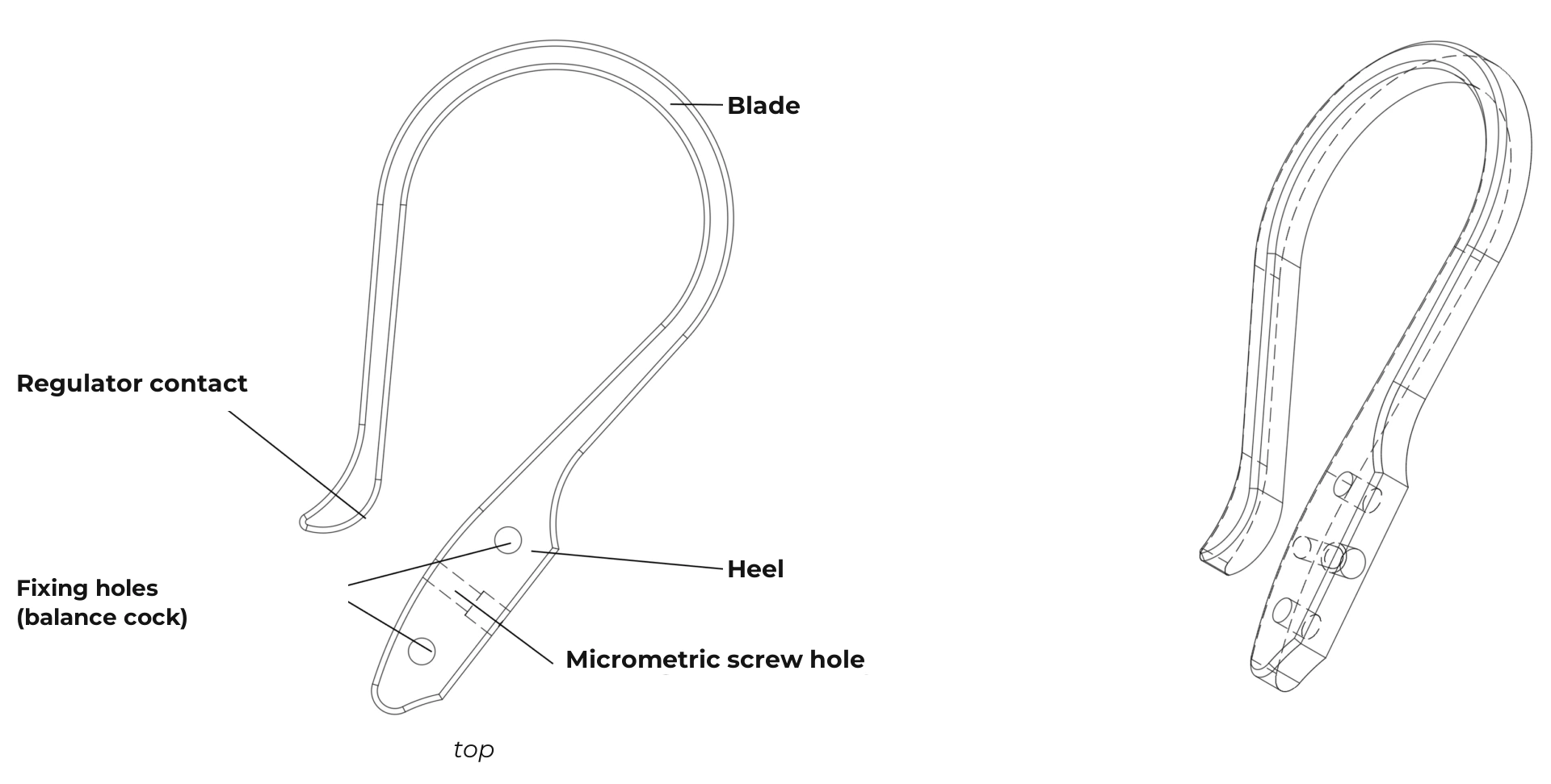
Figure 1
Diagram of a Swan’s neck
Click on the thumbnail to enlarge it
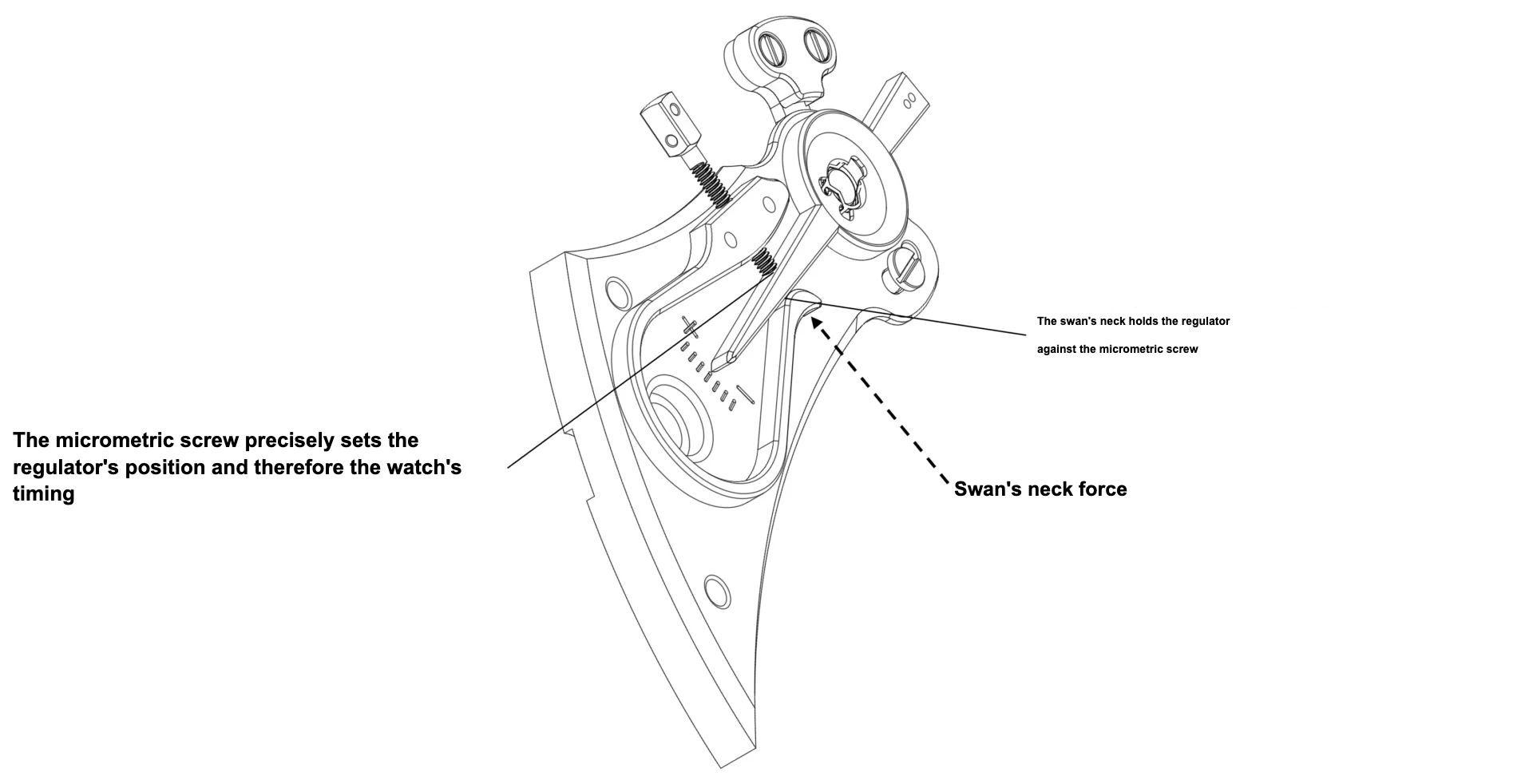
Figure 2
Assembled Swan’s neck (interaction between Regulator and micrometric Screw)
Click on the thumbnail to enlarge it
2. History
It is difficult to attribute the invention of the swan’s neck and to date its appearance. Obviously, it comes after the invention of the Balance–Hairspring (balance spring) by Christian Huygens in 1675. It seems that the swan’s neck emerged as chronometry evolved significantly during the 19th century. Such mechanisms still exist today in high-end traditional watchmaking; however, similar mechanisms have since been developed (e.g.: a double-arm regulator adjusted and constrained in its position by an eccentric stud). Such systems achieve the same level of result, from a strictly technical and functional standpoint, at a lower production cost. They simply do not offer the same aesthetic nor the same poetry as a finely Beveled / Chamfered.
3. Handcrafted manufacturing of a swan’s neck
The horologist (watchmaker) begins the handcrafted manufacturing of a swan’s neck by tracing its profile using a scribing point on the surface of a plate of steel with a thickness slightly greater than that of the finished component. He then marks the various drilling points (the screws and the feet). Then he carefully cuts the outline of the spring using a piercing saw (jeweler’s saw). The sides of the spring are then filed to bring it to its final thickness, in strict accordance with its shape. The heel and the blade of the spring are then beveled / chamfered and polished using the usual tools (files, scrapers, polishing). These operations are particularly delicate due to the Length, thinness and shape of the Swan’s neck Blade. According to the rules of the art, the craftsman then stretches the lines of the sides of the piece (Satin finish) and the tiny flat that remains on the upper face of the spring.
The Heat treatments and the whitening operations that follow them are also particularly delicate due to the Length, shape and thinness of the spring. The optional nature of the Swan’s neck, its artisanal dimension, and thus the time and cost it requires, make it a component reserved for watches of a certain level of range (in terms of quality and price).
4. Artisanal Decoration of a Swan’s neck
5. Semi-industrial production of a Swan’s neck
To optimize the production costs of a single piece or a small series of components, Electrical discharge machining (EDM) proves particularly interesting. The implementation costs and machine processing time remain relatively low and suited to small production volumes. Moreover, this technology makes it possible to cut complex and thin profiles, such as those of the Swan’s neck, without exerting any mechanical stress on the component during its manufacture. Compared with the traditional craftsmanship method, cutting by Electrical discharge machining (EDM) offers a considerable time saving with good repercussions on the Decoration steps. The end of the manufacturing and decoration process is similar to the traditional craftsmanship method. Generally, the manufacturing cost of a Swan’s neck is such that it is reserved for prestige (high-end) watches. As a result, the finishes applied to it are most often part of traditional high-end horology.
6. Industrial production of a Swan’s neck
Large-scale series production justifies investing in a stamping die (striking tool) to manufacture Swan’s necks at optimal cost. The widened outline of the profile is thus stamped directly into a strip of steel with a thickness slightly greater than that of the finished component using a stamping press. However, manual steps remain essential. The feet must be driven in to allow its positioning on the balance cock, the spring brought to its final dimensions (profile and thickness), while giving it the finishes and the decorations desired (satin finish, beveling / angling, etc.).
This page has been automatically translated from the French reference version using an artificial intelligence tool. Errors or inaccuracies may remain. If you notice any, especially if French is your native language, please feel free to report them to info@horopedia.org. Your contribution helps us improve the quality of the encyclopedia.
While awaiting translation, images and videos remain temporarily displayed in French.
Thank you for your understanding.