
MENU
1. General description
The click spring belongs jointly to the winding mechanism and to the hand-setting. It allows maintaining the lever/rocker in permanent contact with the setting lever. Depending on the quality of the watch, this can be a blade spring cut from the mass of a steel plate or a simple wire spring.
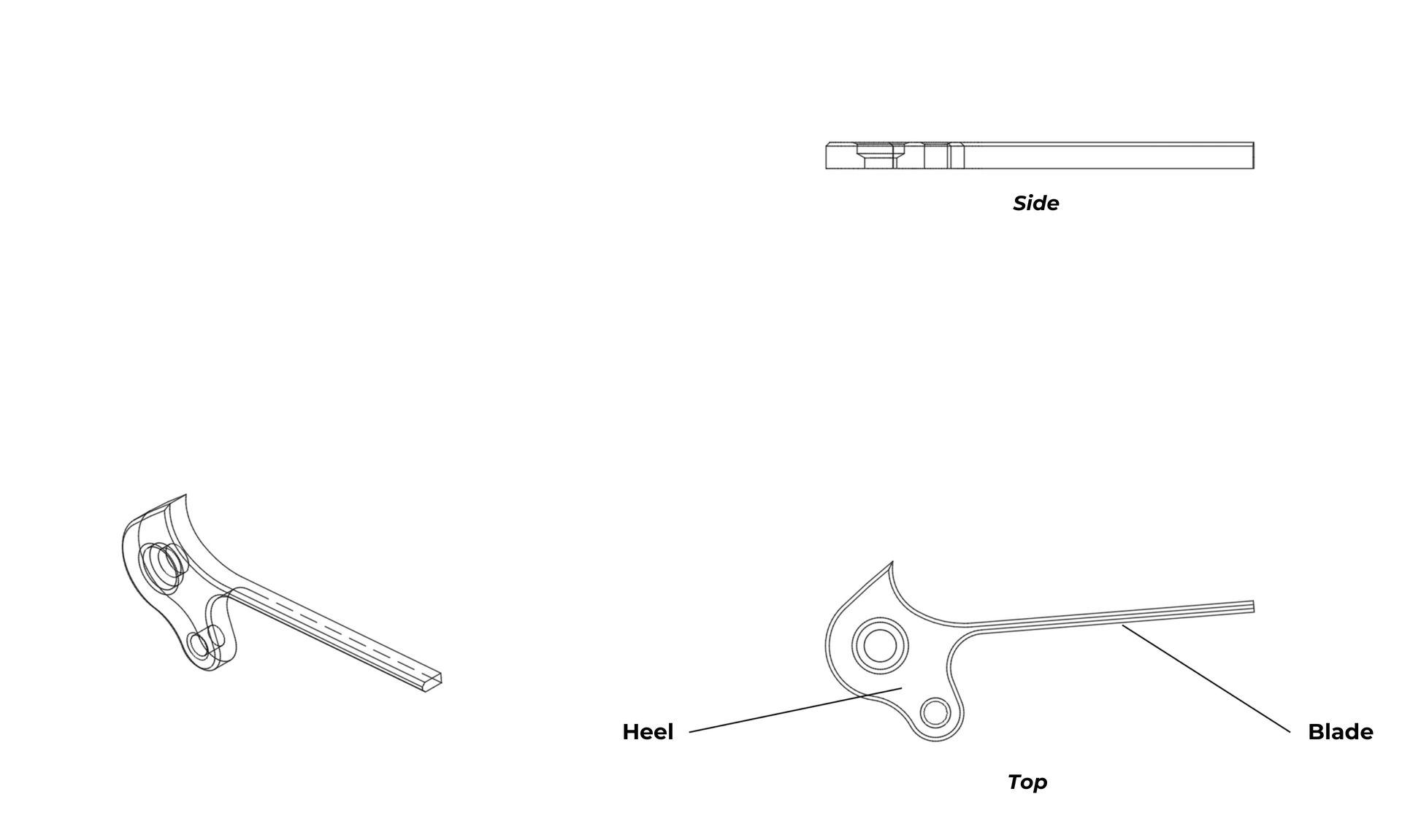
Figure 1
Diagram of a click spring
Click on the thumbnail to enlarge it
2. History
The lever/rocker and thus its spring appeared in 1847 with the invention of the rocking-bar winding mechanism by Antoine Le Coultre, whose lever/rocker is the central element. It has since made it possible to switch the control of the crown between the winding mechanism and the hand-setting mechanism, at the very least.
The major developments made to Le Coultre’s invention consisted of multiplying the functions adjustable by the crown.
3. Handcrafted manufacture of a click spring
The watchmaker begins the handcrafted manufacture of the click spring by engraving its profile using a scribing point on the surface of a plate of steel of a thickness slightly greater than that of the finished component. He then marks the various drill points (screws and feet). Then he carefully cuts out the outline of the spring using a piercing saw (jeweler’s saw). The sides of the spring are then filed to bring the spring to its final thickness while strictly maintaining its shape. The heel and the blade of the spring are then beveled and polished using the usual tools (files, burnishers, polishing). These operations are particularly delicate due to the length, the fineness, and the shape of the spring’s blade. According to the rules of the craft, the artisan then draws out the lines on the sides of the piece (satin finish) and of the tiny flat surface remaining on the upper surface of the spring.
The heat treatments and the whitening operations that follow are also particularly delicate due to the length and fineness of the spring.
4. Handcrafted decoration of a click spring
5. Semi-industrial manufacture of a click spring
To optimize production costs for a single piece or a small series of components, Electrical discharge machining (EDM) is particularly advantageous here. The implementation costs and machine processing time remain relatively low and suited to small production volumes. Moreover, this technology allows for the cutting of complex, fine profiles without exerting any mechanical stress on the component during its manufacturing. Compared to the artisanal method, cutting by EDM offers a considerable time saving with good repercussions on the decoration. The end of the manufacturing and decoration process is akin to the craftsmanship method or the level of finishing required.
6. Industrial production of a click spring
Large-scale production justifies the investment in a stamping die (striking tool) to manufacture click springs at an optimal cost. The enlarged contour of the profile is thus punched directly into a strip of steel with a thickness slightly greater than that of the finished component using a stamping press. Manual steps nevertheless remain unavoidable. The click spring must thus be brought to its final dimensions (profile and thickness) while giving it the desired finishes and decorations (satin finish, beveling/angling etc.).
On an industrial scale, and for a quality less refined than that obtained by the method described above, manufacturers commonly use a simple wire spring. This is a steel wire cut to length and shaped, and sufficiently elastic to fulfill its function as a spring.
This page was automatically translated from the reference French version using an artificial intelligence tool. Errors or inaccuracies may remain. If you notice any, especially if this is your native language, please feel free to report them to us at info@horopedia.org. Your contribution helps us improve the quality of the encyclopedia.
Pending their translation, images and videos remain temporarily displayed in French.
Thank you for your understanding.