
MENU
Duplex escapement (2 Hz)
Speed 1:3
Duplex escapement (2 Hz)
Real operating speed
1. History
Adaptation of the escapement for a pendulum created by Jean-Baptiste Dutertre, the duplex escapement found its functional and definitive design around 1750 by Pierre Leroy.
It takes its name from the double profile of its escape wheel, composed of two distinct series of teeth, each fulfilling a specific role (unlocking and impulse) in the process of releasing and transmitting energy.
For a century, the duplex escapement underwent several developments improving its accuracy and reducing its production cost (the escape wheels could be manufactured by stamping). One of the best-known variants of the duplex escapement was developed by Charles-Edouard Jacot. The Duplex-Jacot escapement operates with 3 lost beats, that is one impulse every four vibrations. Combined with a balance oscillating at 14,400 vph (i.e. 4 vibrations per second), it therefore allows a dead seconds display without needing a dedicated mechanism (the seconds hand jumps once per second).
Contemporary with the cylinder escapement, the duplex escapement enjoyed great success before it too was superseded and replaced by the Swiss lever escapement.
2. Description
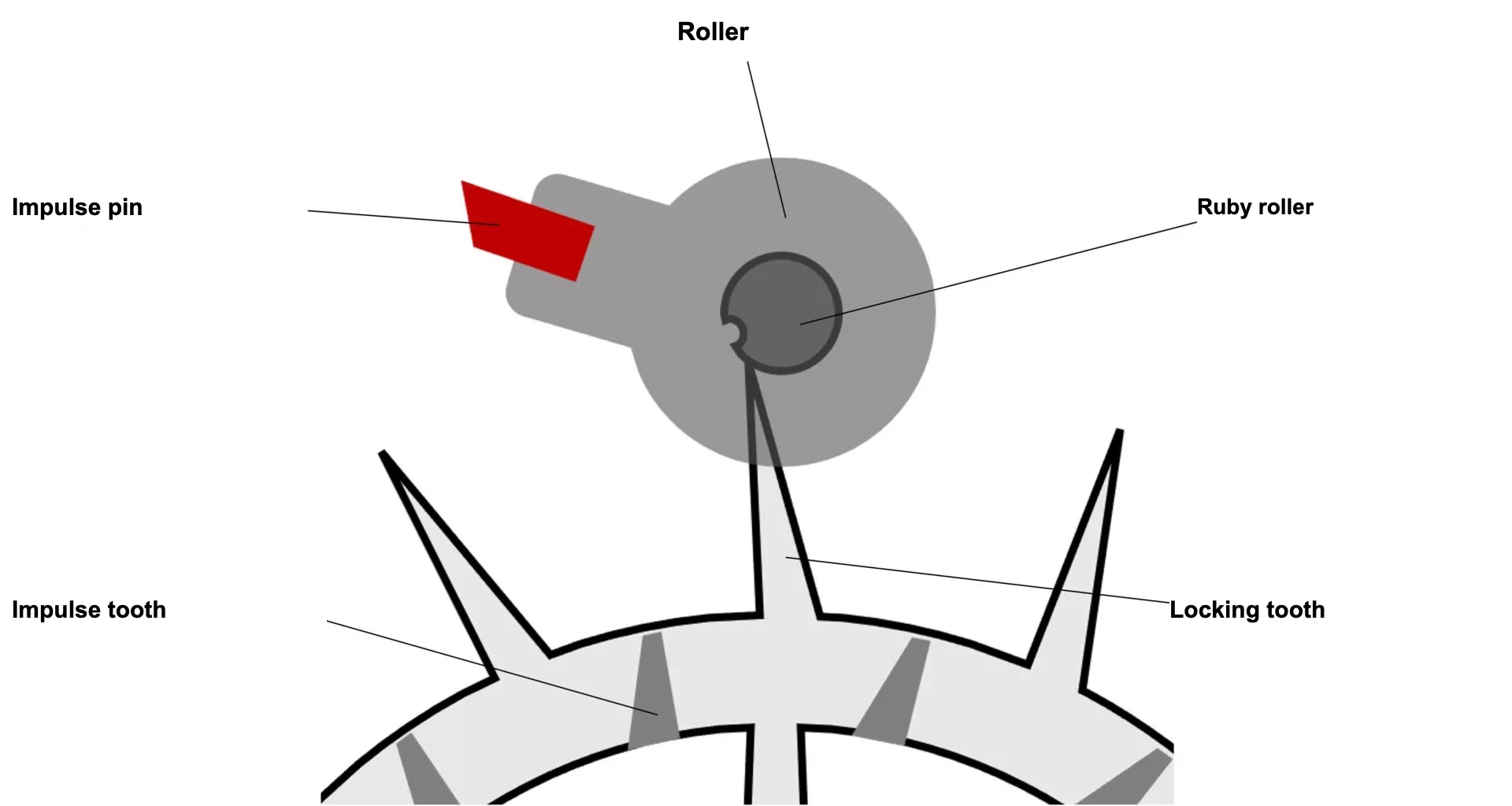
Figure 1
Click on the thumbnail to enlarge it
The duplex escapement, as described here, is a lost-beat escapement, because it transmits only one impulse to the balance per oscillation, and a frictional-rest escapement, because a resting tooth of the escape wheel remains constantly in contact with the roller when the balance performs its supplementary arc. The balance staff carries a notched cylinder, generally in Ruby / Jewel, called the roller. This is glued to the balance staff. Above the roller is the plate pressed onto the balance staff. This plate is fitted with the impulse finger (or lift finger) in steel or in Ruby / Jewel for the highest quality constructions. At the periphery of the escape wheel there is a row of pointed teeth called resting teeth while on the felloe (rim base) of this same wheel, there is another row of trapezoidal teeth called impulse teeth. Depending on the construction, the escape wheel may have between 12 and 15 teeth of each kind (always an equal number for each kind).
3. Operation
The operation of the duplex escapement can be divided into four phases that occur invariably according to the same cycle with each oscillation of the regulating organ. These four phases are:
- Rest
- Unlocking (small lift)
- Impulse (large lift)
- Silent vibration (lost beat)
Let us detail below the action of each component during each of the four phases:
1. Rest
While the balance performs its supplementary arc, a resting tooth is resting against the roller (Figure 2).
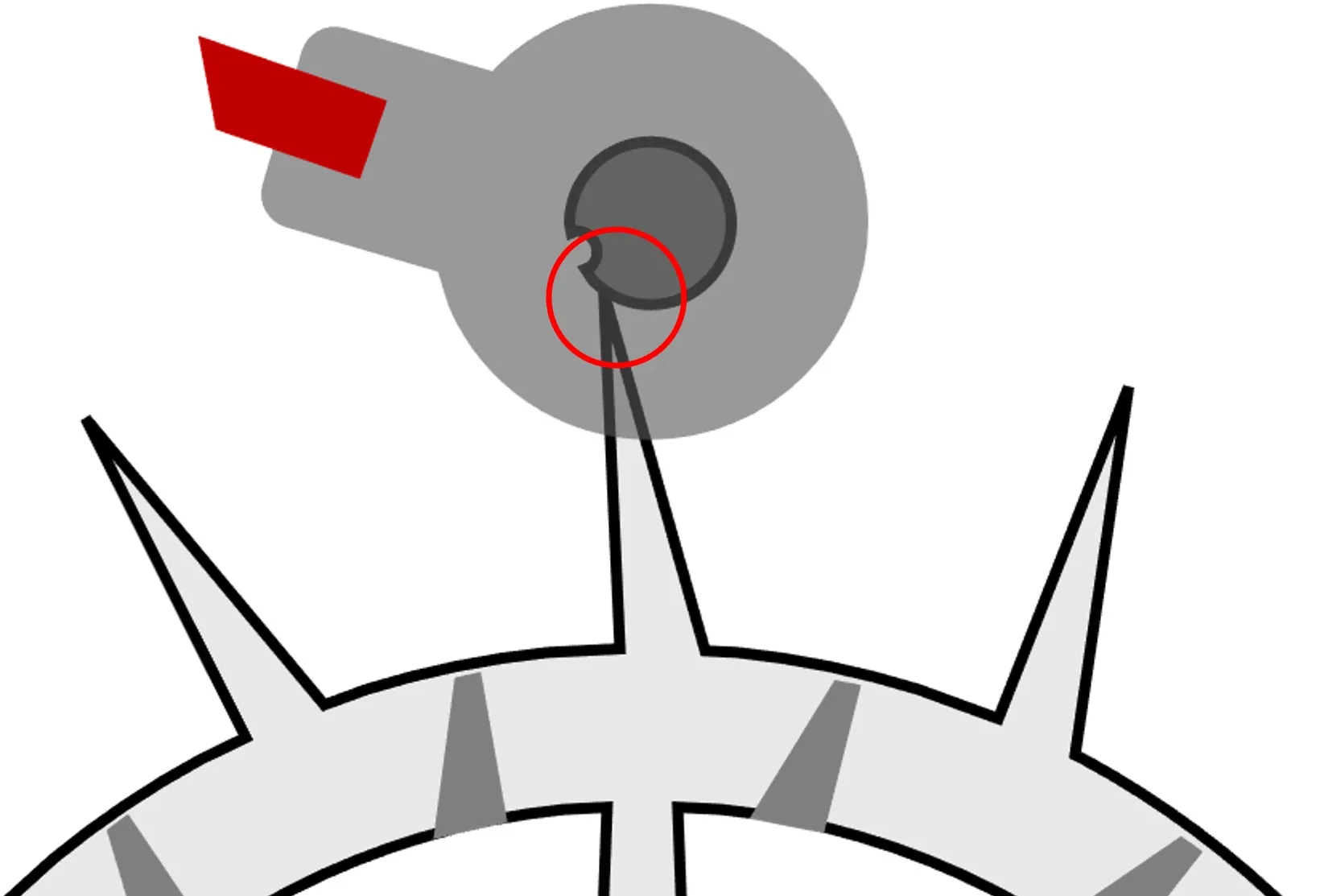
Figure 2
Click on the thumbnail to enlarge it
2. Unlocking (small lift)
When the balance finishes its descending supplementary arc, the resting tooth pressed against the periphery of the roller enters the notch of the roller, thus releasing the escape wheel (Figure 3).
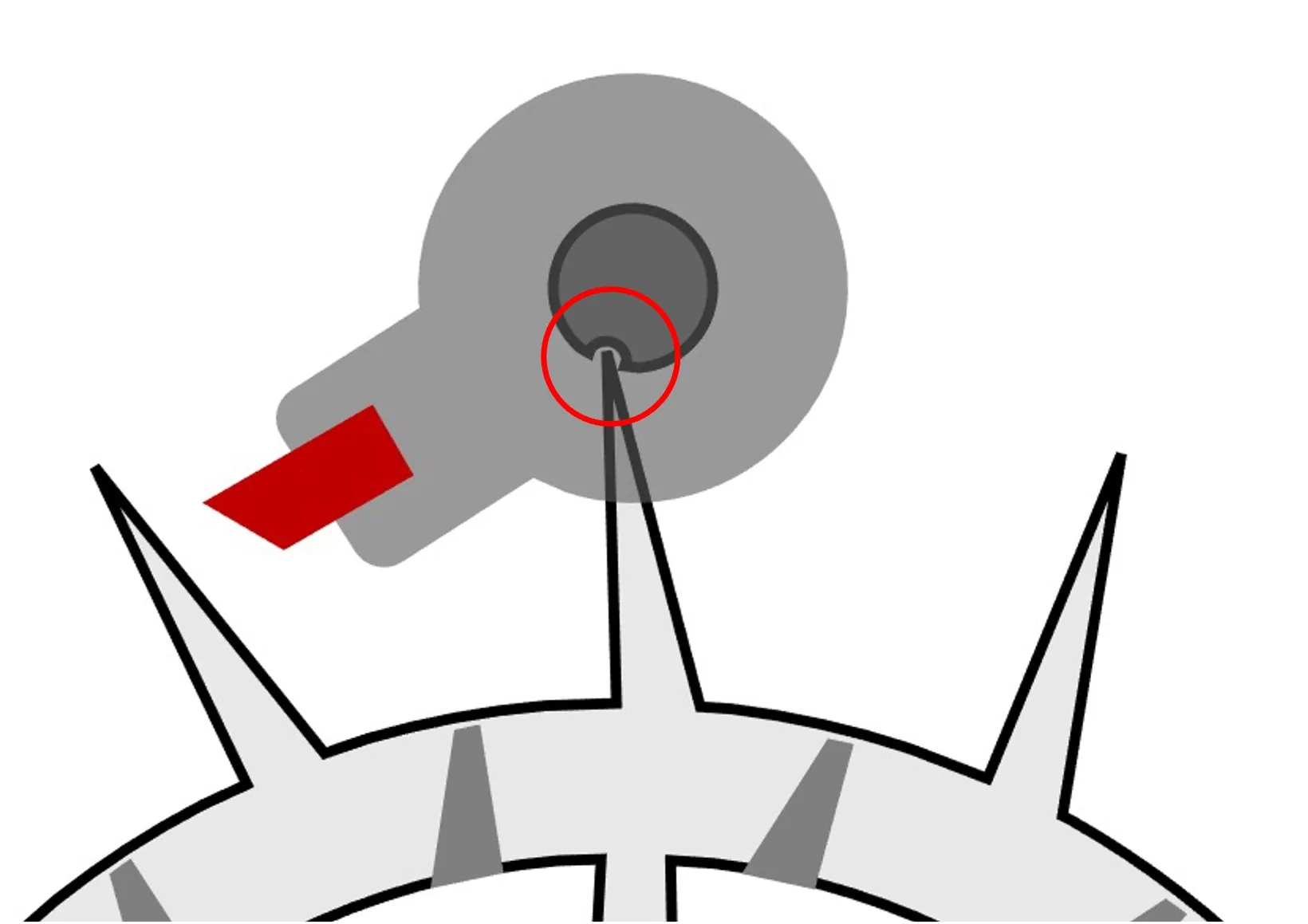
Figure 3
Click on the thumbnail to enlarge it
3. The impulse (large lift)
The escape wheel catches up with the plate. An impulse tooth of the escape wheel comes into contact with the impulse finger carried by the plate (Figure 4).
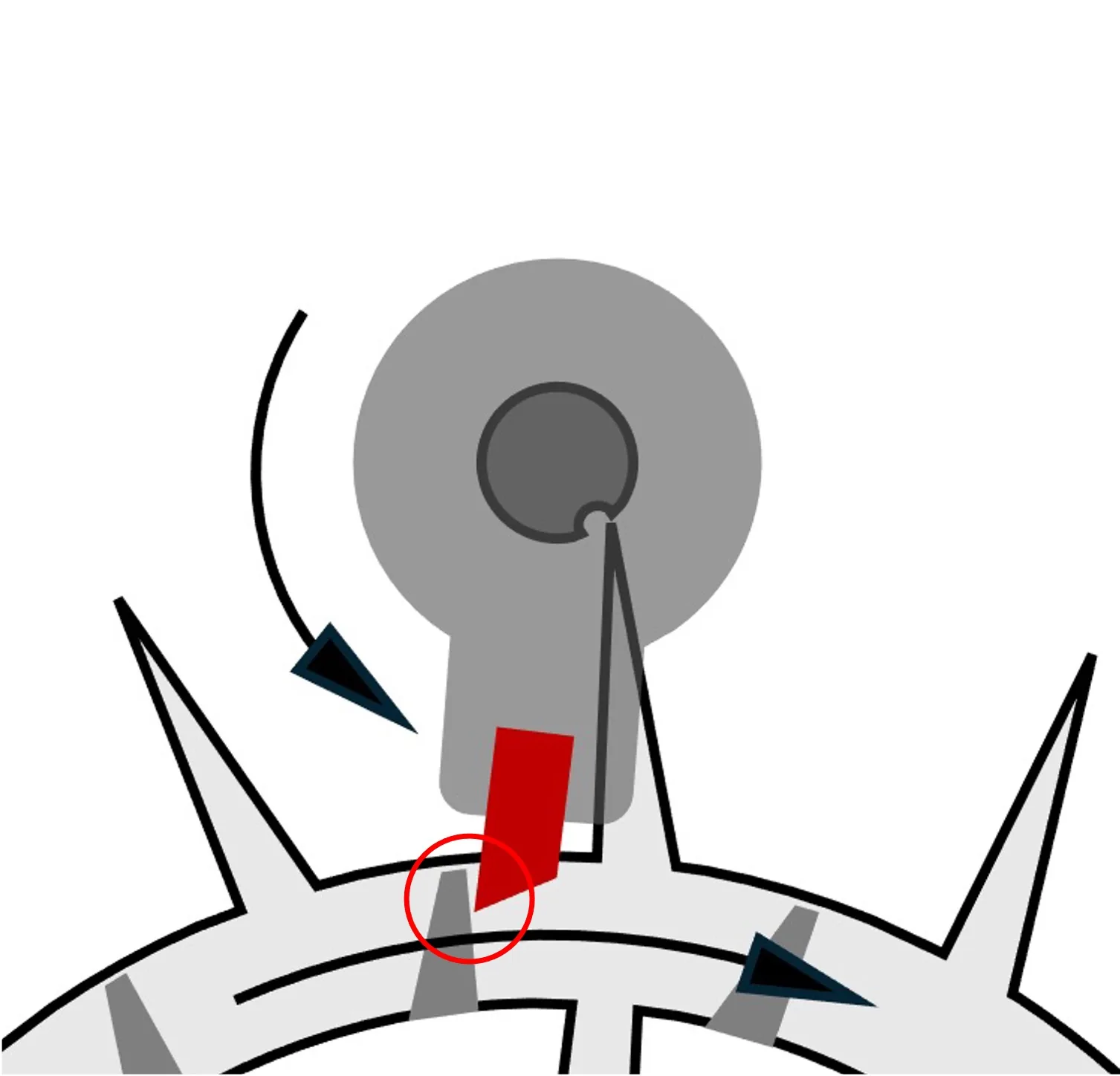
Figure 4
Click on the thumbnail to enlarge it
As soon as the impulse phase is over, the next resting tooth of the wheel comes to rest against the circumference of the roller, while the balance performs its additional ascending arc (Figure 5).
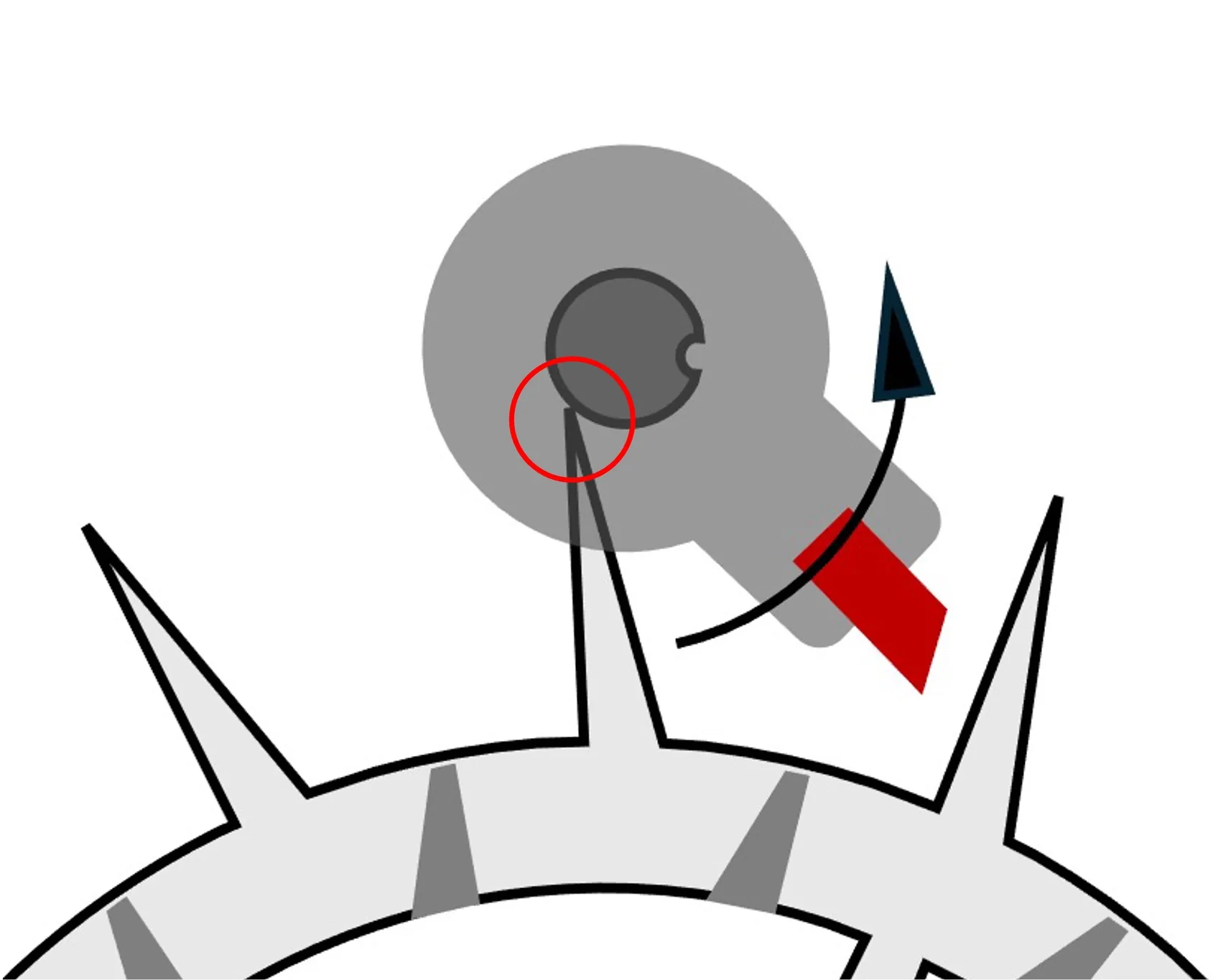
Figure 5
Click on the thumbnail to enlarge
4. The silent vibration (lost beat)
The balance performs this vibration without receiving an impulse. The impulse finger of the plate passes between two impulse teeth without there being the slightest contact between them. The resting tooth remains in contact against the roller. As the notch passes against the resting tooth, the wheel makes a brief jolt (slight forward and backward movement) (Figure 6).
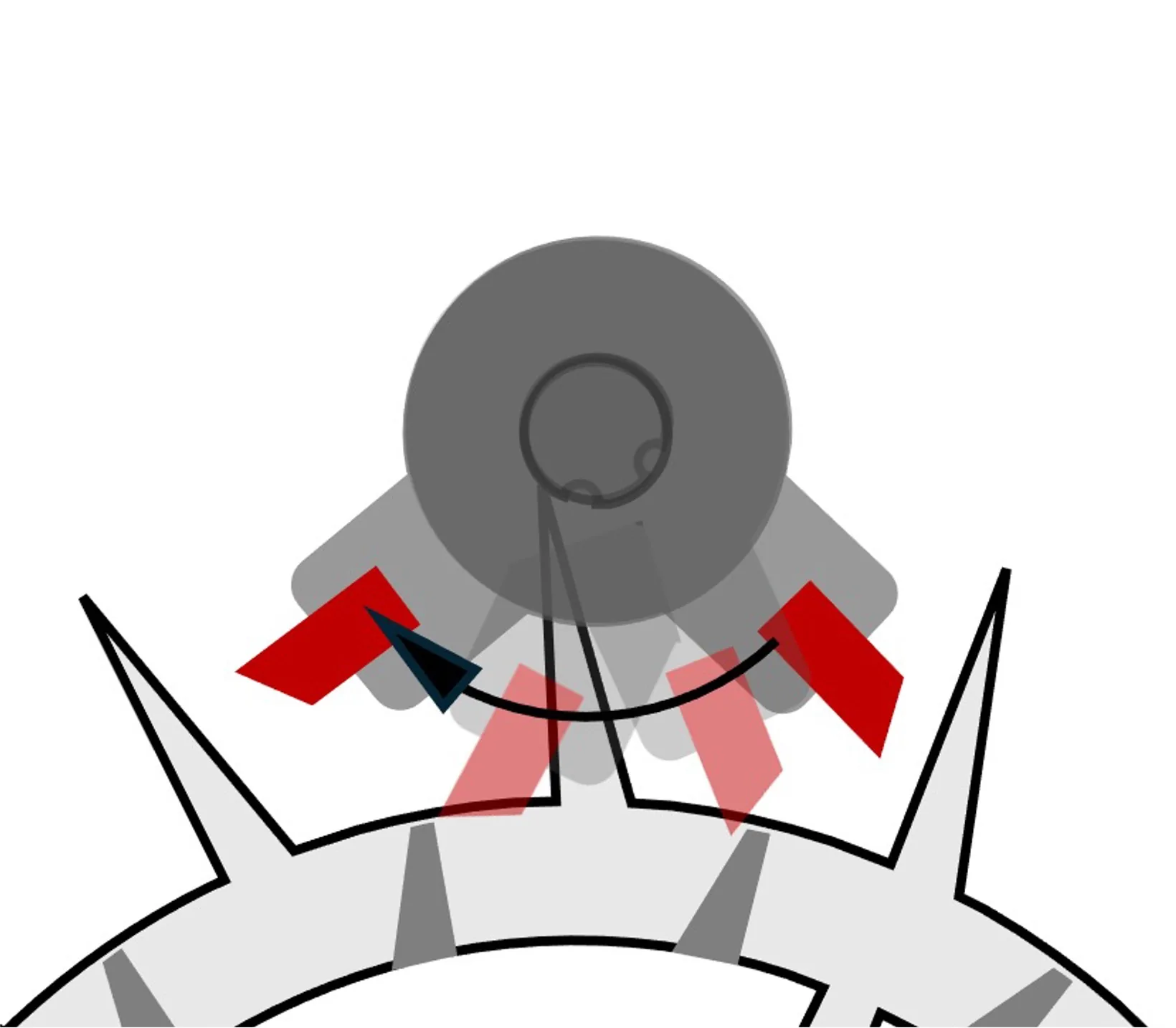
Figure 6
Click on the thumbnail to enlarge
Note:
For a complete overview of how the duplex escapement works, refer to the two animations at the top of this page.
4. Advantages and disadvantages
Advantages
The Duplex escapement offers several notable advantages:
- Great regularity of the balance due to the separation of the impulse and rest phases.
- Reduced friction compared to the cylinder escapement or verge escapement.
- Relative simplicity of the mechanism, with a small number of interacting moving components.
- Limited manufacturing cost, the escape wheel can be manufactured by stamping.
These qualities make it particularly suited to high-precision pocket watches used before the advent of the Swiss lever escapement.
Drawbacks
Despite its technical merits, the duplex escapement also has several limitations:
- Mechanical fragility, particularly of the dual-profile escape wheel whose resting teeth are relatively delicate.
- Sensitivity to shocks, making it poorly suited for watches worn under dynamic conditions.
- Unidirectional impulse, requiring precise adjustments to balance the oscillations of the balance.
These defects contributed to its gradual disappearance in favor of more reliable escapements with less friction (free escapements)
This page was automatically translated from the reference French version using an artificial intelligence tool. Errors or inaccuracies may remain. If you notice any, especially if this is your native language, please do not hesitate to report them to us at info@horopedia.org. Your contribution helps us improve the quality of the encyclopedia.
While awaiting their translation, images and videos remain temporarily displayed in French.
Thank you for your understanding.