
MENU
1. Interview with Vanessa Lecci (enameller)
2. General description
Millennia-old, enamel remains a material that is still just as difficult to master. Creating enamel requires essentially the same know-how as in Antiquity. Yet it is a difficult exercise that combines two variables: the proportion of the components and their thermal treatment.
Its base component is silica. It is melted with a ‘flux’, which reduces its melting temperature to around 800°C. The material thus obtained is taken out of the kiln and, before it cools, colouring agents are added: most often copper oxides or other minerals.
The colourants used are metallic oxides:
- – selenium (in the absence of lead) for a yellow colour;
- – uranium for a vivid orange colour;
- – iron for blue, brown, black;
- – chromium for green and pink;
- – copper for green, red and blue;
- – cobalt for a deep blue and green;
- – manganese for mauve;
- – metallic gold for a strong red (Cassius purple).
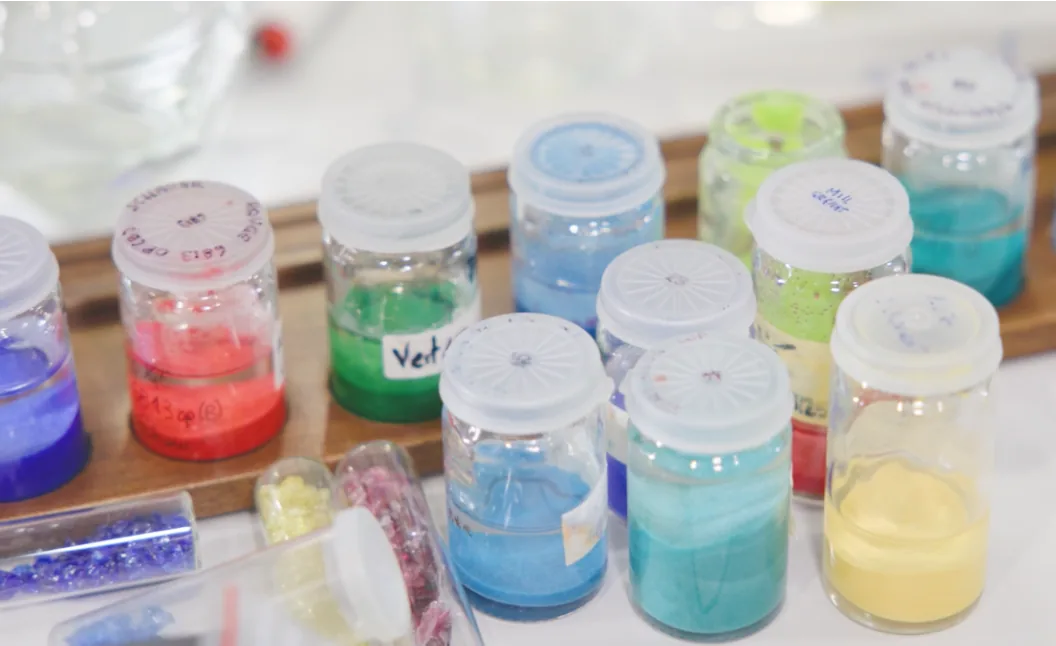
Figure 1
Enamel (different colours)
Click on the thumbnail to enlarge it
This first step produces a block of coloured glass. It must be heated again and then cooled to reduce it to pieces, which are crushed in an agate mortar with a pestle of the same material.
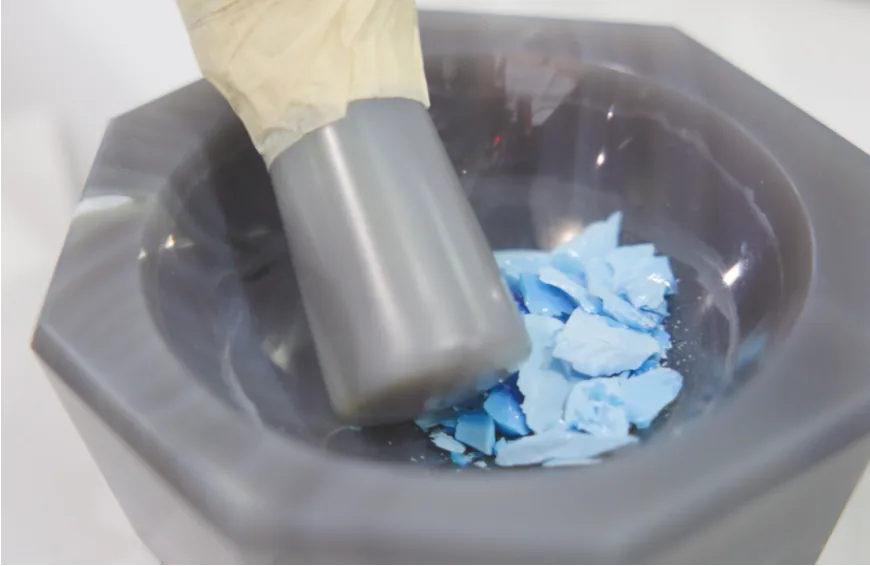
Figure 2
Coloured silica before being ground into powder
Click on the thumbnail to enlarge it
Each colour is ground separately. Once a powder with even grains is obtained, the Enamel is washed with distilled water about ten times in order to achieve absolute purity. The Enamel is then mixed with this distilled water to form a paste. It is generally applied with a brush or spatula onto a metal support made of Copper, Gold, Silver, bronze or Iron, then fixed through a series of firings in a kiln, at a Temperature between 650°C and 950°C.
3. History
Enamel is a fusible substance, composed of various minerals, rendered very hard by heat, intended to cover various materials for protective or decorative purposes, thanks to unalterable colours.
Enamel refers to both the material, the technique and the finished work.
The material is a vitreous Mass composed notably of silica (similar to crystal). It can be transparent or opaque. It is coloured by metallic oxides. Firing allows its vitrification to be achieved.
The technique consists of applying enamel (in powder form) onto a support (generally made of Gold, Silver or, more often, Copper).
The art of enamelling is very ancient. It is not known with certainty which people were the first to practice enamelling, but it is known that the Egyptians made jewelry with cloisons in which enamel has been identified.
In the 3rd century BCE, the Celtic lands housed the main centers of enamelling in Europe, used to decorate harness pieces or decorative studs.
At the beginning of the Roman era, enamelling developed mainly in Scotland and England; it was used to decorate weapons, ornamental objects, horse bits, and harness plates. Then, the Byzantines took up this technique to decorate goldsmith pieces intended for churches, from the 6th to the 12th century.
From the 10th century onward, France had a major enamelling centre in Limoges, where the technique developed in the city’s numerous goldsmith workshops. Limousin artists mainly created painted enamels, known as Limoges enamels, whose subjects were in relief.
This hour of glory was as much technical as it was corporate: thanks to strong ecclesiastical demand, the enamel craftsmen of Limoges almost invented a mass production system, while also developing techniques such as Champlevé.
Miniature painted subjects, portraits, or pictures appeared at the beginning of the 17th century. They were depicted using colours formed from metallic oxides, applied to a watch case back or to a plate covered with white enamel.
This technique originated in goldsmith workshops in the first third of the 17th century. Jean Toutin (1578-1644), born in Châteaudun, is credited as the father of this art. His son, Henri Toutin (1614-1683), would also become a great master of enamel painting.
While this enamel painting technique probably originated in Châteaudun, it was in Paris and Blois that it developed. But at the end of the 17th century, the industry of Blois and Châteaudun disappeared and became established in Geneva. Paris retained part of its activity.
Enamel painting became established in Geneva in the same way as watchmaking. Many of these artists were Protestants who, following the Revocation of the Edict of Nantes (1685), took refuge in Geneva. Others arrived through the exchange of workers. At that time, when an apprentice became a journeyman, he undertook what was called his “tour de France.” The same was true for the French who came to Geneva, and some of them stayed.
Little information is available about the beginnings of enamel painting in Geneva. The artists best known to us are those who went to work abroad, notably in Paris or London. Among them, for example, are Jean Petitot (1607-1691), Jacques Bordier (1616-1684), as well as the Huaud family, who would bring the Geneva workshops to the same artistic level as those of Blois.
For nearly half a century, the Huaud workshop produced small marvels, of which a good hundred pieces are known to us, while they supplied the whole of Europe. Their signature can be found on watches from London, Paris, Cologne, Amsterdam, The Hague, Haarlem and Marseille. Most of the subjects painted are drawn from ancient history and Greek mythology.
From 1685 to 1700, they worked notably in Berlin for the Elector of Brandenburg (future Frederick Ist, King of Prussia). Having contributed decisively to the birth and development of enamel painting in Geneva, the Huaud family can be considered the founder of the Geneva school of miniature painting, whose renown they also helped to spread.
In the 18th century, enamel was still considered a varnish, formed by the vitrification of fusible substances, in which silica was used as a base to which colouring oxides were added.
It was not until the beginning of the 19th century that enamelling technique was used to make our everyday products, such as kitchen utensils (saucepans, bowls, stewpots, casserole dishes, etc.). Thanks to its solidity and resistance to moisture, enamel was also used as a coating on small pieces of furniture for the kitchen or bathroom. Once the advantages of this material had been proven, it was only natural that the first enamelled sheet-metal street signs appeared in 1847. Public services, such as the police, ministries and schools, also adopted this medium for their signage.
In 1895, the history of enamelled plates took a turning point and caught the attention of brands. Enamel was increasingly used for advertising plates: all brands of chocolates, aperitifs, beverages or cars had their enamelled products.
As local demand increased, the 1920s marked the beginning of mass production and industrialisation. More and more enamel workshops emerged and contributed to the economy by creating new jobs. At the 1925 International Exhibition of Decorative Arts in Paris, Limoges enamels were widely displayed in galleries and exhibition halls. The success achieved fostered a new boom in enamel production throughout the century.
After reaching its peak in the 1930s with the creation of numerous industrial enamel workshops (Jean, Japy, Émaillerie Alsacienne…), the post-war boom period and the rise in standard of living strongly influenced the manufacture of enamelled plaques. During this period, when production and the economy were the main concerns, new manufacturing techniques emerged. In the 1950s, plastic became the leading material in industry thanks to its ease of use and low cost.
With the rise of new advertising media such as television, radio and the press in the 1960s, enamelled plates lose their appeal. Communication now needs to be fast, massive and varied. The introduction of taxation on outdoor advertising that same year further reinforces the decline of enamelled signage.
Today, enamelled plates are generally regarded as collector’s items.
4. Grand feu Enamel
An art craft par excellence, grand feu enamel is a Decoration technique, notably used in watchmaking. Here we are talking about the most difficult and most delicate technique to execute. In return, decorations made in grand feu enamel have an exceptional, even unalterable, lifespan.
Enamel is a silica base to which fluxes are added, such as sodium, potassium or lead oxides. The color is then obtained thanks to other metallic oxides or salts such as Copper, manganese, Silver or tin.
The assembly is then vitrified, meaning transformed into glass through fusion. This operation takes place in a kiln heated between 800 and 1200 °C. Hence the term “grand feu”, often used in watchmaking. The result is more or less opaque, depending on the composition of the mixture and the vitrification parameters. Several cycles of firing and Polishing are necessary to obtain a smooth and uniform surface.
The piece is thus entirely covered with Enamel, leaving no Metal visible on the surface.
5. “Flinqué” (engine-turned engraving) Enamel
Layer of translucent or opalescent Enamel applied onto a plate of Metal with Guilloché (engine-turning) or engraved in low relief. Guilloché (engine-turning) produces patterns composed of straight or curved lines that cross or intertwine.
6. Champlevé Enamel
Champlevé is a technique that involves hollowing out cavities in a plate of Metal. This is engraved with a Graver or by means of an acid. It used to be called “raising a field”. The enamel paste (powder agglutinated with water) is deposited in the hollows to fill them. The cavities are often filled with several layers. The finished piece allows the metallic parts to be glimpsed.
This technique is today one of the best known in watchmaking. Contrary to popular belief, champlevé is not exclusive to enamel or to watchmaking! It is a generic technique that involves hollowing out a material serving as a support, then pouring enamel (or any other material) into the areas thus hollowed out. One could just as well pour Gold or silver into it, or set it with stones. Once the surfaces are filled, the plate is placed in a kiln. Some polishings (fine sanding) then remove the excess Enamel, giving the piece a glossy finish.
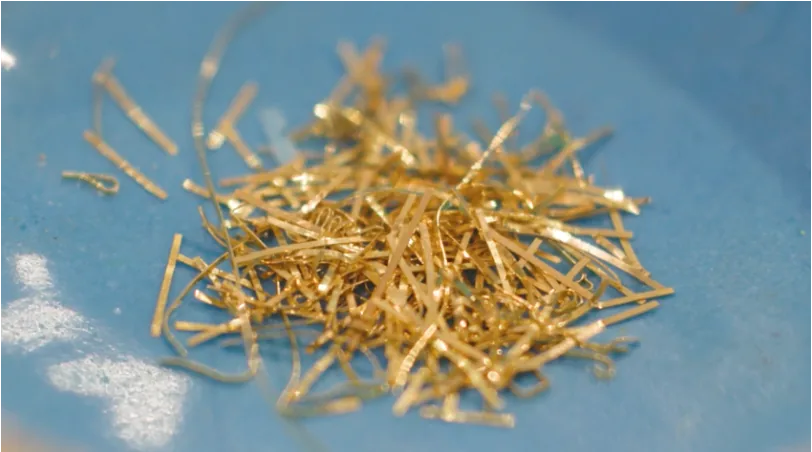
Figure 3
Gold wires for cloisonné Enamel (height 0.4 mm thickness less than 0.1 mm)
Click on the thumbnail to enlarge it
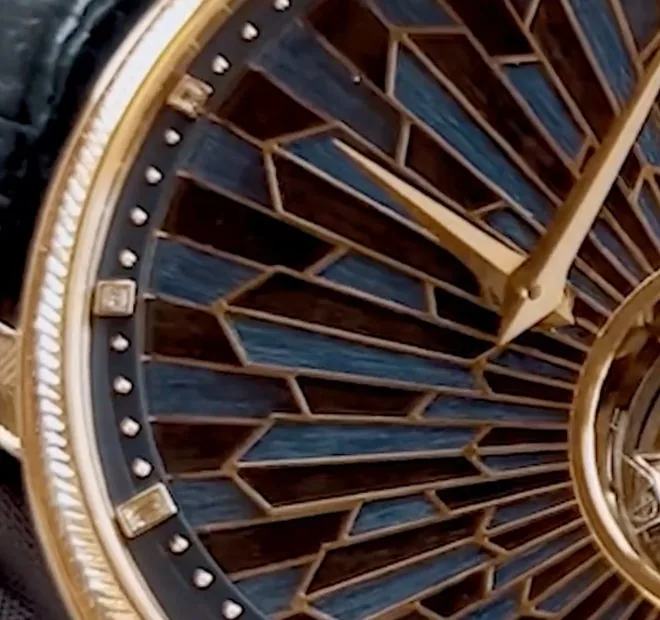
Figure 4
Detail of a cloisonné enamel dial
Click on the thumbnail to enlarge it
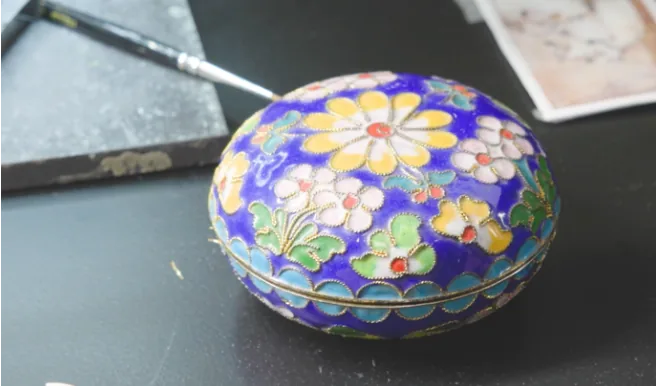
Figure 5
Case in cloisonné enamel
Click on the thumbnail to enlarge it
An alternative version exists: in the so-called “jour” or “plique-à-jour” cloisonné, the cells are first closed with a thin sheet of glued Copper or Silver, which is then dissolved with acids. There is therefore no Case back, allowing for transparency effects.
8. Grisaille (or monochrome) Enamel
This technique consists of treating the Enamel in monochrome, in the manner of Enamel painting. Grisaille is particularly suited to figurative or ornamental subjects.This involves layering a large number of coats of white Enamel over a black background. Thanks to a firing between each layer, the different strata blend into one another, creating tiny variations between the background colour and the white.
The technique of Limoges white grisaille was invented in the 16th century, notably to create copies of engravings, which were very fashionable at the time. Some say that Limoges white was born in Limoges. Others claim it was made or invented at roughly the same time in northern Italy. The mystery remains unsolved, but Limoges gave its name to this very distinctive white Enamel.
This is a mixture roughly equivalent to a white Enamel, except that it contains more oxide than glass and is ground into a very fine powder. It is mixed with Oil to obtain a paste with roughly the same texture as Oil paint. It is therefore easier to achieve gradients and shades of grey than with an opal Enamel, which is also used for grisaille (a modern technique).
9. Paillonné Enamel
The paillonné enamel technique consists of inserting a tiny decoration in Metal – a “paillon” – between two layers of Enamel, thus creating brilliant effects through transparency. The paillon is as thin as a sheet of paper.
According to the dictionary of the Académie française, paillons derive their origin from the word “paille” (straw). These tiny objects can take on very diverse shapes: geometric (round, square, rectangular, triangular), numerical, arabesque, botanical, etc.
In watchmaking, this technique is used to bring brilliance and Light effects to the Dial.
10. Plique-à-jour (or Enamel à jour)
The plate is pierced with a pattern onto which the Enamel will be applied, all on a mica base (a mineral forming a translucent case back that prevents the Enamel from leaking through underneath). After firing, this base is removed, producing an effect similar to that of church stained-glass windows.
11. Miniature painting (Enamel)
The craftsman’s work consists of creating or transferring a drawing or illustration on a reduced scale in order to adapt it to the shape of an object.
Both sides of the plate are first covered with white or colourless Enamel, then the piece is fired. In this way, the back is protected from deterioration and the front is ready to receive the Decoration. The colour layers (pure oxides) are then applied using lavender Oil with a very fine brush, and the plate is fired again after each addition of colour.
The miniature painter begins by painting the background and the decorative elements, then finishes with the details, layer by layer, colour by colour, with patience and precision.
Miniature painting brings a richness of colours, contrasts and details impossible to achieve with current industrial processes.
This is indeed one of the Enamel techniques, not to be confused with acrylic miniature painting.
This page has been automatically translated from the French reference version using an artificial intelligence tool. Errors or inaccuracies may remain. If you notice any, especially if this is your native language, please feel free to report them to info@horopedia.org. Your contribution helps us improve the quality of the encyclopedia.
While awaiting their translation, images and videos remain temporarily displayed in French.
Thank you for your understanding.