
DISCOVER THE LATEST DEVELOPMENTS OF THE ENCYCLOPEDIA, MORE INTERNATIONAL, MORE INTUITIVE AND MORE VISIBLE
Horopedia continues its development with a redesign of its platform and several major changes. From content now available in six languages to a redesigned navigation, as well as optimized search engine visibility, these new features help make horological knowledge more accessible and share it with as many people as possible.
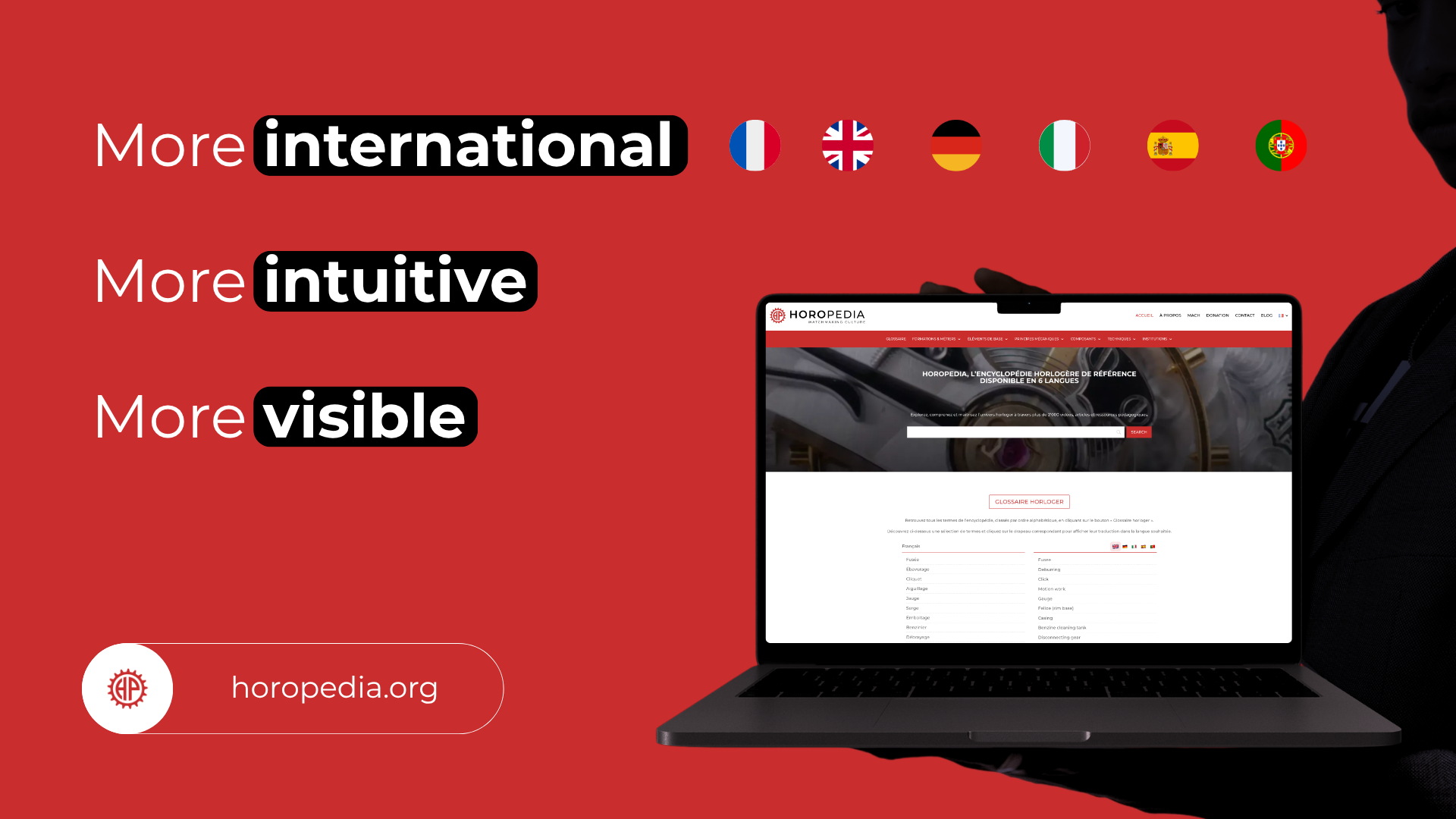
Horopedia now available in six languages
Perhaps you’ve noticed in recent days? It is now official: Horopedia is accessible in six languages. In addition to french, english and german, the encyclopedia is now available in italian, Spanish and Portuguese (PT-PT). This development makes horological knowledge accessible to an increasingly international audience and brings to more than 3,600 the number of available pages across the different language versions of the encyclopedia.
This development is made possible thanks to a new translation tool based on artificial intelligence. It automatically generates the different language versions from French, which remains the reference language of the encyclopedia. Textual content has already been translated, while the adaptation of audiovisual content, particularly images and videos, is progressing gradually. Some of these elements may therefore temporarily remain available in French in the different language versions.
Despite the care taken with these translations, errors or inaccuracies may remain. The Horopedia community is thus invited to contribute to their improvement : if you identify a translation that could be corrected or clarified, particularly in your native language, please do not hesitate to let us know at info@horopedia.org. Your contributions are invaluable to us in continually improving the quality and accuracy of the encyclopedia.
A redesigned navigation and an enriched glossary
With several thousand pages, definitions, technical drawings, and educational films, Horopedia covers a wide range of topics related to horology. To make it easier to explore these resources, the menus and navigation of the encyclopedia have been completely redesigned around broader, clearer, and more intuitive thematic categories:
- Training & careers lists watchmaking schools and training programs in Switzerland and around the world, as well as the different careers in the industry and testimonials from those who bring the watchmaking ecosystem to life.
- Basic elements gathers the fundamental knowledge needed to understand watchmaking expertise, including Materials, tools, machines, units, and Measuring instruments.
- Mechanical principles allows you to explore how timepieces work, from basic mechanisms to complications and the different types of escapements.
- Components presents the different elements making up the Movement, the Case, the Dial, as well as the various types of straps and clasps.
- Techniques covers manufacturing methods, adjustment operations, decoration techniques, assembly steps, quality controls as well as the various treatments applied to components.
- Institutions lists the various players in the horological ecosystem, such as museums, certification bodies or watchmaking companies.
- A–Z Glossary, considerably enriched and redesigned, now makes it easier to find the many watchmaking terms defined within the encyclopedia.
This new organization allows for more natural navigation between the different themes and quick access to the information sought, regardless of one’s level of knowledge in watchmaking.
Content that’s easier to find online
This overhaul is also accompanied by significant work on optimizing content referencing.
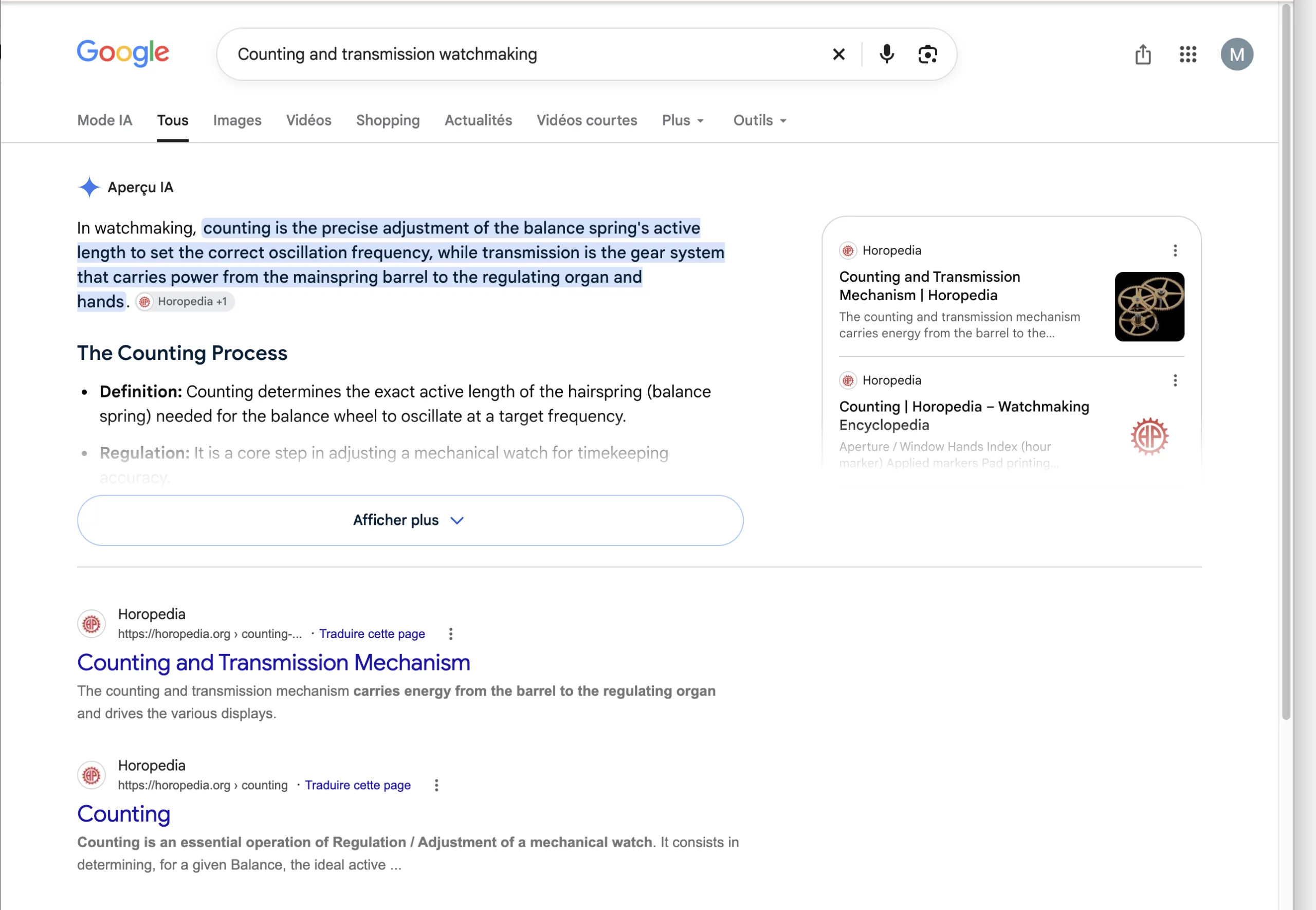
The structure and content of the encyclopedia have been optimized to improve their visibility and accessibility on search engines. The objective is simple: to enable students, professionals, enthusiasts or simply curious people to more easily access the horological knowledge offered by Horopedia when they conduct their online searches.
This work accompanies the growth of the encyclopedia, also perceptible through the evolution of the site’s traffic, and contributes to its primary purpose: to preserve, transmit and make accessible to as many people as possible horological knowledge and expertise.
►► More international, more intuitive and more visible, familiarize yourself now with the new features of the encyclopedia and take advantage of the numerous resources made available free of charge on Horopedia.org to deepen your knowledge of horology.
►► To support our educational initiatives and contribute to the promotion of an exceptional craftsmanship, become a patron! More information here.
ABOUT HOROPEDIA
The Horopedia Foundation was created in February 2023 and has received public interest status. The Foundation’s Board is composed of Philippe Dufour (President), Dr Helmut Crott, André Colard and Marc André Deschoux.
The Foundation manages Horopedia.org, the first online video encyclopedia on horology. The platform was launched in 2022 and quickly received unanimous support within the community.
To date, more than 100 multilingual documentary films on museums, horology schools, watchmaking tools and components, and the mechanical principles behind their operation can be found on Horopedia.org. To strengthen its educational mission, the platform also includes visual teaching materials to facilitate a better understanding of the information provided. The site offers nearly 1000 pages with detailed definitions of horological terms and historical anecdotes about significant horological inventions.
Horopedia.org meticulously covers all aspects of the fascinating watchmaking industry in French, English and German. It offers detailed definitions of tools and complications, 3D images of movements, and in-depth video explanations on the production of components, their history and their functions in a watch. A dedicated section of the site lists horological institutions, including schools and museums in Switzerland and around the world.
More recently, the Foundation unveiled its ambitious project: the Maison des Arts & de la Culture Horlogère (MACH). More than a museum, the MACH will be a living space for exhibition, transmission and exchange around the art of watchmaking. Located in the heart of the Quartier des Banques, this house of 1,250 m² will span four floors, offering educational, thematic, and chronological exhibitions, complemented by a space dedicated to temporary exhibitions. Visitors will also be able to enjoy a shop, an auditorium, and various interactive spaces designed to spark curiosity and encourage discovery. Open and lively, MACH aims to become the crossroads of watchmaking in Geneva.
This page has been automatically translated from the reference French version using an artificial intelligence tool. Errors or inaccuracies may remain. If you notice any, especially if this is your native language, please do not hesitate to let us know at info@horopedia.org. Your contribution helps us improve the quality of the encyclopedia.
While awaiting their translation, images and videos remain temporarily displayed in French.
Thank you for your understanding.