
MENU
1. Introduction
Skeletonizing and openworking are two decorative techniques applied to watch movements to give them an airy, refined and light appearance. Whether handcrafted or industrial, the working methods are the same for openworking as for skeletonizing. The distinction between the two terms is based on the final overall aesthetic result of the work.
2. Definition and distinction between skeletonizing and openworking
Skeletonizing, like openworking, consists of removing part of the metal from the components of a watch movement to expose the internal mechanisms while maintaining the integrity and functionality of the piece. This technique is often applied to dials, to bridges, to main plates and to wheels to create a visible structure of the movement.
Skeletonizing: We distinguish skeletonizing from openworking by the transparency it offers throughout the entire thickness of the movement. The result gives the appearance of a “skeleton”, where the essential parts are cut out or hollowed. Furthermore, skeletonizing generally concerns the entire surface of the movement, whereas openworking may be carried out on only a portion of it.
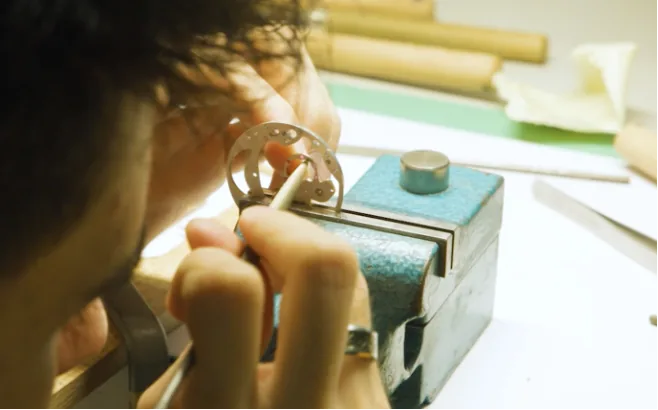
Figure 1
Decoration of a skeletonized main plate
Click on the thumbnail to enlarge it
Openworking: By contrast, openworking only applies to a part of the layers of a movement. For example, the dial and the surface of a bridge to reveal a particular mechanism.
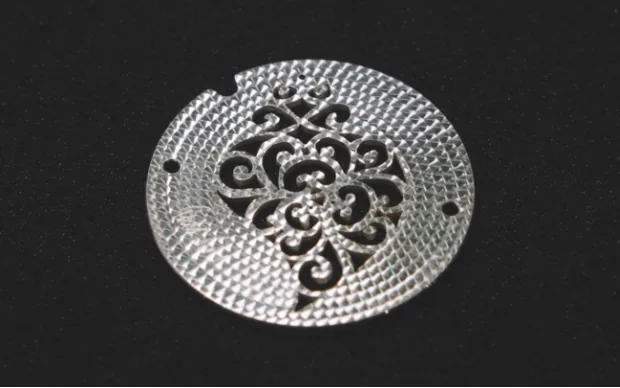
Figure 2
Openworked module plate
Click on the thumbnail to enlarge it
3. History
Skeletonizing has its roots in 18th-century horology, at a time when horologists sought to combine both practicality and aesthetics. The technique was popularized by Swiss master horologists, particularly those from the Geneva region, renowned for their skills in movement decoration. Skeletonizing became a way for horologists to demonstrate their expertise, offering an unobstructed view of the complex gears and showcasing the beauty of the movement’s internal architecture.
In the 19th century, skeletonizing became a true signature of luxury horology and reached its peak between 1950 and the quartz crisis (1974). Skeletonizing was then seen not only as a technical achievement, but also as a mark of quality and exclusivity.
4. Skeletonizing and openworking methods
The working methods and choice of techniques are identical for openworking and skeletonizing.
Design and drawing
Whatever working method is chosen (artisanal or industrial), a piece of openworking or skeletonizing work begins with a study and a drawing of the cutouts, which must meet both aesthetic and technical criteria. Each functional element of a component must remain firmly attached to the structure, and the structure itself must retain reliable rigidity.
Artisanal skeletonizing
Artisanal skeletonizing is meticulous work carried out by hand by experienced craftsmen. It involves the painstaking cutting, drilling, and filing of the movement’s components, most often using simple hand tools, such as the piercing saw (jeweler’s saw) and files that are sufficient for the most dazzling creations. After generally cutting and hollowing out the components using the piercing saw (jeweler’s saw), the craftsman “draws” their precise outlines by filing the edges. Depending on the complexity of the skeletonizing design, filing requires significant know-how and experience specific to the technique. Artisanal skeletonizing of a movement generally includes all the decoration operations of the component (beveling / angling, drawing of the edges, etc.). This process can take hours, or even days, for each piece, depending on its complexity. Each movement is unique, with skeletonizing patterns customizable according to the taste and know-how of the watchmaker or their client.
Semi-industrial skeletonizing
In the case of small series or customizations, for example, the craftsman may rely on industrial or semi-industrial methods for the cutting phases in particular, before finishing the work by hand and achieving finishes comparable to those of purely handmade work. Depending on the case, the nature and material of the components, their cutting may be carried out by machining (turning and/or milling), by stamping or by electrical discharge machining (EDM). Electrical discharge machining (EDM) is ideal for steel components whose cuts can be fine and complex (without mechanical stress), but it is expensive and poorly suited to large series.
Industrial skeletonizing
In the modern watchmaking industry, skeletonizing is increasingly carried out using computer-controlled machines and laser cutting techniques or engraving. These methods make it possible to save time and reduce production costs. However, although this approach is faster and more uniform, it can sometimes lack the authenticity and finesse found in artisanal work. The minimum diameter of a milling cutter, for example, does not allow for sharp corners to be created. Industrial skeletonizing is commonly used in the production of large-scale, lower-end watches, and the finishing there is generally also of industrial origin (CNC Beveling / Angling and diamond polishing).
5. Combinations with other decorations
Skeletonizing and openworking can be combined with other forms of decoration to enhance the visual effect. Among the most common techniques that complement skeletonizing and openworking are:
- Engraving : Engraving can be used to add fine details to the edges of openworked or skeletonized parts, creating additional light effects and artistic patterns. For example, skeletonized bridges can be engraved with floral or geometric motifs, which enriches the aesthetic appearance of the movement.
- Setting (stone/jewel setting) : Setting (stone/jewel setting), which consists of fixing precious stones (such as diamonds, rubies, or sapphires) onto the movement’s parts, is sometimes used in combination with skeletonizing and openworking. The stones can be placed on the edges of the bridges or in the openworked cutouts, adding a touch of luxury and extra brilliance to the watch.
6. Advantages and disadvantages
Advantages
- Aesthetics : Skeletonizing and openworking offer visually impressive finishes. They allow one to appreciate the engineering of the movement in an artistic way.
- Lightness: By removing part of the metal, these techniques help reduce the overall weight of the movement, which can, in some cases, be beneficial for the performance of a mechanism.
- Originality: Each skeletonized or openworked watch is often unique, offering a distinctive character that can appeal to collectors and enthusiasts of rare pieces.
Drawbacks
- Cost: Skeletonizing and openworking, especially in their artisanal form, are long and costly processes that significantly increase the price of the watch.
- Manufacturing complexity: These techniques can make production more complex, particularly during skeletonizing, where the structure of the movement is modified. This can affect the strength of the parts or their durability.
- Reduced strength: Adding cutouts and perforations can weaken the structure of the components, but this is now more easily offset by the strength of the materials used.
While skeletonizing reveals the mechanical beauty of watches by removing a large amount of metal, openworking focuses on the decorative aspect with patterns cut in a more superficial way. These techniques, whether artisanal or industrial, play a crucial role in creating unique, precise, and visually captivating watches. Their combination with techniques such as engraving or setting (stone/jewel setting) often elevates skeleton watches to the rank of works of art.
This page has been automatically translated from the French reference version using an artificial intelligence tool. Errors or inaccuracies may remain. If you notice any, especially if this is your native language, please feel free to report them to info@horopedia.org. Your contribution helps us improve the quality of the encyclopedia.
Until they are translated, images and videos will remain temporarily displayed in French.
Thank you for your understanding.