
MENU
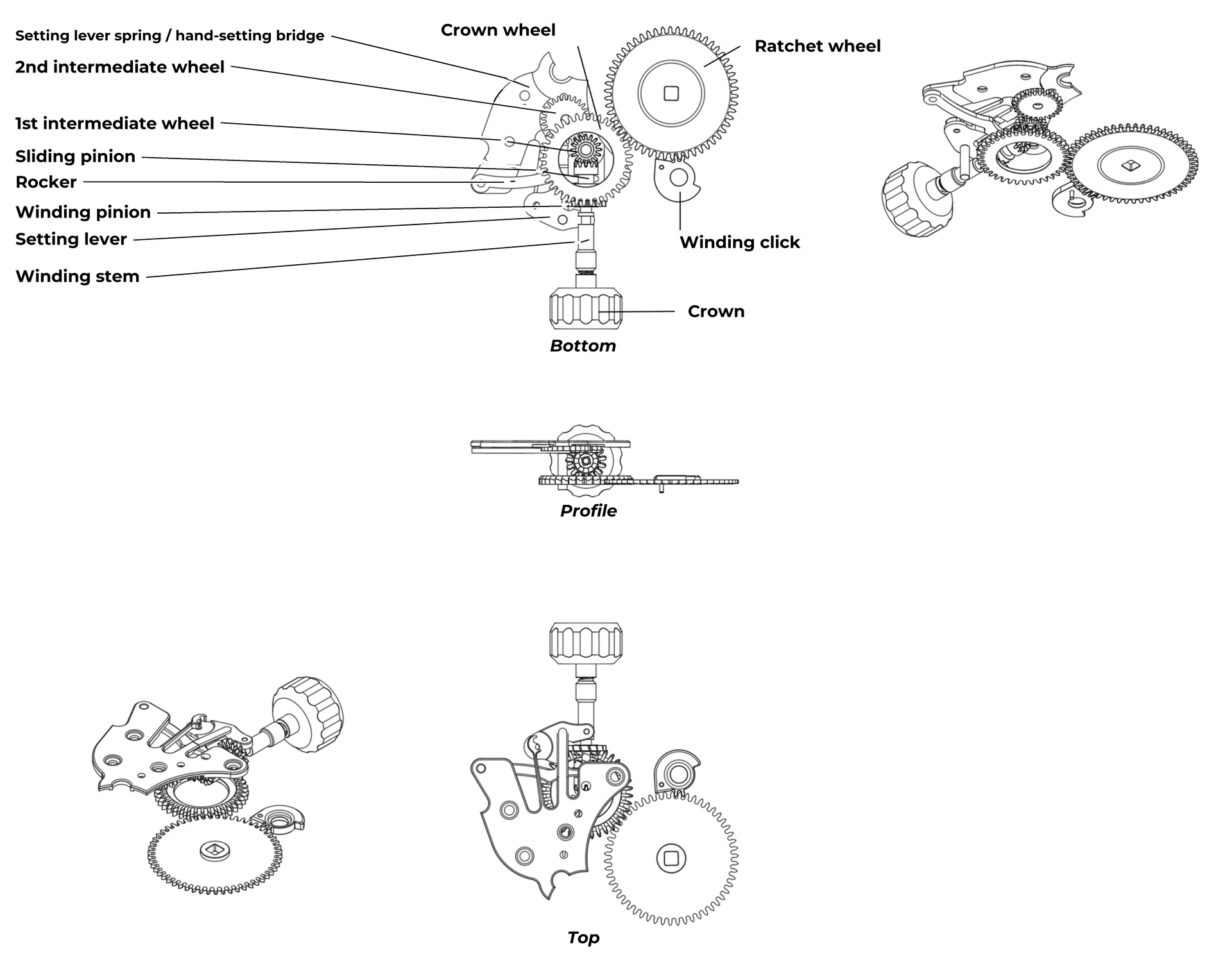
Figure 1: Diagram of a winding mechanism and hand-setting mechanism
Click on the thumbnail to enlarge it
Figure 2: Lever / Rocker between the winding mechanism and the hand-setting mechanism
Click on the animation to enlarge it
1. General description
As its name indicates, the winding and hand-setting mechanism allows the watch user to carry out the winding and the hand-setting by mechanically switching from one function to the other. Although we consider it as a single organ of the movement and many components are common to both functions (winding and hand-setting), we will detail each one below, individually, for a better understanding.
2. History
Until the 19th century, winding and setting the time on a watch required a key. This key allowed direct driving of the barrel arbor (winding) or the centre pinion (hand-setting), at the end of which was a square corresponding to the key. In 1842, Adrien Philippe invented crown winding. This mechanism allows the winding mechanism to be driven directly by a crown, permanently linked to the movement and accessible from outside the case.
This same crown also allows hand-setting to be carried out, but requires a second control element on the periphery of the case: a setting lever. This setting lever makes it possible to switch from one function to the other, both then being operated by the crown. It was not until 1866 that Antoine Le Coultre invented the winding and hand-setting system with lever / rocker as we know it today.
From then on, it is enough to pull the crown to activate the hand-setting mechanism and to push it back to activate the winding mechanism. Since then, the system has been improved and can now be used to operate many other functions, the most common being the date / calendar (date) and/or the day of the week which can be corrected using an intermediate position of the crown.
3. Operation
By pulling on the crown, the winding stem comes out about 1 mm. During this movement, the winding stem drives the setting lever in a limited rotational movement. As it pivots, the setting lever pushes the lever / rocker toward the center of the movement. The end of the lever / rocker, in its motion, drives the sliding pinion, which slides along its square toward the center of the movement. During this phase, the movement of each mobile element is limited by the setting lever. As it approaches the center, the epicyclic toothing of the sliding pinion meshes with the first intermediate wheel. It is then enough to turn the crown to set the time on the watch.
By pushing the crown back in, the reverse movement is engaged. The winding stem actuates the setting lever, which pivots in the other direction. Pressed against the inclined plane of the setting lever, under the effect of its spring, the lever/rocker pivots toward the outside of the movement. The lever/rocker slides the sliding pinion toward the outside of the movement until it disengages from the first intermediate wheel and its “Breguet” teeth mesh with the winding pinion. From then on, by turning the crown, it drives the winding stem, which in turn drives the sliding pinion. By turning in one direction, this will drive the winding pinion, then the crown wheel, and finally the ratchet wheel.
By turning the winding crown in the other direction (and, de facto, the winding stem and the sliding pinion), the sliding pinion will disengage from the winding pinion under the combined effect of the “Breguet” teeth and the click spring.
THE WINDING MECHANISM
Its role is to transmit the kinetic energy of the rotations of the crown to the motor organ (power source) responsible for storing it and gradually redistributing it to the movement.
THE HAND-SETTING MECHANISM
When the winding stem is pulled out (in hand-setting position), it allows, through the rotations of the crown, to drive the hands via the motion work and thus adjust the displayed time.
This page has been automatically translated from the French reference version using an artificial intelligence tool. Errors or inaccuracies may remain. If you notice any, especially if it is your native language, please do not hesitate to report them to info@horopedia.org. Your contribution helps us improve the quality of the encyclopedia.
While awaiting their translation, images and videos remain temporarily displayed in French.
Thank you for your understanding.